


Infinity: HexaDome Tactics has officially launched on Steam, giving PC players a new way to enter the Infinity sci-fi universe through compact, competitive turn-based battles. Developed by Blindspot Games, the release is the first PC title set in the established sci-fi board game setting, but its focus is not on translating a sprawling tabletop session directly onto a screen. Instead, it frames tactical confrontations as a futuristic combat show, with two players competing in a close-quarters hex-grid arena.
The central idea is a 1v1 strategy game built around champions, positioning, and calculated sequences of actions. Players assemble a roster from characters with distinct abilities, battlefield roles, and possible synergies, then aim to outthink an opposing team in PvE or PvP matches. The launch also arrives with a major rules adjustment shaped by community feedback: dice rolls have been removed from combat, and attacks now always connect.
That means the game's tactical outcomes are designed to be deterministic. Rather than seeing an otherwise sound plan fail because of a missed roll, players can make decisions with complete knowledge that an attack will land. The remaining challenge lies in choosing the right champion, timing abilities, controlling crucial spaces, and finding the most productive order for each turn.
A hex-grid arena built for fast tactical clashes
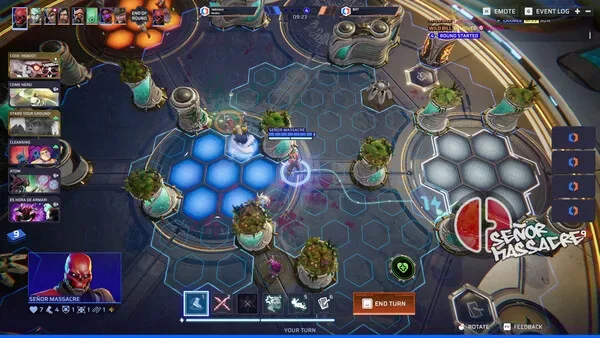
Infinity: HexaDome Tactics places its battles on a compact hexagonal grid, a format that keeps distance, approach angles, and occupied terrain at the center of every exchange. In a smaller arena, a single square can matter: it may block an opponent's route, open a line toward an objective, or create the setup required for a more damaging or disruptive follow-up.
For useful background on this topic, read Forza Horizon 6 Clarifies Itasha Rules Amid Ongoing Moderation Backlash.
The game is positioned as a fast-paced tactics experience, which distinguishes its match structure from larger-scale strategy games where players may manage a broad map, resource economy, or long list of units. Here, the encounter itself is the point. Each side enters with a selected collection of champions and attempts to gain an edge through deliberate tactical play.
Champion selection should therefore be more than a cosmetic decision. The available fighters have individual roles and abilities, while the roster-building system emphasizes synergies between them. A player's plan may depend on pairing characters whose tools complement each other, whether that means creating openings, capitalizing on control of a key area, or arranging turns so that one action strengthens the next.
Since every attack is now guaranteed to hit, those interactions become easier to evaluate before a move is committed. Players will still need to assess the board state and anticipate how an opponent may respond, but they will not need to build a strategy around the chance that a direct attack simply fails to connect.
For another perspective on this story, read Infinity: HexaDome Tactics Launches on Steam With Dice-Free, Deterministic Combat.
Winning means more than defeating the other side
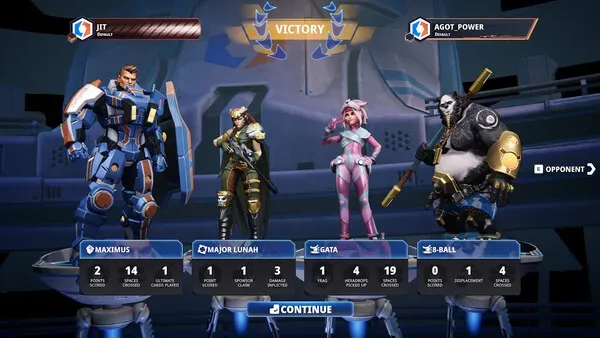
Eliminating rivals is not the only route to victory in Infinity: HexaDome Tactics. Matches also ask competitors to capture zones, fulfill sponsor objectives, and work the crowd. Those additional goals give the arena-show premise a mechanical role rather than leaving it solely as presentation.
Zone control can force a difficult decision between chasing an enemy champion and securing a position that contributes toward winning the match. Sponsor objectives add another layer of priorities that can pull players away from a straightforward elimination plan. Working the crowd likewise suggests that a strong performance is measured by more than raw damage output.
The result is a game structure where a player may need to consider several paths at once. An aggressive advance can put pressure on an enemy, but it may also leave an objective unclaimed. Holding territory may improve a player's standing, but it can create a predictable formation that an opponent can exploit. The strongest turn is not necessarily the one that deals the most immediate damage; it may be the turn that simultaneously controls a zone, advances an objective, and prepares a decisive follow-up.
Blindspot Games also highlights the ability to chain turns for major plays. In practical terms, this makes action order an essential part of the tactical puzzle. Players are encouraged to think beyond isolated moves and instead look for combinations that gain momentum across a sequence. With deterministic attacks, planning those chains can be approached as a question of positioning and available options rather than probability management.
Dice-free combat changes the emphasis
The removal of dice rolls is one of the most notable elements of the Steam launch. It was implemented following community feedback, with the aim of putting the spotlight squarely on strategy. Attacks always hit, so players can calculate their actions without a hit-or-miss layer changing the result at the last moment.
Randomness can create memorable surprises in tactical games, but it can also make outcomes feel disconnected from a player's plan. Infinity: HexaDome Tactics is taking the opposite direction at launch. The game's competitive identity now rests on clear cause and effect: if a champion is in position, has access to an ability, and a player chooses to act, that attack will connect.
This does not mean that every outcome will be simple. Guaranteed hits make choices more legible, but the game still asks players to account for enemy counterplay, objective pressure, roster composition, and the constraints of the hex-grid. The absence of combat dice shifts the question from "Will this work?" to "Is this the best move available, and what does it allow my opponent to do next?"
For players who enjoy turn-based games as puzzles of perfect or near-perfect information, that direction may be especially appealing. A loss can be examined through battlefield decisions, objective priorities, and sequencing rather than attributed to an unfavorable roll. Likewise, successful turns can be reproduced and refined because their results are not dependent on a variable accuracy chance.
PvE and PvP options on PC
The Steam version includes both PvE and PvP modes. The inclusion of PvE gives players a way to engage with the game's systems outside direct competition, while PvP is where the arena premise and deterministic rule set can be tested against another human player's plans.
In competitive play, the compact board and multiple victory considerations could reward adaptability. An opponent who commits too heavily to eliminating champions may leave zones or sponsor objectives exposed. Conversely, a player concentrating only on scoring tasks may give up too much initiative on the battlefield. Reading which goal matters most at a particular point in a match will be as important as executing a clean attack.
The PvE side is also positioned as part of the same core experience rather than a separate genre. Players can learn champion roles, experiment with roster combinations, and become familiar with the demands of objectives and turn chaining before taking those lessons into player-versus-player encounters. No specific campaign structure, matchmaking details, or further modes were announced with the launch information.
The Infinity universe reaches PC tactics players
Infinity: HexaDome Tactics represents the Infinity sci-fi board game universe's first move to PC gaming. Rather than attempting to replicate every element associated with tabletop play, Blindspot Games has built a digital tactics game around a focused arena format and a future-sport presentation.
That approach gives the setting a natural frame for repeated matches. Champions enter an entertainment-driven combat environment where capturing territory, satisfying sponsors, and impressing a crowd matter alongside defeating the opposing lineup. It is a premise that supports the game's emphasis on short-form tactical conflicts while still giving the battles a distinct sci-fi identity.
For newcomers, the Steam launch offers an entry point that does not require tabletop experience. For existing fans of the Infinity universe, it provides a different kind of encounter: a 1v1 digital tactics game centered on controlled arenas, roster synergies, and transparent combat results.
Available now on Steam
Infinity: HexaDome Tactics is available now on Steam for PC. Its launch version puts deterministic combat at the heart of its design, ensuring every attack hits and placing greater weight on positioning, objectives, champion combinations, and carefully chained turns.
With PvE and PvP modes, an arena-show setting, and victory conditions that reach beyond simply removing every enemy from the board, the game aims to offer a tactical contest where each move has a visible consequence. Players looking for turn-based strategy without combat accuracy rolls can now step into the HexaDome and see whether their planning holds up under pressure.




Community
Discussion
Start the conversation.
No comments have been posted yet.