

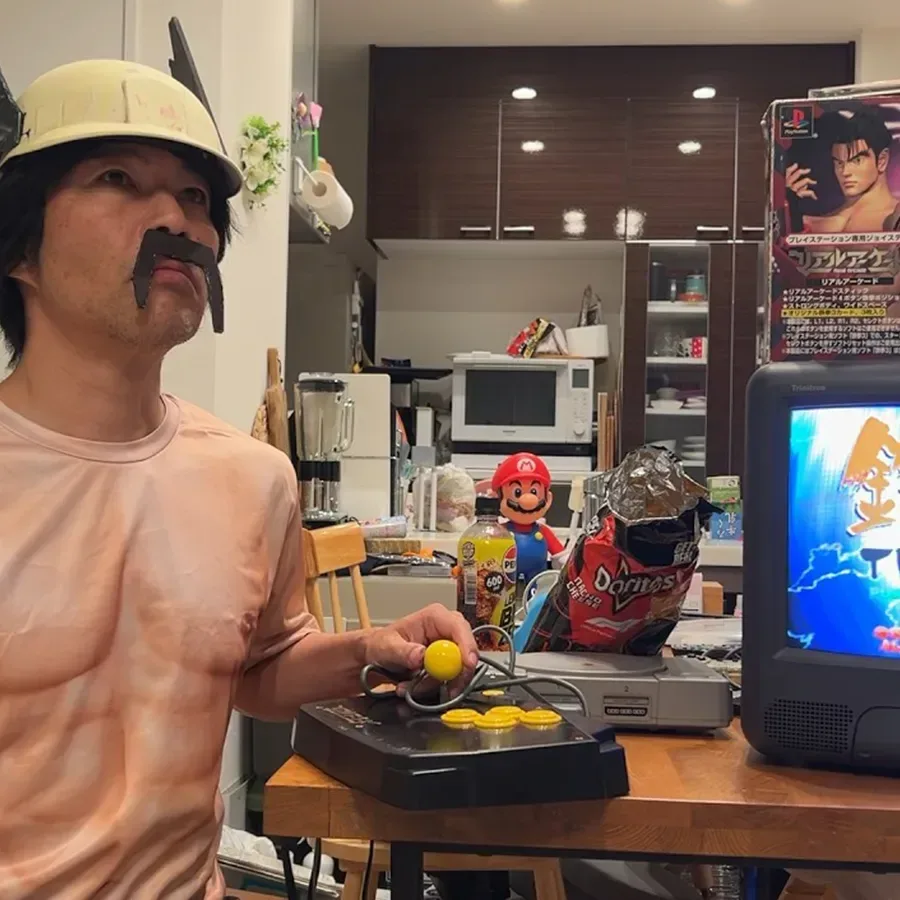
A classic fighting game has become an unlikely starting point for one Japanese creator's martial arts ambitions. AskJapan, a 52-year-old YouTuber known for casual vlogs, retro games, and handmade character costumes, has begun using Tekken 3 as part of his personal effort to learn about karate after being inspired by his young son.
The creator shared the new goal in a video published on November 3, explaining that he had watched one of his son's recent karate demonstrations and felt moved to take up a challenge of his own. Rather than immediately enrolling in lessons, he decided to begin in familiar territory: playing a fighting game and carefully watching its martial arts-inspired techniques.
It is an unconventional route, certainly, but one that neatly reflects why games can mean more than competition, high scores, or nostalgia. For AskJapan, returning to a late-1990s fighter is a way to turn admiration for his son into motivation. The journey is not presented as a substitute for formal instruction or as a claim that controller inputs can teach every part of a real discipline. Instead, Tekken 3 has become the spark that got him moving.
A Son's Demonstration Creates a New Goal
AskJapan said his son is 10 years old and holds a brown belt in karate. The child has reportedly trained since the age of five. Brown belt sits just below black belt in the ranking description shared by the creator, making the boy's ongoing commitment especially striking to his father.
For useful background on this topic, read EA Revives Ultima, Wing Commander, Road Rash and More on Steam and GOG.
After seeing his son perform, AskJapan described the demonstration as overwhelming and said it stirred his spirit and motivation. He began considering the possibility that karate could still be a meaningful pursuit at 52. The central message of the video was simple: there is no need to wait for a perfect moment before taking the first step toward an interest.
"His performance inspired my spirit, my motivation," AskJapan said while reflecting on his son's karate demonstration and his decision to begin practicing through games.
The father's approach is immediately recognizable to anyone who has ever found a hobby through a game. A racing title can lead someone to learn about cars; a strategy game can create interest in history; a sports simulation can make a player follow a new league. In this case, a beloved 3D fighter has helped make an intimidating real-world discipline feel approachable enough to explore.
That does not mean martial arts can be reduced to animations, however. Games such as Tekken represent attacks, stances, timing, and dramatic character identity through a designed combat system. Karate training also involves safety, conditioning, balance, controlled technique, etiquette, and direct guidance. The appeal of AskJapan's videos is not that they blur that line, but that they show a player using a game as encouragement to begin learning more.
Tekken 3 Becomes an Unusual Training Companion
For his first karate-focused session, AskJapan played Tekken 3 on a homemade arcade cabinet constructed from cardboard. He took notes while playing, studying what the characters were doing and treating the experience like an informal first lesson. The cardboard setup fits the cheerful, low-budget creative style that has become part of his channel's identity.
AskJapan has built an audience of more than 189,000 subscribers through vlog-like videos where he talks with viewers and plays older games on classic hardware. He frequently adds handmade cosplay to the presentation, turning a simple play session into a performance with personality. Recently, his videos have spent time with fighting games including Street Fighter II and Tekken 3, making the move toward a martial-arts-inspired project feel like a natural extension of his current interests.
Tekken 3 is particularly suited to the kind of playful study he is attempting because of its enduring reputation among fighting game fans. Its roster is packed with distinct combat styles, memorable animations, and characters who communicate a great deal through their movement alone. Even players who are not experts can understand the appeal of pausing to look at a stance, a kick, or a sequence of attacks and wondering how much real athleticism sits behind the fantasy.
Of course, the series is also famous for exaggeration. Its combatants perform feats that are deliberately theatrical, and its matches include the sort of forceful launches and acrobatics that belong to videogame spectacle. The important part of AskJapan's plan is the enthusiasm behind it, not an expectation that every on-screen move should be reproduced outside of the game.
Heihachi Cosplay and an Arcade Mode Setback
AskJapan's next Tekken 3 video, uploaded on November 4, leaned further into the comic side of his fighting-game quest. This time, he made a Heihachi-inspired costume using a helmet and cardboard. The improvised outfit is very much in keeping with the channel's handmade cosplay tradition, while also paying tribute to one of the franchise's most recognizable figures.
His goal was to unlock Heihachi by completing the game's arcade mode. It did not go as planned. AskJapan was unable to clear the mode and did not unlock the boss character during that attempt. Yet the failure is part of what makes the series easy to root for: the videos are about trying, reacting, and returning for another round rather than presenting an effortless path to mastery.
In fighting games, that attitude matters. Progress often comes slowly, whether someone is learning basic movement, working out a difficult matchup, or simply trying to finish an arcade ladder without continuing. Tekken 3 may be decades old, but overcoming its challenges still calls for patience and practice. AskJapan's unsuccessful run therefore gives his wider karate goal an unexpectedly fitting metaphor. Starting something new can be awkward, funny, and frustrating, but it can still be worthwhile.
Viewers Rally Around the Mission
The response from viewers has been encouraging. Fans have offered support for both halves of AskJapan's undertaking: improving at Tekken 3 and pursuing karate later in life. One viewer noted that there is no age limit on beginning karate and complimented the creator's apparent fitness. Another hoped that Katsuhiro Harada and the wider Tekken team might see the videos and appreciate the enthusiasm behind them.
The support highlights a welcoming side of game communities that can be easy to overlook. Fighting games can demand technical execution and deep knowledge, but they also create room for stories like this one: a parent sharing in the excitement inspired by a child, a retro game gaining new meaning, and a creator inviting viewers to laugh along with setbacks rather than hide them.
AskJapan's story also arrives amid broader reminders that martial arts communities and gaming communities often overlap in unexpected ways. Earlier this year, a fighting game community member drew attention after using sumo wrestling experience to defend himself from a knife-wielding person at a local gaming café. Following that alarming incident, he returned to his Twitch stream and joked about the 14 League Points he had lost in League of Legends because of the interruption.
That episode was a serious real-world confrontation, while AskJapan's videos are a warm, family-driven creative project. Still, both examples underline that game players bring varied interests and lived experiences into the communities around the games they play. Martial arts can be a competitive sport, a discipline, a fitness practice, a cultural tradition, or simply a new skill someone chooses to investigate after seeing a loved one excel.
More Than a Retro Game Challenge
There is a particular charm in seeing Tekken 3 serve this role. The game remains an important piece of fighting-game history, but AskJapan is not treating it as a museum object. His cardboard cabinet, handwritten observations, and Heihachi costume turn it into something active and personal. It is a tool for curiosity, a comedy prop, and a bridge between a father's gaming hobby and his son's karate achievement.
Whether AskJapan ultimately joins a dojo or continues his studies through a mix of game sessions and observation, the first stage of his project has already connected with viewers. His enthusiasm suggests that beginning a new pursuit does not require expertise, expensive equipment, or a polished plan. Sometimes it starts with a family performance, an old fighting game, a cardboard arcade cabinet, and the decision to press start.
Community
Discussion
Start the conversation.
No comments have been posted yet.