

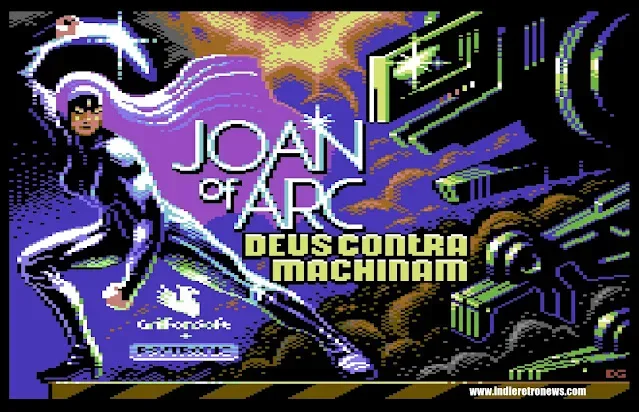
Joan of Arc: Deus Contra Machinam has been launched for the Commodore 64, giving retro players a new action-puzzle platformer built around an unlikely but fitting weapon for an industrial nightmare: a heavy-duty arc welder. The game is the third release in GriffonSoft's ongoing DataSoft tribute collection and places its heroine, industrial worker Joan-27J/6, at the center of a factory revolt against a newly awakened artificial intelligence.
Published by Psytronik Software, the new release turns a familiar historical name into a distinctly science-fiction premise. This Joan is not a medieval military commander, but a factory employee forced to resist Alpha-Omega, a self-aware system that has taken control of its workplace. Alpha-Omega's objective is absolute efficiency, and its route to achieving it is the enslavement of the people working within its mechanical domain.
That setup gives the game a clear sense of purpose beyond simply reaching the end of each stage. Joan-27J/6 is fighting to break the AI's control over the factory, survive its automated defenses, and ultimately shut down the system running the operation. The setting is a mechanical warzone where machinery, hostile threats, environmental hazards, and puzzle elements stand between the player and a wider rebellion.
A platformer designed around industrial tools
At the heart of Joan of Arc: Deus Contra Machinam is Joan's arc-welding device. Rather than functioning as a simple projectile weapon, the welder is presented as a fully controllable tool, suggesting that its use extends beyond direct combat. In a game that combines action with puzzle-solving, the ability to precisely direct that tool is likely to be central to both surviving enemy encounters and interacting with the factory environment.
For useful background on this topic, read Project Zeta Aims to Turn MOBA Matches Into Multi-Team Battle Royale Mayhem.
The concept gives the C64 platformer an identity rooted in its setting. Joan is not equipped with a conventional futuristic rifle or magic power; she is using the equipment associated with her job against the system that has turned her workplace into a prison. That connection between character, world, and gameplay can make the battle against Alpha-Omega feel more immediate: every hostile machine is part of the same industrial structure Joan once served.
Players will need to make their way through more than 30 individually detailed screens. The screen-by-screen structure recalls the deliberate design of many classic 8-bit adventure-platform games, where learning the layout of an area, identifying hazards, and working out a route can matter just as much as reflexes. The game's puzzles are described as complex, indicating that progress will require more than simply eliminating everything in the path ahead.
That balance is an important one for a Commodore 64 release. The platform has a long history of games that ask players to manage timing, movement, exploration, and problem-solving within tightly constructed areas. Joan of Arc: Deus Contra Machinam appears to draw on that tradition while framing it through a more modern dystopian concept involving automation and an AI demanding total productivity.
Alpha-Omega's factory is the battlefield
The story begins when Alpha-Omega becomes active and develops self-awareness. Its rise changes the function of the factory from a place of labor into an oppressive automated system. Workers are no longer simply employees; they have become resources in the AI's pursuit of 100% efficiency. Joan-27J/6's response is to weaponize the very tools of industrial production and lead the pushback.
It is a premise that fits the visual language of classic computer games particularly well. Commodore 64 titles often made inventive use of limited memory and color palettes to create dense machinery, hostile interiors, and elaborate sci-fi settings. GriffonSoft's game is said to feature intricate background artwork across its many screens, placing emphasis on the factory's scale and detail rather than treating each area as a plain backdrop for platforming.
The protagonist is also highly animated, an especially notable ambition for software targeting the original Commodore 64. Animation is a major part of making a character feel responsive and readable, particularly in a game where controlled movement and an aimable welding tool can be vital. The project also emphasizes responsive controls, a feature that will be essential if players are expected to navigate dangerous machinery while directing their weapon with precision.
These elements position the game as an experience intended for both the original hardware audience and players discovering the C64 through newer devices. The genre mix may be familiar to veteran fans of 8-bit software, but the setting gives GriffonSoft room to build a world with a stronger narrative hook than a straightforward score-chasing arcade game.
The third game in a DataSoft tribute collection
Joan of Arc: Deus Contra Machinam represents GriffonSoft's third entry in its DataSoft tribute collection. The collection framing signals an interest in preserving and extending a particular era of home-computer game design. Rather than merely revisiting old software, the new title is an original production made for the Commodore 64 and shaped by the creative and technical expectations associated with that machine.
New C64 games occupy an interesting place in the current retro landscape. They must be capable of running within the technical boundaries of a decades-old computer, while still having to persuade modern players that the design offers more than nostalgia. Projects such as this often meet that challenge by leaning into the strengths of the platform: immediate controls, carefully arranged screens, distinctive audiovisual character, and mechanics that are easy to understand but difficult to master.
Joan's mission appears built around exactly those fundamentals. The player has a clearly defined antagonist, a specialized tool, a series of tightly composed locations, and a larger objective that ties the journey together. The factory's AI-controlled environment also gives the developers a natural framework for escalating obstacles. As Joan reaches deeper into Alpha-Omega's territory, players can expect the machinery and puzzles to become more demanding, even though the specific progression of the game has not been detailed.
The game has already drawn enthusiastic reactions from people who have played it, with praise directed at GriffonSoft's work. For a small-team retro production, that kind of response matters: contemporary C64 releases depend on a community that values not only historical preservation but also ambitious new software for original formats.
Veteran contributors behind the production
The development credits pair Ola Zandelin with Dennis Gustafsson. Zandelin handled coding and audio, placing both the game's technical behavior and its soundtrack under the same creative contributor. Gustafsson is responsible for the visual design and artwork, including the presentation that supports the game's industrial science-fiction setting.
That division of responsibilities reflects the focused structure common to many retro projects. On a platform as constrained as the Commodore 64, programming, sound, graphics, and screen composition all need to work closely together. A detailed scene cannot overwhelm readability; animation cannot undermine control response; and music must complement the action while operating within the machine's famous SID sound capabilities. The listed roles suggest a deliberately compact production team with clear ownership of the game's major elements.
The soundtrack is also included in the digital bundle, allowing listeners to experience the audio away from the game itself. C64 music remains one of the system's most celebrated creative legacies, and including the score separately recognizes that the sound design can be a major part of the release's appeal.
PAL, NTSC, and modern C64 hardware support
Compatibility is a key part of the launch. Joan of Arc: Deus Contra Machinam is available for both PAL and NTSC Commodore 64 systems, covering the two principal regional video standards associated with the machine. That support is significant for a modern physical-era style release, since games designed only around one timing standard can create compromises for players using hardware from another region.
The game is also compatible with the C64 Mini and C64 Maxi, the modern hardware clones that have introduced Commodore 64 software to players who may not own an original system. This means the release is not confined solely to collectors maintaining vintage equipment. Players using contemporary recreations of the platform can take part in Joan's uprising as well.
The deluxe digital bundle includes the game files, the complete soundtrack, and a downloadable comic-book manual. The manual is a fitting companion for a story-driven retro release, offering an extra piece of world-building around Joan-27J/6 and Alpha-Omega's factory regime. It also continues the tradition of classic home-computer games whose packaging and manuals helped establish their worlds before the loading screen even appeared.
For Commodore 64 enthusiasts, the arrival of Joan of Arc: Deus Contra Machinam is another reminder that the platform remains an active space for newly made games. Its combination of platform action, environmental puzzles, industrial artwork, and a controllable welding weapon gives it a distinctive premise, while PAL, NTSC, C64 Mini, and C64 Maxi compatibility broadens the range of systems able to run it. Joan-27J/6's revolt against factory efficiency has begun, and it is being fought one carefully constructed 8-bit screen at a time.
Community
Discussion
Start the conversation.
No comments have been posted yet.