

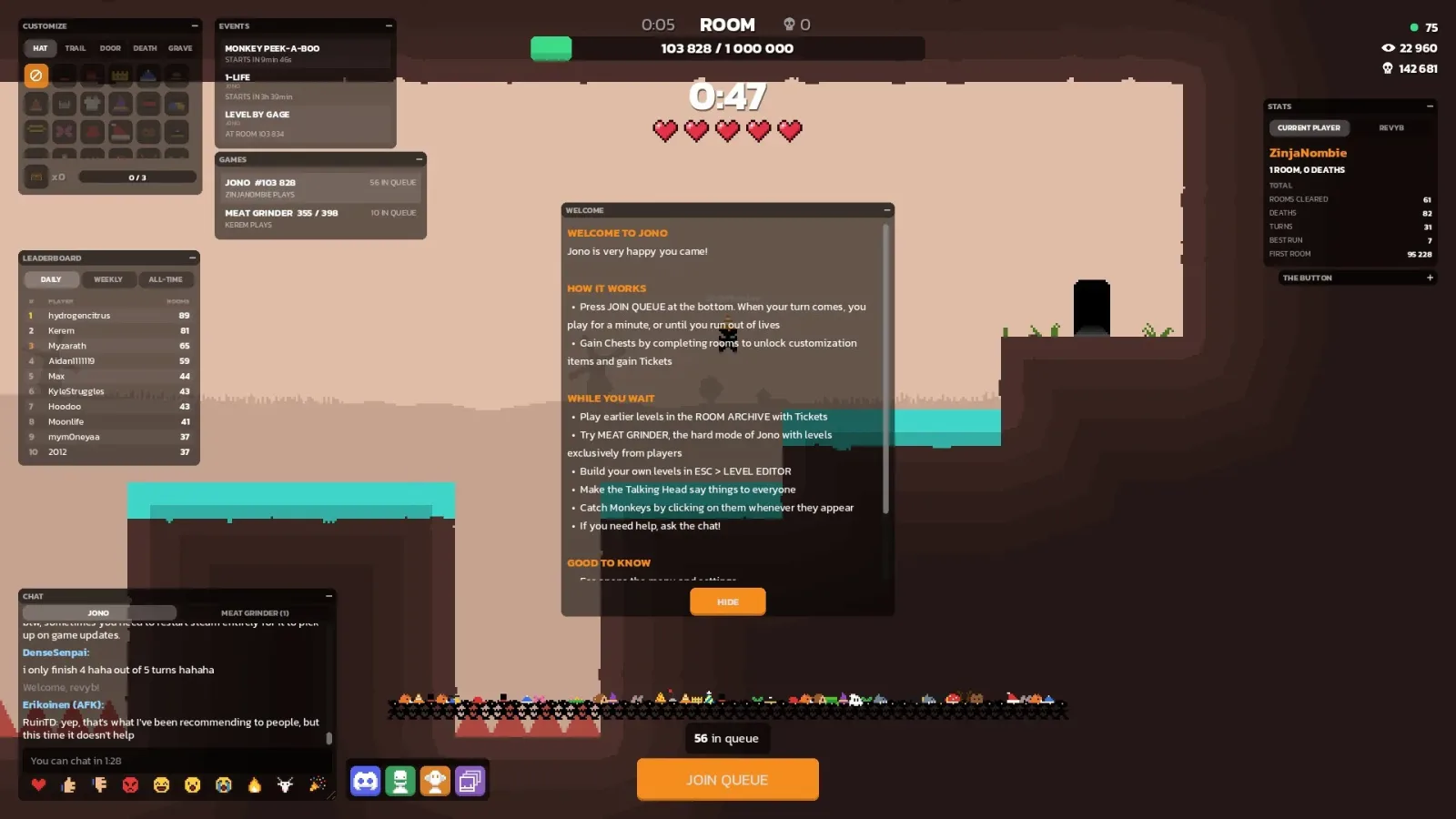
Jono takes a familiar platforming foundation--jumping, double-jumping, spikes, doors, and precision hazards--and wraps it in an unusually social constraint: only one person in the world can control the character at any given moment. Everyone else watches, chats, waits in line, and hopes the player ahead can solve the current room before their brief turn ends.
Available free on Steam with no monetization described in the game, Jono is built around a shared global progression rather than individual campaigns. The premise sounds almost deliberately inconvenient. A player joins a queue, observes whoever currently has control, then receives up to one minute to make progress. Their turn can end even sooner after five deaths. Control immediately passes to the next name in line.
That setup turns every failed jump into a tiny public performance, and every cleared room into progress that belongs to the entire community. The stated objective is immense: work through one million rooms. At the time of observation, players had reached room 104,680, leaving a very long collective road ahead.
One character, one turn, one shared challenge
The core rules of Jono are easy to understand. Players control a small stick-figure character through compact single-screen obstacle courses. The character can jump and double-jump, while the usual target is a door placed somewhere else in the room. Reaching it completes the stage and advances the worldwide game to the next one.
For useful background on this topic, read Saving Mass Effect Means More Than Demanding Another Game.
The catch is that the current player may not have much time to study the room, let alone master it. A timer counts down from one minute, and five deaths also end a run. On a difficult screen full of spikes, a participant can burn through all five attempts in seconds. Then their character disappears, a new username appears overhead, and the next person has their chance.
That format makes the game less about being the one player who carries a stage from start to finish and more about contributing an attempt to an ongoing relay. Someone might discover a hidden danger, reveal where a surprise spike emerges, test a portal, or simply make enough progress that the next player understands a safer route. The community moves forward one short, messy turn at a time.
Rooms reportedly remain completed permanently. When a new stage begins, the global group does not return to earlier cleared rooms. Players respawn at the start of whatever room the community has reached, preserving forward momentum even as individual runs end in failure.
A basic platformer made unpredictable by its hazards
On its own, Jono is intentionally straightforward. Its visual language centers on simple characters and rooms, with red spikes serving as the most prominent lethal obstacle. Yet the stage design appears to add enough variations to prevent the shared run from becoming routine.
Some dangers can appear unexpectedly, giving the platforming a light Kaizo-style edge where prior knowledge matters almost as much as execution. Other observed ideas include teleporting portals, slippery ice floors, inverted rooms, and keys that must be collected to open a locked route. These mechanics create the kind of short, readable-but-demanding challenges that fit a one-minute format.
They also create a peculiar rhythm for spectators. The first player to encounter a new trick may spend their whole turn learning what it does. The next few players can capitalize on that knowledge, unless they panic under the ticking clock or find another layer of the room's design waiting for them. Because the game is always live and always shared, watching somebody else fail is often useful preparation for one's own turn.
The room count invites an obvious question: how can a game claim one million levels? Jono's creator has said that stages come from a mixture of procedural generation following preset patterns and player-created levels that are reviewed and scheduled by the developer. There is no AI disclosure listed on the Steam page.
Player-made stages do have another destination as well. The game includes a secondary mode called the Meat Grinder, which houses especially difficult community creations. Its stated submission requirement is that the creator must have beaten their own stage once, echoing the basic validation principle used by games such as Super Mario Maker. That separation means the main global route can maintain its own intended pacing while still giving extreme challenge creators a place to test the wider audience.
The queue is the game's real stage
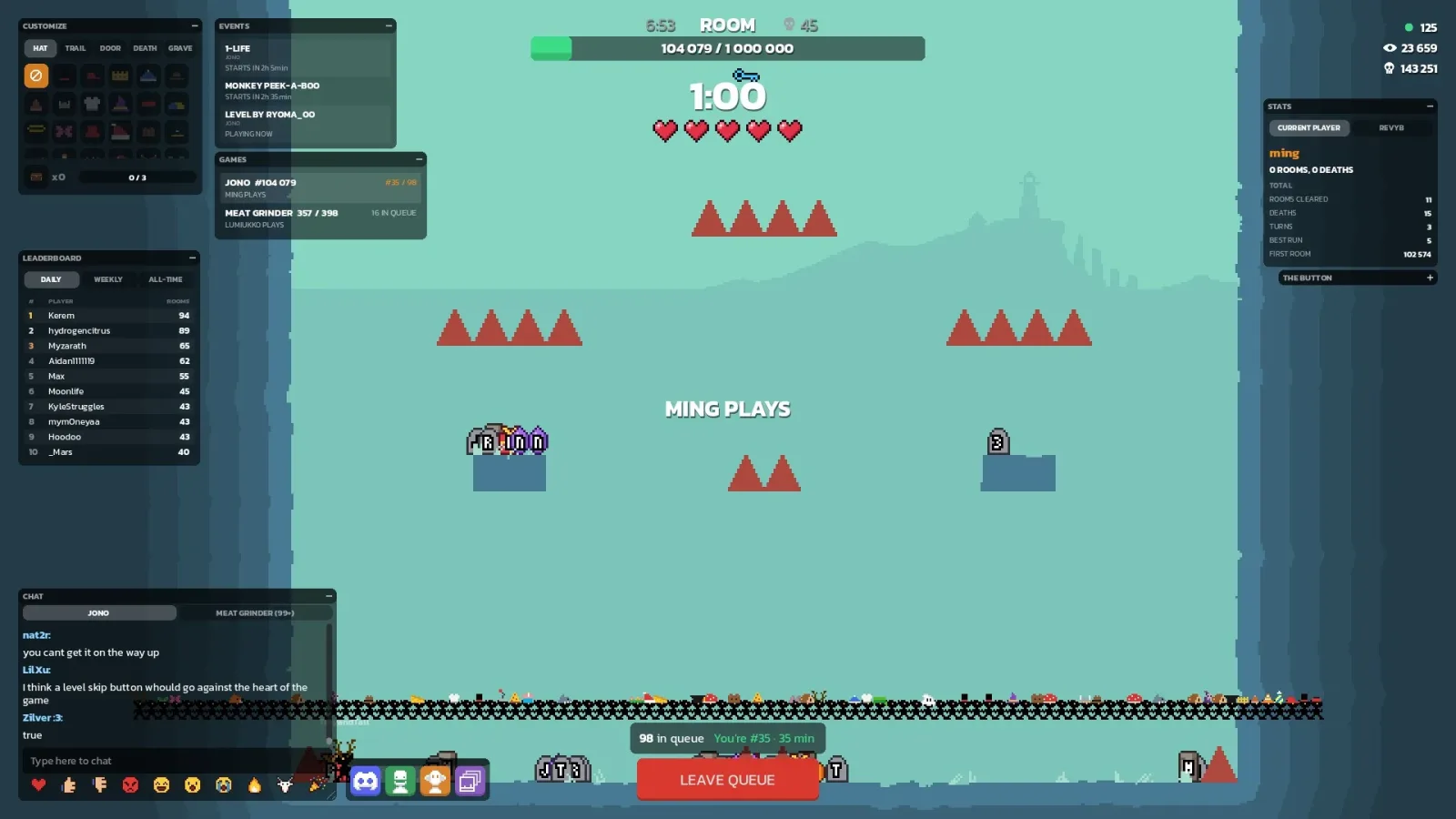
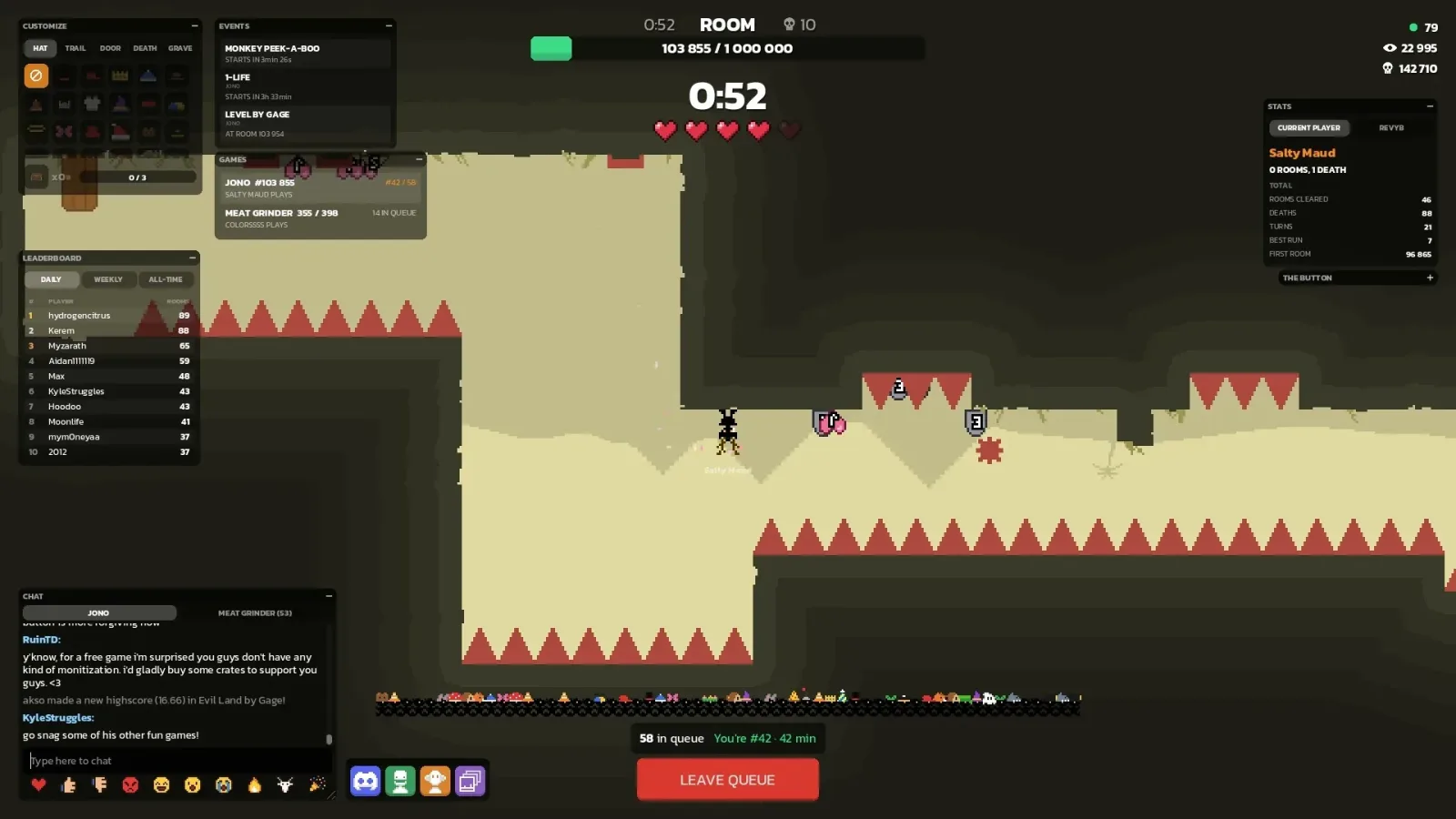
Jono's most distinctive feature may not be any individual room. It is the crowd surrounding each attempt. Opening the game gives users a view of the active player, along with the opportunity to join the queue. Names and character variants wait along the bottom of the screen, making the line visible at all times.
During busy periods, the queue has reportedly tended to sit in the low hundreds. That may sound like an overwhelming wait for a game that grants only a minute of direct input, but several factors keep the line moving. Some people leave before their turn arrives. Others use their five deaths quickly and hand off control almost immediately. In practice, a person can reportedly get a brief attempt roughly once an hour under those conditions.
Waiting is not treated as dead time. A chat window lets the audience react to each run, celebrate successful clears, offer encouragement, or gently heckle disastrous attempts. Players can view statistics such as rooms completed and total deaths, while emoji reactions add the fast-moving language of livestream chat to the platforming action.
It is a structure that should feel recognizable to anyone accustomed to watching livestreams: there is a performer, a crowd, recurring names, shared jokes, and the constant possibility that the next person will either produce an incredible clutch play or immediately fall into spikes. Jono simply rotates the role of performer through its own audience.
That distinction matters. In a traditional platformer, failure is private unless a player chooses to share it. Here, failure is expected, visible, and briefly communal. The current player gets a moment in the spotlight; the queue gets a reason to lean closer; then the cycle starts again. Even the player who fails contributes to the collective spectacle.
Cosmetics and small diversions reward participation
Jono also gives waiting players a few lightweight incentives and distractions. Completing three rooms awards a chest, which can provide cosmetics. These include hats for the stick-figure avatar and distinctive tombstones that mark the place where a player dies. They do not appear to change the central challenge, but they make the procession of players more recognizable and let regulars bring a little personality to their very short appearances.
The game further fills its downtime with odd side activities. One ongoing minigame tells players not to press a button, while a small monkey can occasionally appear at the edge of the screen for participants to click before anyone else does. These diversions are modest, but their purpose is clear: Jono is not asking its audience merely to stare at a queue number.
Instead, it aims to be something that can stay open beside other work or games. A player can casually watch the current room, glance over when a difficult section generates excitement, join in chat, and become increasingly invested as their own position approaches the front. The active gameplay may last just a minute, but the social presence can extend for hours.
An experiment in communal progress
Jono's design challenges the usual idea that games must constantly maximize personal control and minimize waiting. Here, the waiting is not an accident or a server problem. It is the central ingredient. The limitation of one active player transforms a modest platformer into an ongoing communal event.
That will not appeal to everyone. Anyone looking for a platformer to practice freely, replay on demand, or conquer through uninterrupted sessions may find the queue structure frustrating. A difficult room can arrive at exactly the wrong moment, leaving a player with only seconds to react before five deaths or the timer ends their chance.
But that same limitation gives every attempt weight. Clearing a room matters because it is not simply another item on one person's checklist. It changes the course of a shared world, handing a new problem to the entire line behind it. A player may never become the defining hero of the million-room trek, yet their jump, mistake, discovery, or lucky escape can still become part of the group's progress.
For a free Steam game with no reported monetization, Jono's unusual proposition is compellingly simple: log in, take a number, watch the chaos, and eventually get sixty seconds to help push a global platforming marathon one room further.
Community
Discussion
Start the conversation.
No comments have been posted yet.