

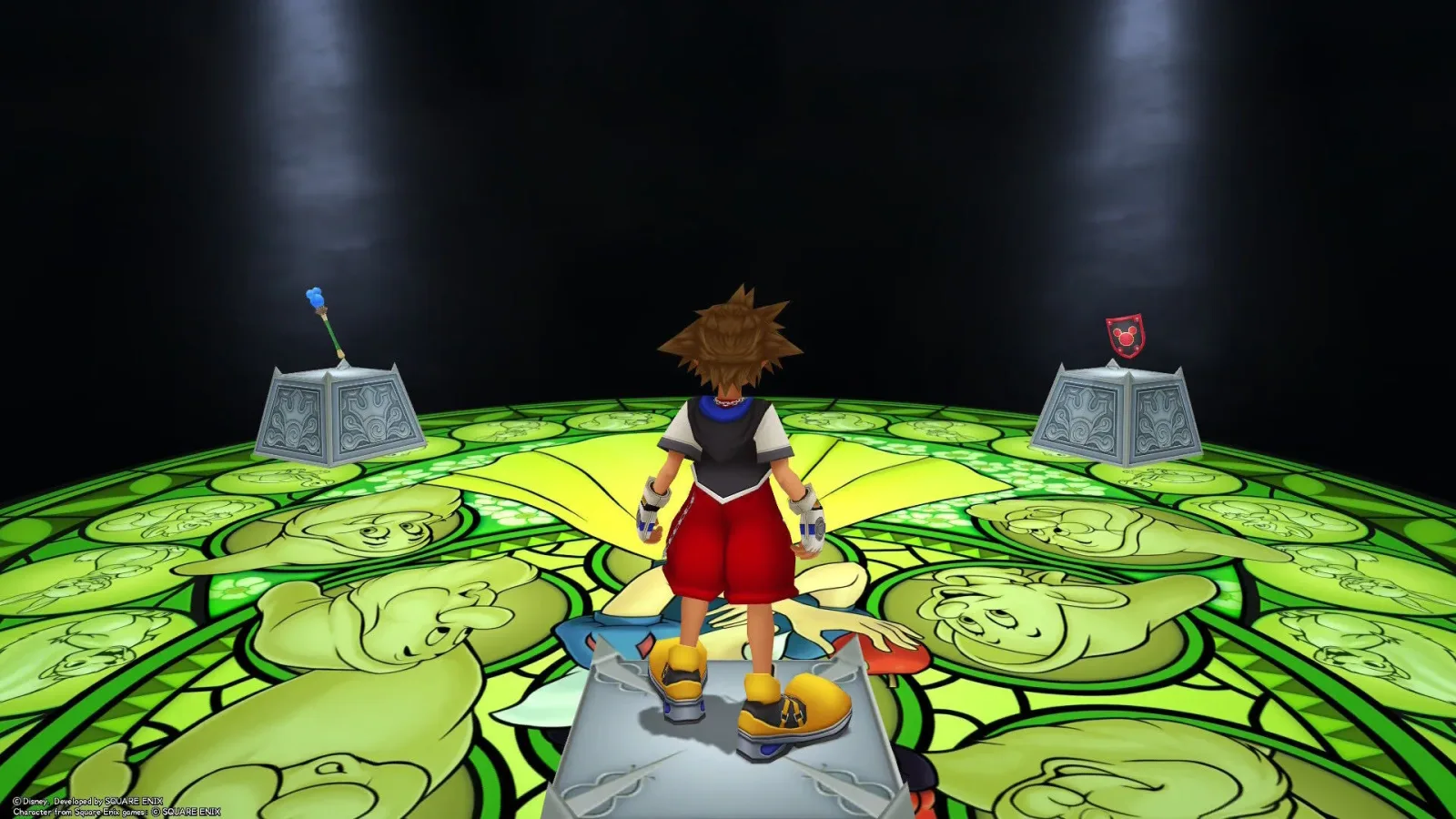
It is easy to remember Kingdom Hearts as an exuberant collision of Disney characters, Final Fantasy cameos, oversized shoes, and impossible sincerity. That description is not wrong, but it can flatten what makes the original game's first hour so memorable. Before Sora visits a Disney world, before Donald and Goofy become party members, and before the Keyblade's broader role is remotely clear, Square Enix opens its adventure with something much stranger: a dream that feels like a warning.
The opening cinematic, set to Hikaru Utada's "Simple and Clean," remains one of the most immediately recognizable sequences in the series. Its imagery is both elegant and disquieting, moving between the young cast on Destiny Islands and suggestions of separation, falling, water, darkness, and distant worlds. Yet after the song ends, the game does not immediately invite players into a carefree island adventure. Instead, Sora falls into an abyss and wakes on an enormous stained-glass platform depicting Snow White.
That moment is the beginning of the Dive to the Heart, an introductory sequence that doubles as a tutorial, a character-building system, a tonal mission statement, and a remarkably early promise that this story has secrets far beyond its opening premise. For players who approached the PlayStation 2 game expecting little more than a Disney-themed action RPG, it was a startling introduction. Even now, it is one of the most effective openings in the entire series.
A tutorial built like a prophecy
The Dive to the Heart teaches basic movement, combat, interaction, and saving. On paper, it is a conventional onboarding area. Sora receives a weapon, battles Heartless, and follows directions from an unseen voice. In practice, the presentation makes every routine lesson feel portentous. The player is not simply being shown how to swing a weapon; they are being initiated into something whose shape is still deliberately concealed.
For useful background on this topic, read Street Fighter Fans Are Questioning the Movie's Radical Cammy Reinvention.
The setting does much of the work. The giant stained-glass pillars feature Disney princesses whom Sora has not met and will not encounter for hours. Snow White is only the first. Other princesses appear as players move between platforms, creating an odd disconnect between what Sora knows and what the game is already showing the audience. These characters are not presented as a collection of cheerful Disney references. They are elevated, distant, and almost sacred in scale.
That choice gains more weight as the series develops. The recurring Dive to the Heart spaces become strongly associated with hearts, connection, identity, and the hidden conditions affecting key characters. The princess imagery in Sora's first descent therefore reads as more than decorative crossover material. It suggests that the game is placing important figures in front of the player long before it explains why they matter. Their presence is an early thread in a web that will become much more elaborate.
For a first-time player, though, there is no practical answer to that mystery. Sora is just a 14-year-old boy having an alarming dream. The game offers no immediate task involving these princesses and no plain-language explanation of the situation. It simply plants the images, then moves on. That restraint is crucial. Kingdom Hearts does not need players to understand the symbolism at once. It only needs them to feel that something is wrong, something is missing, and something important is already underway.
The choices that quietly shape Sora
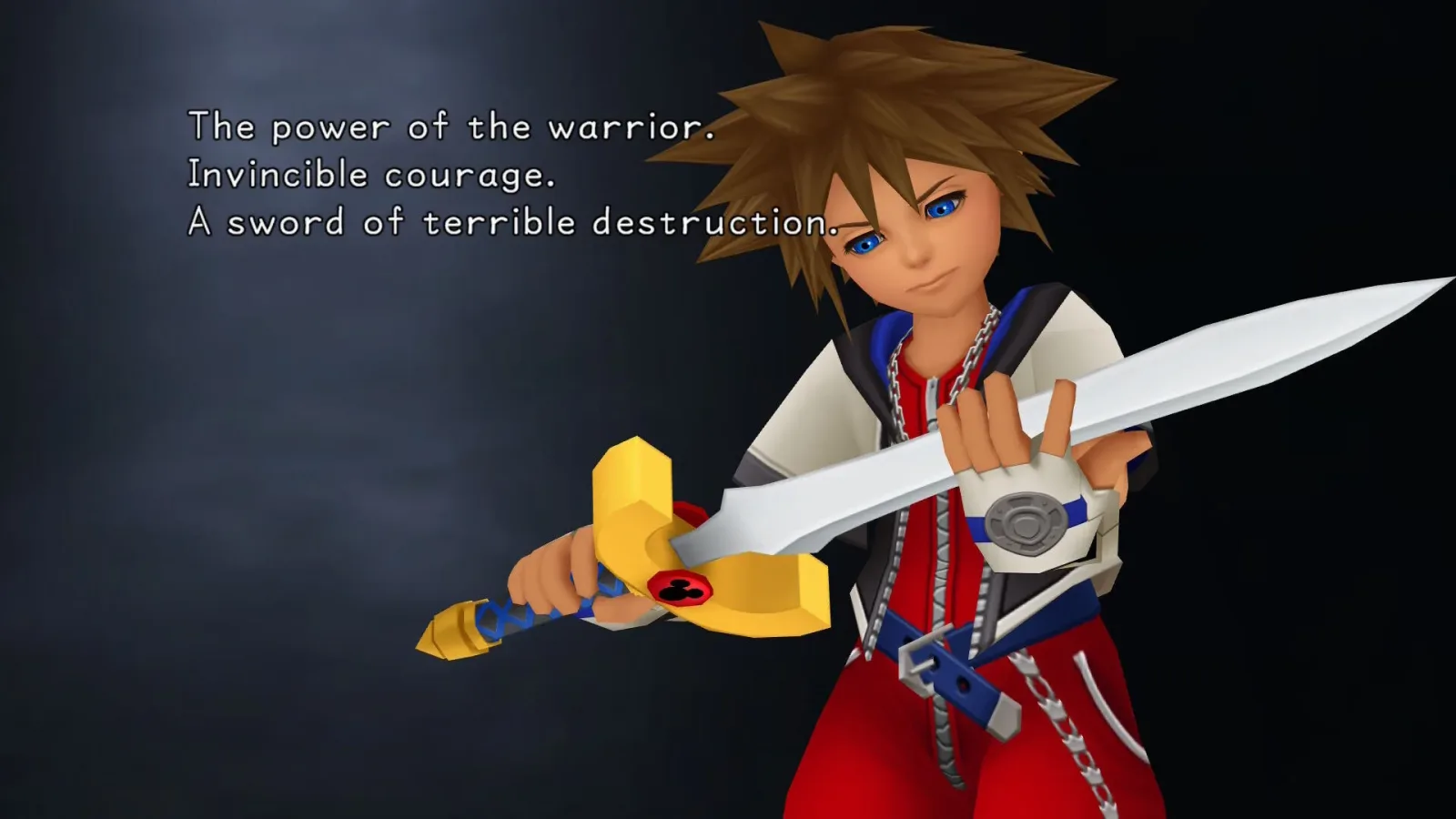
The opening also contains one of the original game's most consequential role-playing decisions, presented in a way that obscures its mechanical significance. Sora is asked to choose among a sword, a staff, and a shield. Then he must give one of the other two up. The scene frames this like a thematic choice about strength, wisdom, and defense rather than a conventional menu asking players to select a class.
Underneath that abstract presentation, the decision affects Sora's starting statistical emphasis and the order in which he learns abilities. Choosing a path does not lock the player out of completing the game or turn Sora into a rigid specialist. He remains broadly capable, and the original Kingdom Hearts can be completed with any of the options. Still, the system matters, especially in a game where defensive tools, magic, attack power, and ability progression can noticeably affect the feel of combat.
What makes the choice especially interesting is that the game does not rush to clarify it. There is no lengthy explanation of build optimization, no chart of future unlocks, and no warning that the selection will influence the adventure for its full duration. Many players likely made the decision on instinct as children, picking the weapon that looked coolest or choosing an ideal that sounded appealing. Later knowledge can make that first decision feel almost startlingly consequential.
That hidden complexity matches the game's larger storytelling approach. Kingdom Hearts often introduces concepts as symbols, emotions, or fragments before it defines them as systems. The sword, shield, and staff selection is a gameplay version of that same method. The player is told to make a meaningful decision before fully understanding its implications, just as Sora is pushed toward a larger destiny he cannot yet comprehend.
Questions for a child at the edge of the world
After the early combat lessons, the dream shifts into a distorted version of Destiny Islands. This should be reassuring territory: Sora's home is sunny, youthful, and filled with the ordinary concerns of his friendships with Riku and Kairi. But the mood does not fully lift. The foreboding score continues, and Final Fantasy characters appear to ask Sora a series of personal questions about his hopes, fears, and values.
There is something unintentionally funny about these towering figures treating a teenager's tutorial segment like an existential interview. At the same time, it is effective because Sora is not portrayed as someone who has prepared answers for all of this. His life has been small, familiar, and bounded by an island. The questions force the player to consider ideas that Sora himself has barely had reason to confront: what he values, what he fears, and what kind of future he imagines.
These prompts also influence elements of the game's progression, another example of the opening embedding mechanics within atmosphere. But their greater impact is emotional. The sequence tells players that childhood is about to end. Sora may not know the rules of the wider universe, but the universe is already asking him to define himself before it takes everything familiar away.
The music is essential to that feeling. Rather than leaning into the celebratory energy one might expect from a Disney crossover, the Dive to the Heart is accompanied by solemn choral material. It lends the stained glass, the vast empty space, and the unseen narrator a spiritual weight. The game is not merely introducing a fantasy world. It is presenting a kind of judgment, or perhaps a calling.
Darkside and the first encounter with darkness
The sequence culminates with Darkside, the towering Heartless that has become one of the franchise's most enduring enemy designs. Mechanically, it is not an especially demanding boss. Players attack its hands when they strike the platform and learn the basic rhythm of avoiding danger while dealing damage. Visually, however, Darkside is imposing. It is enormous compared with Sora, and its arrival makes the prior unease tangible.
That is the key achievement of the encounter. The danger that has lingered in the soundtrack, the strange dialogue, and the endless void finally gets a body. Darkside is not just another tutorial obstacle; it is the nightmare's physical manifestation. Sora can defeat it in the immediate fight, but victory does not restore control. Darkness still engulfs him.
This is a bold way to start an adventure aimed at players who may have arrived for Disney nostalgia. The game quickly proves that beating an enemy does not mean the threat is over, and that darkness is not a simple obstacle waiting to be punched away. It is a force that will repeatedly surround Sora, separate him from others, and test the connections that define him.
Why the opening endures
The original Kingdom Hearts eventually delivers the playful Disney-world exploration its premise promises. There is humor, warmth, spectacle, and plenty of charmingly awkward crossover energy. But the Dive to the Heart ensures that those brighter elements never entirely erase the sense of uncertainty underneath them.
Its princess imagery foreshadows story elements that will matter later. Its weapon choice quietly establishes a character build. Its questions make the player participate in shaping Sora's path. Its music and imagery announce an emotional scope far larger than a simple vacation through animated film settings. And Darkside makes clear that Sora's journey begins not with a triumphant departure, but with being swallowed by the unknown.
That opening remains powerful because it understands the difference between mystery and confusion. It withholds answers, but it offers strong feelings in their place: wonder, dread, sadness, and the certainty that the hero standing on the stained glass is being called toward something immense. Long before the series became known for its sprawling mythology, Kingdom Hearts had already made its intentions clear. Behind the familiar characters and bright colors was a story about hearts, loss, darkness, and a child being asked to open a door he does not yet understand.
Community
Discussion
Start the conversation.
No comments have been posted yet.