

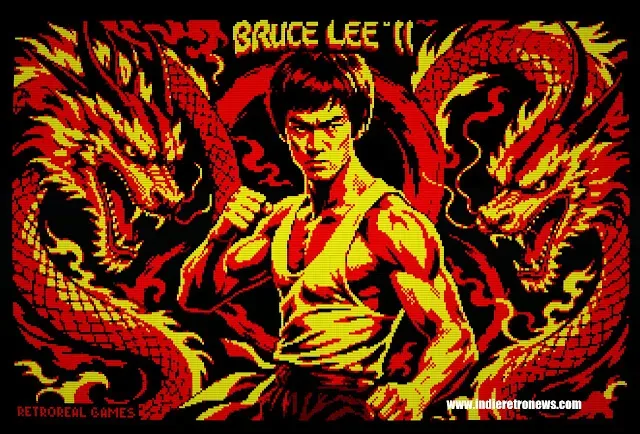
Bruce Lee II, the unofficial sequel created by Bruno R. Marcos, has arrived on the Amstrad CPC through a new conversion from RetroReal Games. The release gives the fan-made follow-up a particularly fitting home: Marcos' original PC project was deliberately designed around the visual character and mechanics of the 8-bit Bruce Lee games, with the Amstrad CPC version serving as a major point of reference.
It is a notable full-circle moment for a game whose identity was built on admiration for a 1984 action-platforming classic. The original Bruce Lee became one of the defining games of its era on 8-bit home computers, combining accessible movement, martial-arts combat, exploration, and a constant threat from memorable pursuing enemies. The newly available CPC conversion brings Marcos' expanded interpretation of that formula to the hardware aesthetic that inspired it.
A return to an 8-bit action-platforming favorite
The story of this conversion begins with Datasoft's 1984 Bruce Lee. The original game found a broad audience across 8-bit microcomputers and earned its long-standing reputation through an unusually clean blend of ideas. Players could run, jump, climb, kick, and navigate a compact but hazardous series of screens, while the game's straightforward controls made it immediately approachable.
Its tension came from more than level hazards. Two persistent foes helped turn each area into a frantic contest of movement and timing: a fast ninja opponent and the hulking green Yamo. Rather than merely appearing at isolated moments, these adversaries could make routine platforming much more complicated. The player was regularly balancing progress through the environment against the need to avoid, outmaneuver, or fight enemies closing in from behind.
For useful background on this topic, read Street Fighter Fans Are Questioning the Movie's Radical Cammy Reinvention.
That constant activity is a major reason the game endured. The levels were easy to understand at a glance, yet danger could emerge from platforms, drops, traps, enemy positioning, and hurried decisions. It was an action game with platforming at its core, but it also encouraged players to learn routes, react quickly, and use the environments to their advantage.
On the Amstrad CPC, the original was distributed by U.S. Gold and became especially well liked among the machine's players. Its responsive controls and colorful presentation helped it stand out, giving the CPC edition a strong place in the system's software library. That specific version would later become far more than a historical footnote for Marcos: it became the central visual benchmark for his own sequel.
Bruno R. Marcos' sequel expanded the original formula
Marcos created Bruce Lee II for PC in 2013 as an unofficial continuation made in close dialogue with the earlier game's design. It was not simply an attempt to reproduce a familiar structure with fresh stages. While it retained the direct physics, easy-to-read action, and recognizable style of the original, the sequel widened the range of obstacles and situations facing players.
The game follows Bruce on a mission to rescue his sister from the villain Tao-Bao. That premise provides a clear framework for a larger adventure, one that pushes beyond the earlier game's basic room-to-room dangers. Its environments introduce switches, traps, and moving platforms, asking players to pay attention not just to enemies but also to changing routes and interactive level elements.
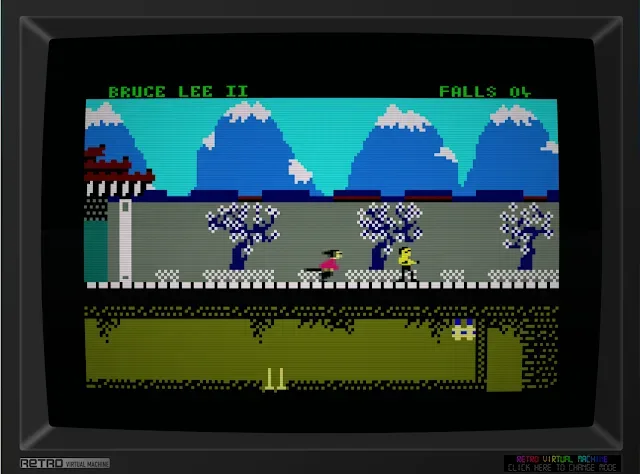
Swimming sections further distinguish the sequel from its inspiration. Underwater areas add another type of movement and environmental challenge, expanding the pace beyond the original's familiar running, jumping, climbing, and combat. The result is a game that aims to preserve a classic play feel while offering more complicated spaces to explore.
Marcos also added opponents influenced by martial arts figures Chuck Norris and Kareem Abdul-Jabbar. Their inclusion fits the game's broader kung-fu-cinema spirit while giving the sequel a personality of its own. The project remains rooted in the old Bruce Lee template, but these additions show that it was conceived as an expansion rather than a strictly conservative recreation.
Classic fundamentals, bigger complications
The appeal of a sequel like Bruce Lee II lies in the balance it tries to strike. The 1984 game remains fondly remembered in part because its basic language was so readable. Players understood how to move, how to attack, and why an approaching enemy or a gap in the floor mattered. Marcos' version preserves that immediate clarity while layering in more elaborate scenarios.
- Switches can make progression depend on interacting with the level rather than simply reaching the next platform.
- Traps place additional pressure on movement and timing.
- Moving platforms create routes that change as players navigate them.
- Underwater segments vary the game's movement and atmosphere.
- New enemy concepts broaden the martial-arts-inspired opposition.
Those features can make a game feel meaningfully larger without abandoning the fundamentals that made the original approachable. For retro action-platforming fans, that is often the ideal direction for a follow-up: maintain the familiar response and screen-by-screen urgency, then create new reasons to master them.
The CPC connection is more than a late port
What makes this conversion especially interesting is that the Amstrad CPC was already embedded in the DNA of the PC release. Marcos treated the CPC edition of the original game as the definitive visual guide for Bruce Lee II. The sequel even included a dedicated display mode intended to emulate the distinctive look of the Amstrad machine.
That decision speaks to the importance of platform-specific identity in retro game development. Although the original Bruce Lee appeared across multiple 8-bit computers, different versions could leave very different memories with players depending on their machine of choice. Color use, screen presentation, responsiveness, sound, and the overall impression of motion all shaped how a game was remembered. For Marcos, the CPC presentation was not merely one variant among many; it was the visual standard that informed his sequel.
Now, RetroReal Games has brought that homage directly to the hardware family that inspired it. The conversion therefore carries an unusual sense of historical symmetry. A 2013 PC game made to evoke the Amstrad CPC can now be experienced as an Amstrad CPC game, rather than only as a modern production simulating its visual language.
That is valuable for more than nostalgia. Conversions to original retro platforms invite players to consider a game through the limits, strengths, and conventions of the machine itself. The CPC's presentation is part of the experience, not a filter applied after the fact. For enthusiasts who still play on original systems or use period-appropriate setups, this release offers a new title that belongs naturally beside the library that inspired it.
A welcome addition for CPC owners and preservation-minded players
The Amstrad CPC continues to receive new games and conversions because its community remains interested in both preserving the past and extending it. Releases such as Bruce Lee II occupy an appealing middle ground. They are modern works in the sense that they were created long after the machine's commercial peak, but their design vocabulary comes from the period and from the platform's established classics.
For players who know the original game well, the prospect is easy to understand: an unofficial sequel that respects the brisk, accessible nature of the 1984 design while offering more environmental variety and a new rescue mission. For those discovering it through the CPC conversion, it is also a chance to see how enduring the core concept remains. Quick movement, clear dangers, enemy pressure, and compact platforming rooms are ideas that can still support compelling action decades later.
The project also demonstrates how fan-made sequels can become part of the wider retro ecosystem when handled with evident knowledge of the material that inspired them. Bruce Lee II does not erase or replace the original. Instead, it builds from the aspects that made the earlier game memorable: its tightly controlled action, simple rules, colorful personality, and the chaos created by opponents who refuse to leave the player alone.
Bruce Lee II's journey comes full circle
RetroReal Games' Amstrad CPC conversion gives Bruce Lee II a natural new destination. The PC sequel was already shaped by the system's version of the 1984 classic, down to an optional visual mode that echoed the CPC's graphical identity. Bringing it to the actual platform turns that inspiration into a more direct connection.
For the CPC community, it means another action-platforming adventure built around a familiar lineage. For followers of Bruno R. Marcos' work, it represents a new way to play a project designed with deep respect for an 8-bit favorite. And for retro gaming more broadly, it is a reminder that classic systems continue to inspire new releases--not only through remakes and reissues, but through sequels and conversions that keep their defining styles alive.
Community
Discussion
Start the conversation.
No comments have been posted yet.