

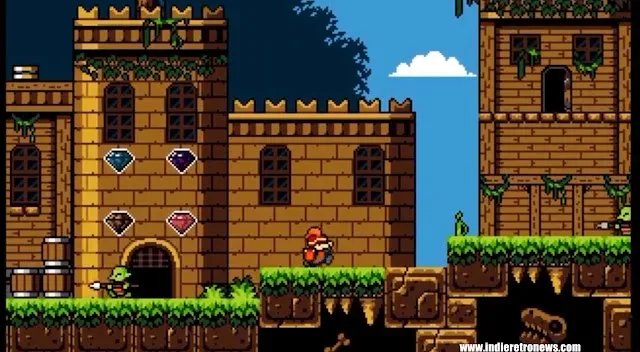
Amiga homebrew developer HooGames2017 has revealed Lost in the Middle Ages, a new medieval adventure in development for the Commodore Amiga. Built with the Scorpion Engine, the project combines an old-school action-adventure premise with experience-based character growth, collectible items, hidden locations, and an emphasis on searching beyond the most obvious route through each stage.
The game is still actively taking shape, so its final size has not been determined. However, five complete stages have already been created, and each is said to include secrets and concealed areas for attentive players to find. Lost in the Middle Ages is also being designed with classic Wonder Boy gameplay as a stated point of inspiration, giving its medieval setting a familiar foundation for fans of colorful, exploratory retro platform adventures.
A stranger arrives in a kingdom awaiting a saviour
Lost in the Middle Ages begins with the appearance of a mysterious outsider in a village. The stranger is brought before the king, only for the ruler to reveal that this meeting was expected. Rather than questioning why the newcomer has arrived, the king recognizes the figure as someone foretold to become the kingdom's ultimate saviour.
That premise gives the adventure a straightforward but promising fantasy frame: a hero entering an unfamiliar realm already burdened by a prophecy. Medieval kingdoms, villages, houses, hostile creatures, and tucked-away rewards are all natural components of the game's setting, while the prophecy provides a reason for the player character's journey and gradual rise in power.
For useful background on this topic, read Thousand Hells Turns Every Underworld Heist Into a Risky Crew Story.
It is an especially fitting setup for a game built around progression. The hero is not simply expected to rush through a set of levels. Players will defeat enemies and gather items to earn experience points, helping them build up the character as the journey continues. The precise details of the leveling system, including which attributes can be improved or how much player choice it will offer, have not yet been specified.
Exploration is central to the design
While combat and experience gains are part of the core loop, exploration appears to be equally important to Lost in the Middle Ages. The completed stages include hidden locations and secrets, and players will be able to enter houses in local settlements. Those interiors are not merely background scenery: they can contain rewards for players willing to investigate.
That detail helps distinguish the game from a purely linear action platformer. Entering buildings encourages players to pause, check side paths, and consider whether an ordinary-looking location might contain something useful. In games inspired by the 8-bit and 16-bit eras, this kind of design can make a compact world feel considerably larger. A stage becomes more than the distance between its start and finish when it contains alternate spaces, bonuses, and rewards that are easy to overlook on a first visit.
For another perspective on this story, read Lost in the Middle Ages Brings Wonder Boy-Style Adventure to Amiga 500.
The direct reference to Wonder Boy also offers a useful indication of the intended rhythm. The long-running series is closely associated with accessible side-scrolling action, memorable environments, enemy encounters, items, and a strong sense of forward movement. Lost in the Middle Ages is not being presented as a remake or official continuation of that series, but the inspiration suggests an adventure that values immediate, readable action alongside curiosity and replay-minded discovery.
Five stages are currently complete, but the total number of levels remains undecided while development continues.
For retro players, that uncertainty is worth keeping in mind. The project is not yet locked into a final content count, and the medieval world may grow or change as work proceeds. What is established so far is the presence of five finished stages, each with secrets, rather than a confirmed final campaign length.
A new Scorpion Engine game for the Amiga scene
Lost in the Middle Ages is being developed using the Scorpion Engine, a toolset that has become an important part of modern Amiga game development. Its continued use in homebrew projects has enabled creators to pursue polished, console-style action games for classic Commodore hardware while still building entirely new worlds and mechanics.
For an Amiga release, the choice of engine is significant because the platform remains an active target for developers working outside the traditional commercial model. New games for vintage machines often have to balance authenticity with accessibility: they need to feel at home on the hardware while still giving players enough new ideas to justify revisiting a system decades after its original commercial peak.
The ingredients currently outlined for Lost in the Middle Ages suit that balance well. A medieval fantasy world is instantly legible, the hero's growth gives players a tangible reason to engage with enemies and items, and secret-filled stages encourage repeat runs. At the same time, being able to walk into houses and search for rewards gives the game a more lived-in feeling than a sequence of isolated obstacle courses.
There is also a practical advantage to a design built around discrete stages. It allows each area to introduce its own secrets and challenges while maintaining a clear sense of progression. Whether Lost in the Middle Ages ultimately leans more heavily into platforming, combat, item collection, or role-playing-style advancement remains to be seen, but its current concept leaves room for all of those elements to work together.
HooGames2017 returns after prior Amiga releases
HooGames2017 is already known in the Amiga homebrew community for projects including ARC4NERD, Dr. Dangerous, and Phantom Leap. That background makes Lost in the Middle Ages a notable next project, especially because it is being framed around a broader adventure structure rather than a single-sentence arcade hook.
Previous work can matter greatly in the retro space. Players interested in newly made software for original hardware often follow developers as closely as they follow individual games, since a proven record can offer a sense of the creative approach, technical ambition, and style likely to appear in the next release. HooGames2017's return with another Amiga title adds one more project to a scene that continues to produce original games for classic computers.
Lost in the Middle Ages also highlights how contemporary homebrew development can draw from the language of classic games without being limited to imitation. The stated Wonder Boy influence establishes a recognizable starting point, but the prophecy-led story, experience points, village houses, and expanding stage count give this project its own identity. Its success will likely depend on how naturally those systems connect: secrets should feel rewarding, upgrades should matter, and exploration should offer more than simply delaying the path ahead.
What remains unknown
As with many projects revealed during development, there are still major details waiting to be announced. No final number of stages has been confirmed. The exact scope of the item system, the mechanics of experience progression, the range of enemy types, and the game's complete story are also yet to be detailed. A release date has not been announced.
Those unknowns are not necessarily a concern at this stage. The developer has been clear that the project's scope is still changing, and that makes the existing five-stage milestone more useful as an indicator of active progress than as a promise of final scale. The important takeaway is that Lost in the Middle Ages has moved beyond a bare concept: playable stages have been completed, the world's premise has been established, and its key design priorities have been identified.
For now, Amiga enthusiasts have a new medieval quest to watch. Lost in the Middle Ages is shaping up as a secret-packed, progression-driven adventure with a clear affection for classic side-scrolling design. If its exploration, combat, and character growth come together effectively, it could offer another compelling reason to power up a Commodore Amiga for something genuinely new.
Community
Discussion
Start the conversation.
No comments have been posted yet.