

Content warning: discussion of graphic violence and injuries.
Marvel's Wolverine puts a hero famous for violence, endurance, and indestructible claws at the center of a highly physical action game. That is an obvious fit on paper. Logan has spent decades cutting through enemies in comics, films, animation, and games, while his healing factor gives creators room to push fights toward brutal extremes. But those same traits can create a design challenge: when the central solution to every obstacle is to lunge forward with claws, slash repeatedly, and absorb almost any punishment, how does the game keep the experience from becoming too familiar?
One sequence in Insomniac's new superhero game reportedly answers that question with unusual confidence. During a later confrontation with Sabretooth, Marvel's Wolverine briefly removes the player's most fundamental tool: sight. It is a nasty story beat that becomes a mechanical idea, turning Logan's regenerative power from visual spectacle into the structure of a tense, disorienting phase of a boss battle.
It is also notable precisely because it appears to be a rare departure from the game's usual rhythm. The wider adventure has been characterized as a fairly traditional, linear character-action experience, one built around close-quarters combat as Logan tracks targets and works his way through hostile environments. That format can certainly be satisfying. There is a particular appeal in finding the cadence of attacks, counters, parries, and evasions, especially when a game encourages the player to maintain aggression. Yet a combat loop that stays too close to the same idea for too long can make even an appropriately savage Wolverine fantasy feel narrow.
For useful background on this topic, read Kingdom Hearts Meets Fortnite in a Trailer Built on Kingdom Hearts 2 Nostalgia.
A Rivalry Finally Turns Violent
The standout moment arrives once the relationship between Logan and Sabretooth changes. Early in the game, the two mutants are portrayed as reluctant allies rather than immediate enemies. Later, that uneasy arrangement collapses, setting up the kind of confrontation audiences expect from two characters whose rivalry is among Marvel's most enduring personal feuds.
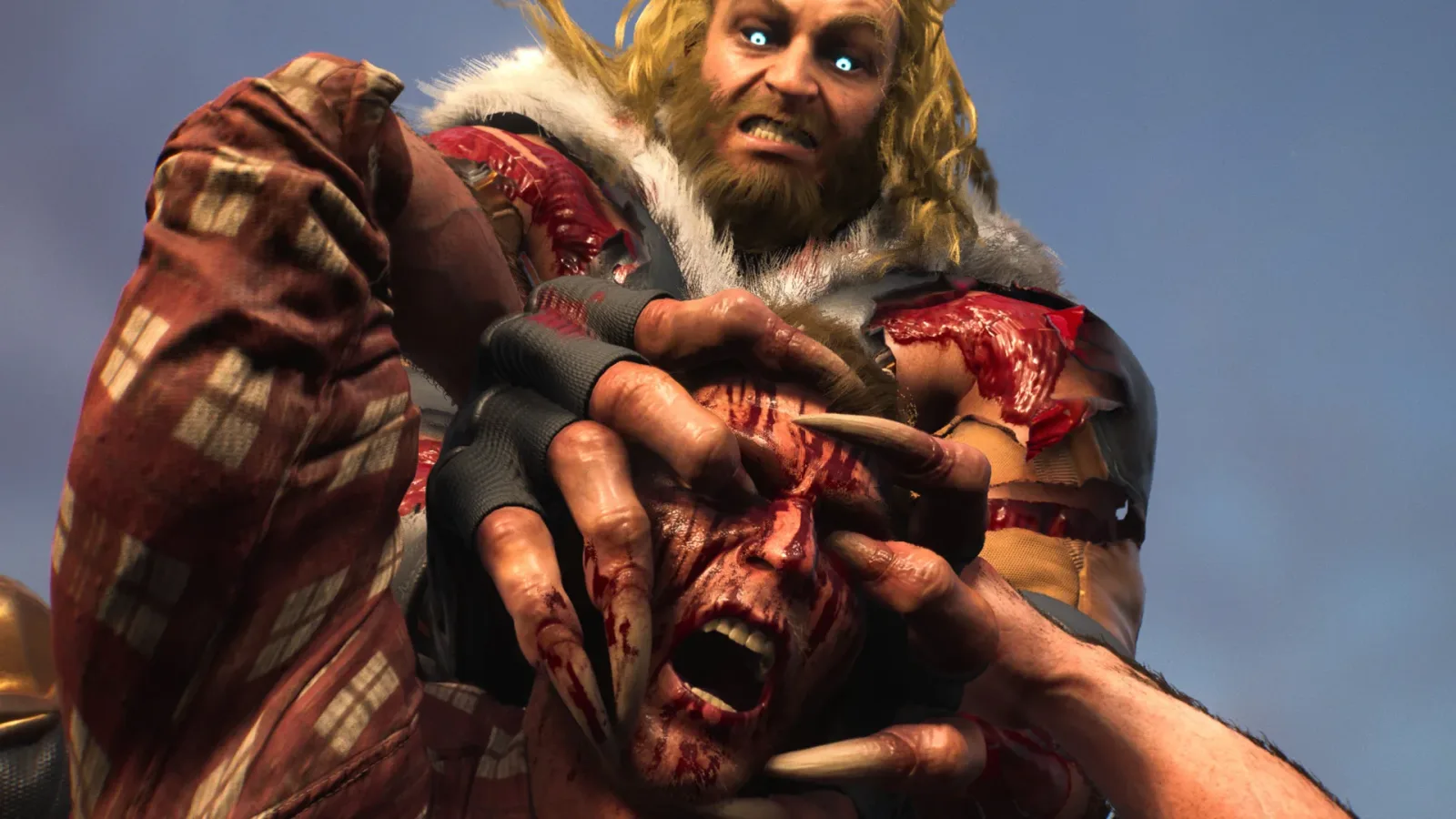
The fight escalates at the docks in Lowtown. At one point, Logan is thrown onto a raft in the water and winds up in a deeply vulnerable position, pinned beneath Sabretooth. Sabretooth restrains Logan's adamantium arms and repeatedly drives his head into the raft. Even then, Logan continues to provoke him, telling his opponent that he is blind if he cannot recognize that he is being manipulated.
Sabretooth responds with literal, horrific force: he gouges out Logan's eyes.
That brutality is consistent with a game willing to show Logan taking damage that would kill an ordinary person. His body can be stabbed, burned, battered, and otherwise destroyed in ways that underline how unnatural his healing factor is. Often, however, such injuries can risk becoming mere punctuation in a cutscene. Logan suffers something gruesome, the scene emphasizes the blood and impact, and his body restores itself quickly enough that the damage does not substantially alter what the player does next.
The Sabretooth encounter takes a more interesting path. For a short stretch, the injury changes the rules.
When the Player Cannot See, Logan Cannot See
After the attack, Marvel's Wolverine shifts into a first-person view. Logan has lost his vision, and the player's screen reflects that condition rather than simply presenting it as a cinematic wound. The player can turn and listen, attempting to work out where Sabretooth is and when another attack may be coming. The sequence asks the player to operate through sound, intuition, and incomplete awareness while an enraged opponent remains nearby.
That decision is simple, but it directly joins character and control. Wolverine games do not need to explain why Logan can survive catastrophic damage; that has always been part of his identity. The more compelling question is what that survival feels like in interactive form. Here, recovery is not just a passive animation or a health-bar abstraction. It unfolds as a temporary handicap that the player must endure.
Logan's eyesight comes back gradually, not all at once. The player begins to regain a sense of the surrounding area, then can slowly identify shapes and the broader outline of Lowtown. Color follows, and eventually the image returns to normal focus. Until that recovery is complete, Sabretooth can still close in and land more hits. The fact that the healing process has a pace gives the scene pressure. It is not merely a cutaway before the next exchange; it is a period in which the player is waiting for a core ability to return while trying not to be overwhelmed.
There is a clever reversal at work, too. Wolverine is normally a character associated with heightened senses and animal instinct. In most action games, players have a nearly all-seeing viewpoint, clean indicators, and a reliable read on enemy positions. This encounter undermines that comfort. Logan's opponent turns an insult about blindness into an injury, and the game temporarily asks the audience to share the consequence.
Healing Factor as Gameplay, Not Decoration
The sequence illustrates why Wolverine's powers offer more design potential than simply allowing a developer to show increasingly elaborate wounds. Regeneration can change pacing. It can make damage matter in unusual ways without automatically causing a standard failure state. It can create temporary losses of function, such as impaired vision, restricted movement, reduced precision, or altered perception. And because Logan is unusually difficult to kill, the game has room to present bodily harm as a changing tactical problem rather than only as a reason to reload a checkpoint.
That does not mean every fight needs to become a gimmick, nor would constant disruption necessarily improve the game. A strong character-action game needs a dependable baseline where players can learn systems, become more capable, and enjoy the rhythm of combat. Wolverine's claws should feel powerful, and fighting through groups of enemies should remain a major part of the fantasy.
But a long game benefits from escalation and contrast. A boss who interferes with the player's senses makes the next conventional claw exchange feel different. An injury that changes targeting, movement, or awareness could make healing feel consequential. Environments could also invite other forms of interaction tied to Logan's identity, whether that means following a trail, responding to sound, exploiting smell, navigating while wounded, or making difficult decisions while the hero's body is still rebuilding itself.
The Sabretooth segment is effective because it does not abandon the core fantasy. Logan is still trapped in a vicious fight with a stronger-looking, equally feral adversary. The scene does not transform the game into an unrelated genre. Instead, it takes a familiar Wolverine element--his ability to regenerate after terrible wounds--and lets that element affect the player's immediate experience.
A Glimpse of Greater Variety
Once Logan's sight returns, the fight reportedly returns to the more familiar business of two clawed mutants tearing into each other. That is understandable: Sabretooth and Wolverine should eventually meet on their most recognizable battlefield, trading slashes and retaliating with raw aggression. Still, the return to normality makes the blinded section stand out even more strongly.
The broader combat experience has been described as potentially repetitive, even if it can become pleasurable when players settle into an aggressive flow of strikes and parries. There is value in that uncomplicated release. Wolverine is not a hero who needs every encounter to be delicate or cerebral. Sometimes the appropriate response is simply to get close, survive a beating, and carve a path forward.
Yet the game's best opportunity may lie in finding more situations where that directness is challenged without being discarded. The Lowtown encounter suggests that Insomniac understands the value of making Logan's extraordinary biology more than surface-level gore. When the player is denied vision and forced to wait for it to regrow, the healing factor becomes suspenseful. When the environment is only partially visible and Sabretooth might strike at any moment, the fight gains a vulnerable edge that ordinary combos cannot provide.
Marvel's Wolverine may still satisfy players looking for a blunt, bloody superhero action game. But its Sabretooth battle points toward a more distinctive version of that idea: one in which Logan's wounds, senses, instincts, and recovery actively reshape the way the player approaches danger. Even as a brief detour, the sequence demonstrates how much more memorable Wolverine combat can be when the character's powers are allowed to influence play as strongly as they influence spectacle.
Community
Discussion
Start the conversation.
No comments have been posted yet.