

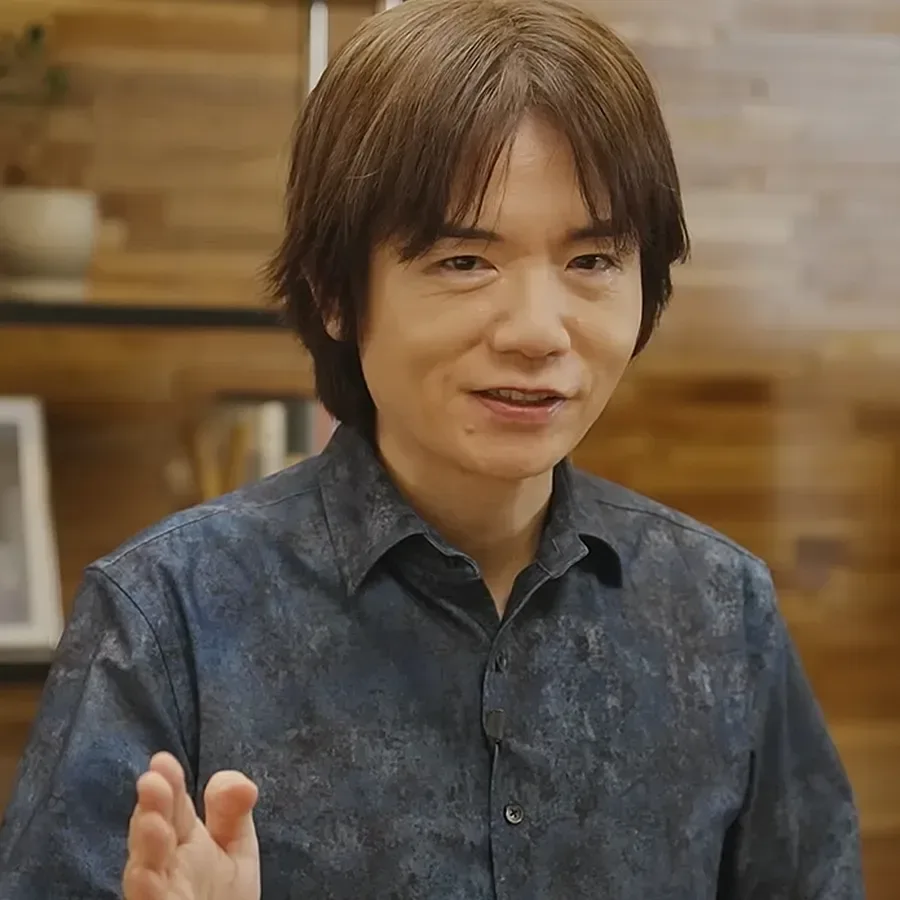
Masahiro Sakurai's long-running Game Designers Award has reached its conclusion. The award, created by the Kirby and Super Smash Bros. creator in 2010 as part of the Japan Game Awards, will not return in future ceremonies after its 16-year run.
Sakurai announced the decision during the Japan Game Awards' Game of the Year Division ceremony on September 14. The reason was not a change in the award's mission, nor a lack of games worth recognizing. Instead, Sakurai said he had been unable to find someone capable of taking over the responsibility of leading an award specifically intended to spotlight unusual, original, and game-changing design.
Its final recipient is Word Game, a text-based puzzle project by independent developer Team9. The selection closes the book on a category that deliberately looked beyond conventional measures of success and attempted to reward games that introduced players to ideas they had not seen before.
An Award Built Around Creative Risk
The Game Designers Award occupied a distinct space within the Japan Game Awards. While major awards can naturally gravitate toward widely played, highly visible releases, this category was designed to focus on creative ambition and originality. Eligible games were expected to bring forward ideas clearly separated from existing works and to broaden what game software could be by presenting fresh ways to play and enjoy it.
For useful background on this topic, read Mark Noseworthy Reflects on The Taken King and Destiny's Drive to Be Better.
The award's stated goal also extended beyond novelty for novelty's sake. The winning game was meant to be a work that reached a broad audience, including people who might not normally engage heavily with games, while leaving a memorable mark on the year.
That is a demanding standard, especially in an industry with an enormous range of genres, budgets, audiences, and business models. It requires judges to look at more than polish, commercial reach, or franchise stature. The core question is whether a game has genuinely moved the medium's possibilities forward.
Sakurai has been closely associated with that philosophy throughout his career. Kirby became an enduring character by making approachable platforming central to its identity, while Super Smash Bros. transformed a crossover concept into one of gaming's most recognizable competitive and social experiences. The Game Designers Award gave him a formal platform to advocate for games willing to pursue similarly unexpected directions.
Why Sakurai Could Not Continue the Award
During his presentation, Sakurai explained that the category's end came down to succession. He said the award had been running for 16 years and that this would be its final installment because nobody had stepped forward to replace him.
"In order to keep this award something that is really convincing and fulfills the role, it needs to be given by somebody who's a director, who's come up with innovative games that have changed gameplay a lot," Sakurai said through live translation.
He said he had actively sought a successor for several years, including making presentations in an effort to find someone suitable. Although the judging process includes other industry figures, no one was able to assume the mantle required to keep the category operating in the way he felt it should.
The point is significant because it suggests Sakurai did not view the position as a ceremonial credit that could simply be handed over. In his view, the award's credibility depended on leadership from a game director with direct experience creating innovative titles that materially changed how players interact with games.
That creates a very narrow and difficult qualification. The games industry is full of accomplished developers, producers, artists, writers, and executives, but Sakurai was looking for a particular combination of design leadership, demonstrated innovation, and the authority to make a persuasive case for experimental work. His inability to find such a replacement ultimately meant ending the award rather than diluting its purpose.
Word Game Becomes the Final Winner
Team9's Word Game now holds the unusual distinction of being the final Game Designers Award winner. The game is a text-based puzzle experience that began as a work using Traditional Chinese characters before being localized for Japanese players.
That localization became a major part of why the game impressed the committee. Word puzzles are often deeply tied to language-specific structures, associations, character forms, and cultural knowledge. A concept that seems inseparable from one written language can be exceptionally difficult to translate without changing its identity or losing the puzzle logic that makes it work.
The judges highlighted the skill and ingenuity involved in communicating that experience to Japanese players. The committee also noted that Word Game won by an overwhelming margin in the second stage of judging, once the process had been narrowed to specific nominated titles.
Its victory neatly reflects the award's intended values. Word Game is not being recognized merely as a polished puzzle game. It is being celebrated as a distinctive work whose appeal depends on an inventive relationship between language, play, and adaptation. For an honor centered on new forms of player experience, a game built around successfully carrying an ostensibly language-bound idea across linguistic boundaries is an appropriate final choice.
The judging panel itself included prominent game creators and veterans, with members including Hideki Kamiya, Yoko Taro, and Toby Fox. Their involvement further underlines the category's emphasis on designers who understand how unusual ideas can become meaningful games rather than simply abstract concepts.
Sakurai's Warning About Innovation and Profitability
Sakurai used the announcement to offer a wider reflection on game development and the place of experimentation in a commercial industry. He described game creation as an ongoing experiment and acknowledged that it is consistently difficult work.
He also drew a distinction between popularity and innovation. Major awards and hit games can receive extensive attention, but the qualities represented by the Game Designers Award do not always align with profitability. Sakurai compared that tendency to consumer habits: many people prefer what they already know rather than choosing the newest or most unusual option available.
That observation is not an attack on familiar games or established franchises. Players often return to trusted genres and series for good reasons, and reliable commercial success helps developers and publishers continue making games. But Sakurai's concern is that an industry relying too heavily on proven formulas can slowly lose the discoveries that keep the medium vital.
"If the industry loses creativity and innovation, I think the industry as a whole will slowly die," Sakurai said through translation.
His argument is especially resonant at a time when game development is increasingly expensive and lengthy. As financial stakes grow, companies may have stronger incentives to pursue recognizable brands, established mechanics, sequels, and predictable audiences. Those projects can be excellent, but the conditions that make smaller, stranger, or harder-to-market ideas possible can become more fragile.
A dedicated award cannot solve that tension on its own. Still, for 16 years, the Game Designers Award offered a visible reminder that the industry benefits from games that take risks. It made room for works that might not be adequately represented by sales charts, global marketing campaigns, or the loudest online conversations.
A Final Chapter for a Distinctive Honor
The last several winners illustrate the kind of varied work the award was willing to elevate. Recent recipients included Sad Owl Studios' Viewfinder, Odd Meter's Indika, and RPG Time: The Legend of Wright. Those games differ dramatically in theme and structure, but each is associated with a strong, individual design identity rather than a conventional attempt to follow market trends.
With Word Game joining that list as the final winner, the award leaves behind a legacy centered on curiosity. It encouraged audiences and creators to value games that could be surprising, awkward to categorize, difficult to explain in a short pitch, or dependent on ideas that had not yet been commercially proven.
Sakurai expressed hope that players will continue to care about creative games even without the award. That may be the most important part of the announcement. The category is ending, but the need it represented has not gone away. Independent teams, established studios, and individual creators will continue trying ideas that challenge assumptions about controls, storytelling, accessibility, language, social play, and genre.
The end of the Game Designers Award is understandably disappointing for those who valued its specific focus. Yet its conclusion also sharpens the message Sakurai delivered at the ceremony: innovation needs active support. Players can provide that support by seeking out unfamiliar games, discussing original mechanics, and giving unusual projects the chance to find an audience. Developers and publishers can provide it by protecting space for experimentation even when the safest option is to repeat what worked before.
There is no announced successor category to replace the Game Designers Award at the Japan Game Awards. For now, Word Game stands as its last honoree, and Sakurai's 16-year initiative ends as a tribute to the creative risks that keep games from standing still.
Community
Discussion
Start the conversation.
No comments have been posted yet.