

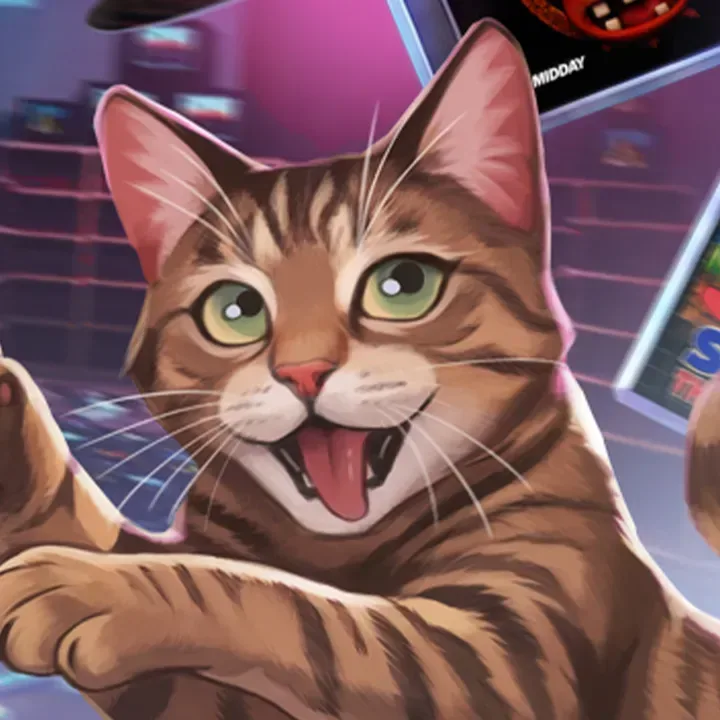
My Cat Scattered Games: Tidy Videogame Supermarket is headed to PC on October 9, offering a very specific kind of cozy task: restoring order to an enormous videogame collection after a mischievous cat has scattered it throughout a supermarket-like store. Developed by ODIUS and published by Loopr Partners, the game turns cataloging, shelving, and spotting gaming references into its core loop, with more than 6,000 games and consoles to organize.
The premise is straightforward in the best possible way. Players arrive to find physical games, cartridges, discs, hardware, and assorted gaming items thrown across the store. The culprit is the player character's cat, which has created the mess and then somehow ended up trapped inside a claw machine. Cleaning up the collection is therefore both the main activity and the route toward rescuing the feline responsible for the chaos.
Rather than positioning this as a pressure-heavy management game, My Cat Scattered Games is designed around a calm, self-directed pace. There are no stated failure states and no way to lose. The objective is simply to work through the disorder, identify where each item belongs, decide how to arrange it, and watch the store gradually become presentable again.
A game about putting games back where they belong
The central interaction revolves around picking up an item, recognizing its platform, locating the appropriate section, and returning it to a shelf. That process may sound modest, but the scale is what gives the concept its appeal. The store is packed with thousands of objects spanning discs, cartridges, consoles, and other collectibles, so even a simple sorting job can become a long-form organizational project.
For useful background on this topic, read Main Sequence Steam Playtest Opens a Free Window Into Its Space Factory Sandbox.
Each shelf can contain as many as three different games, with room for ten copies of an individual title. That rule gives players flexibility in how they choose to build out their collection displays. Some may prefer to keep a platform's biggest titles together, while others may want to focus on neat rows, matching covers, genre-inspired groupings, or their own personal logic. The game's system appears to leave room for players to make the store feel orderly on their own terms instead of enforcing only one rigid arrangement.
As progress is made, players will unlock ways to sort and organize more quickly. The announced details do not specify every upgrade or tool, but the progression is intended to make handling the huge inventory more efficient over time. Importantly, that added efficiency is not described as a response to punishing timers or performance grades. It is part of the game's relaxed loop: restore the collection, improve the process, and continue at whatever speed feels comfortable.
More than 6,000 affectionate parodies
The store's collection is not built around officially licensed games or hardware. Instead, it uses deliberately altered, playful counterparts to familiar names from videogame history. Among the examples revealed are Lovable Kombat, Mega Bavario 64, and Red Spirit 2. Hardware references include the Kekstation 2 and Y-box.
For another perspective on this story, read My Cat Scattered Games Turns 6,000 Fake Classics and One Naughty Cat Into a PC Sorting Sim.
These names establish the tone of the project: it is a game made for people who enjoy recognizing the shape of gaming culture, its box-art traditions, and the eras associated with different formats. As the shelves are restored, players can encounter parody covers, jokes, and references inspired by a range of videogame generations. The task is not merely putting generic objects into matching slots. Part of the reward comes from examining the collection and noticing the references packed into it.
That focus on fictionalized covers also gives the game an identity beyond a standard cleaning simulator. Physical game collections have their own visual language, from cartridge labels and DVD-style cases to distinctive console shapes and shelf layouts. My Cat Scattered Games takes that language and uses it as material for a large-scale organizational puzzle, while keeping the items safely within its own comedic universe.
For players who have spent time alphabetizing shelves, separating systems, arranging boxed games by spine color, or periodically reorganizing a personal backlog, the idea may be immediately understandable. The pleasure is in the small act of transforming clutter into something readable and intentional. A huge collection can be overwhelming when it is spread across a floor, but satisfying once every object has a home.
Cozy design without a fail state
The lack of a lose condition is a notable part of the announcement. Sorting games naturally invites perfectionist play, especially when a player has access to an enormous number of items and several possible shelving strategies. By removing the threat of failure, ODIUS is framing that tendency as something to enjoy rather than something to be tested on.
Players can take time with individual items, compare them against the store's sections, rethink a layout, or simply move slowly through the collection. The game is described as entirely cozy and intended to be played at the player's own pace. That approach puts it closer to the soothing appeal of tidying and collection-building than to the escalating demands of a traditional retail simulation.
There is also a clear sense of completion built into the premise. The scattered inventory creates a visible before-and-after transformation: at the start, the shop is defined by clutter; later, it becomes a curated display shaped by the player's decisions. The trapped cat gives that restoration an additional goal, though the available details have not explained exactly when or how the claw-machine rescue occurs.
That combination of a gentle task and a light narrative hook could make the game suited to short sessions as well as longer organizational marathons. A player may choose to clean a small area, shelve a particular category, or spend an extended stretch getting a larger section into order. Since there is no announced penalty for taking time, the rhythm can remain personal.
A supermarket full of gaming history jokes
The title's "videogame supermarket" setting allows the game to treat physical media as the centerpiece of an unusually large retail space. It is not just a living-room shelf with a few dozen cases to straighten. It is a sprawling collection where the number of items turns familiarity with game platforms and packaging into a practical sorting skill.
The references are likely to be part of the experience for players with memories of different console generations, but the structure does not require an encyclopedic knowledge of real-world releases. The essential task is still understandable: determine what an item is, find the correct area, and put it away. The parody names and covers add flavor while the shelf rules provide the actual organizational framework.
The approach also sidesteps the usual fantasy of running a game store. There is no announced buying, selling, bargaining, staffing, or business-management component. The emphasis is squarely on the collection itself and on the tactile-looking process of returning it to order. The store is a setting for a sorting game, not a stated economic simulation.
That distinction matters because it helps clarify what players should expect. My Cat Scattered Games is not presenting clutter as an obstacle to rush through before the "real" game begins. The clutter is the game. Every cartridge, case, console, and shelf contributes to the main task, while references to gaming history provide a reason to linger over the details.
PC release set for October 9
My Cat Scattered Games: Tidy Videogame Supermarket will launch for PC on October 9. A Steam wishlist page is available for players who want to keep track of the release. No additional platform versions, pricing information, or console release plans have been announced in the currently available details.
With its giant fictional game library, deliberately silly platform names, and a cat that must eventually be rescued from a claw machine, the project has a deliberately narrow but appealing pitch. It is for players who find satisfaction in putting things in the right place, and especially for those who enjoy the personality of boxed games and old hardware.
In an era when many games ask players to react quickly, optimize every second, or overcome increasingly demanding challenges, the prospect of calmly sorting thousands of imaginary classics offers a different kind of reward. My Cat Scattered Games is built around recognizing the mess, choosing an order, and making a space feel right again--one shelf at a time.
Community
Discussion
Start the conversation.
No comments have been posted yet.