

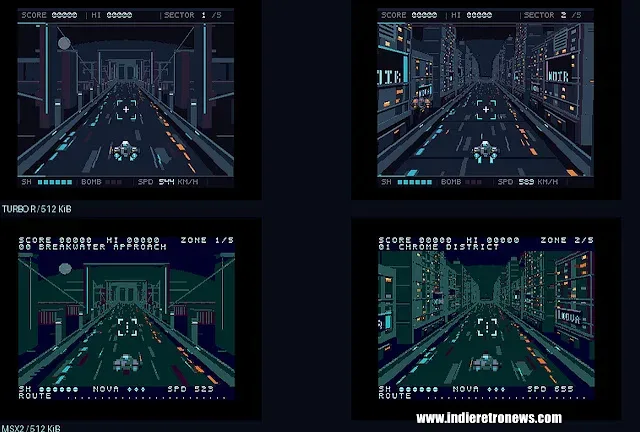
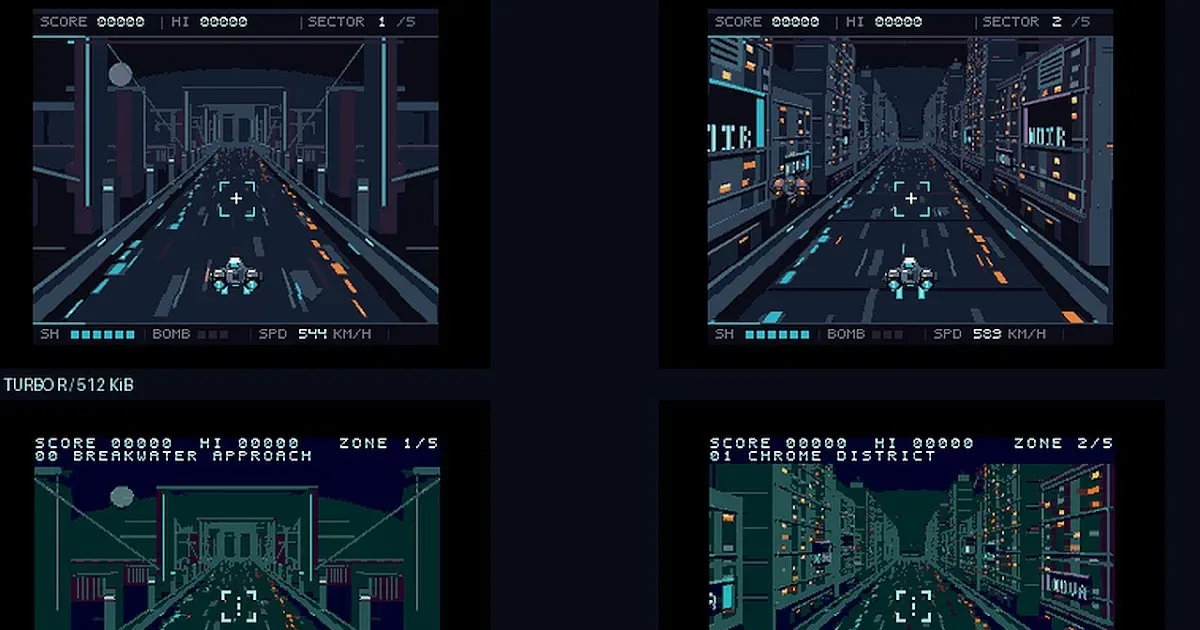
Neon Revenant is an in-development pseudo-3D rail shooter designed natively for the MSX family of computers, and its early prototype is aiming at a notably broad stretch of that hardware line. Created by Kanon-AI, the project is an experimental action game built around speed, perspective effects and system-specific optimization rather than a single universal configuration.
The prototype has been prepared in four separate 512 KiB ROM editions, each intended for a different level of MSX capability. The range covers enhanced V9990 hardware and MSX Turbo R systems, while also extending down through standard MSX2 machines and the much more limited MSX1. That approach makes Neon Revenant less like a straightforward port across compatible systems and more like a set of tailored technical targets built around the strengths and restrictions of each machine class.
At this stage, the game is available as an AS IS prototype. It is a proof-of-concept release rather than a finished commercial product, and players should expect that status to matter: the current build is primarily verified through emulation, even though earlier versions received testing on real MSX hardware. No final release timing, price, or broader distribution plan has been specified.
A rail shooter built around the MSX spectrum
Rail shooters are a natural format for developers chasing the visual impression of rapid forward movement on older hardware. Rather than giving players free movement through a fully simulated three-dimensional environment, the genre moves the player along a predetermined route. The technical budget can therefore be focused on enemies, projectiles, scenery shifts, sprite work and the changing perspective that sells the sensation of depth.
For useful background on this topic, read Ocarina of Time remake Clip Offers a Longer Look at Ganondorf.
Neon Revenant takes that basic format into pseudo-3D territory. The phrase is important: it does not imply conventional polygonal 3D rendering. Instead, the game seeks a three-dimensional appearance through techniques suited to the MSX environment. On machines where every unit of memory, processing time and video capability matters, the presentation depends on carefully managing what is drawn and how quickly the game can update.
Kanon-AI is approaching the project with experience from four earlier MSX works made with ASTRA. Neon Revenant is presented as an experiment in taking the lessons from those projects and applying them to a more demanding action concept. The result is a development effort where the game design and the engineering are closely linked. Its campaign structure, visual features and boss encounters are shaped not only by creative intent, but also by the distinct constraints of each version.
Four ROM editions, four hardware targets
The existence of four 512 KiB ROM editions is one of the prototype's most striking details. MSX is often discussed as a single platform, but the hardware family encompasses multiple generations and expansions with major differences in performance and graphical capability. Neon Revenant explicitly accounts for that spread.
The advanced editions target V9990-equipped systems and MSX Turbo R hardware. The V9990 is a more capable video processor associated with enhanced MSX configurations, making it an appealing destination for a game pursuing fast pseudo-3D action. The Turbo R line, meanwhile, represents the upper end of the official MSX family. These versions have a three-zone campaign.
Below those configurations are editions intended for regular MSX2 systems and original MSX1 machines. The MSX2 and MSX1 builds use standard PSG audio and do not require an FM sound expansion. That decision is significant for accessibility within the retro hardware community. It means the game's baseline sound implementation is designed around the equipment already present in the intended machines, rather than treating an added audio module as a necessity.
The MSX1 edition is especially ambitious because it is designed around tight memory allocations as low as 32 KiB. It also does not simply receive a reduced set of content. Instead, the MSX1 build is described as having an expanded five-zone campaign. That is an unusual and appealing inversion of the usual expectation that the least capable edition of a game must be the smallest one.
The MSX1 version has its own major finale
The expanded MSX1 campaign culminates in a substantial multi-stage battleship confrontation. This PCG battleship boss is said to include articulating hull sections, cannon barrels that recoil when firing, and a pulsing core that can only be reached after its destructible armour has been dealt with.
That encounter gives the prototype a useful illustration of its priorities. A large boss is not merely a static obstacle with a damage counter. The described design calls for multiple moving elements and a layered vulnerability system, turning the fight into a sequence of visual and mechanical changes. On MSX1 hardware, where memory and display resources are sharply limited, creating the impression of a giant machine with separate animated components is an exacting task.
PCG, or programmable character graphics, is well suited to this kind of retro development strategy. It allows developers to define and alter character patterns, using them in ways that can produce sizeable and detailed playfield objects while working within the rules of the hardware. For a battleship whose armour can be destroyed and whose exposed core becomes the critical target, that flexibility is particularly valuable. The boss concept also fits the rail shooter format well, as its parts can dominate the screen and guide the player's attention through an escalating finale.
Performance is the central challenge
Neon Revenant's development emphasis is not simply on putting impressive scenes on an MSX display. It is on sustaining action while doing so. Kanon-AI has relied on detailed technical optimization and framework restrictions to keep the different editions responsive across widely varying hardware limits.
Testing in openMSX indicates that the V9990 version can reach roughly 30 updates per second. For a fast-moving pseudo-3D shooter on vintage hardware, consistent update speed is crucial. The feeling of a rail shooter is tied to motion: enemy approaches, incoming fire, scenery movement and the player's ability to react all benefit from an update loop that remains stable when the screen becomes busy.
The MSX1 version has also passed 400 validation checks across both NTSC and PAL configurations in emulation. That broad validation focus matters because retro software often has to account for regional timing differences that can affect far more than display output. Game speed, music playback, input handling and synchronization can all be altered when a title is bound to the video frame rate.
Neon Revenant is frame-bound, which means PAL players should expect the game and its music to run slightly slower than they do in NTSC configurations. This is not presented as a separate optional mode or a flaw unique to the prototype; it is a direct consequence of tying the game's timing to the machine's frame rate. PAL displays refresh at a lower rate than NTSC displays, so a frame-driven program will naturally advance more slowly unless it has specific compensation built in.
Prototype status remains important
There is clear enthusiasm behind the project's technical scope, but its current status should remain front and center. Neon Revenant is a prototype release supplied on an AS IS basis. The latest build has chiefly been checked in emulation, with openMSX serving as a key test environment. Earlier iterations were tested on physical hardware, but that does not amount to a guarantee that the present prototype has received the same real-machine verification across every intended configuration.
For players who use original MSX computers, flash cartridges, bespoke expansions or period-specific display setups, that distinction is worth noting. Emulation is an essential development and validation tool, particularly for a project spanning several generations of hardware, but real systems can introduce practical variables that are not always apparent in a software environment. The project is therefore best viewed as a promising technical demonstration in active development rather than a finalized compatibility claim.
Still, the prototype's ambition is easy to see. Supporting V9990, Turbo R, MSX2 and MSX1 configurations through distinct ROM editions is already a demanding undertaking. Pairing that with pseudo-3D rail shooting, PSG-based audio on the lower-end versions, regional validation, and a bespoke MSX1 campaign with a multi-stage mechanical boss gives Neon Revenant a much broader goal than a simple nostalgic experiment.
Its eventual importance will depend on how the prototype develops, particularly as further real-hardware testing takes place. But even in its current form, Neon Revenant offers a compelling look at what modern homebrew development can attempt on the MSX family: not merely recreating familiar 8-bit ideas, but designing around each machine's limits in ways that make those limits part of the game's identity.
Community
Discussion
Start the conversation.
No comments have been posted yet.