

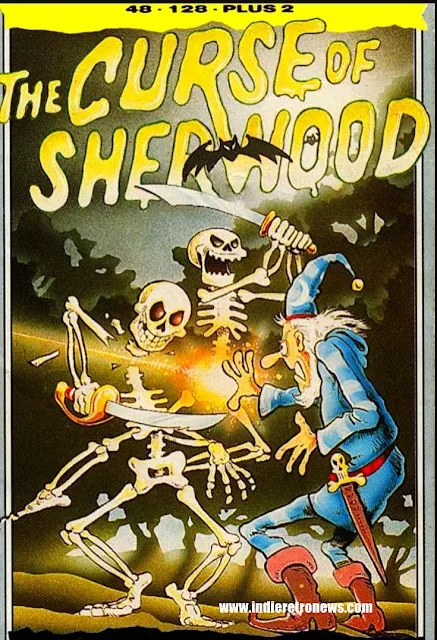
The Curse of Sherwood, a 1987 arcade adventure originally released for the ZX Spectrum, Commodore 64, and Amstrad CPC, has been remade for PC by Sunteam. The new version returns players to a darkly altered Sherwood Forest, where Friar Tuck must uncover the means to overthrow the Cult of Sagalia after Robin Hood and his Merry Men have been defeated.
The project is a modern PC revival of the game created by Derek Brewster and originally published by Mastertronic. While the original appeared across several major home-computer formats of the 8-bit era, Sunteam's remake is said to take especially heavy inspiration from the ZX Spectrum edition. That choice is significant: it points to a remake concerned with retaining the specific look, rhythm, and structure of the Spectrum game rather than transforming the material into an entirely different modern action title.
A desperate mission in a corrupted Sherwood
The premise begins with Sherwood Forest under the brutal control of the sinister Cult of Sagalia. Robin Hood's band has already attempted to resist, only to suffer a crushing loss. In response, Friar Tuck turns to the Bishop of Derby, hoping a great exorcism can rid the forest of the cult's influence and restore order.
That plan collapses when the Bishop is found dead. What remains is a bloodied parchment carrying a cryptic rhyme. The message is not merely a clue to the crime: it contains the secret needed to destroy the cult for good. Friar Tuck becomes the central playable hero, setting out through the dangerous forest to find the artifacts required for the sacred task.
For useful background on this topic, read Battlefield 6 Platoons Delayed to 2027 as Season 5 Plans Change.
It is an unusually ominous take on the familiar Robin Hood setting. Sherwood is often depicted as a place of rebellion, fellowship, and swashbuckling adventure, but The Curse of Sherwood leans into occult danger and religious imagery. The pressure is immediate, too. The legendary outlaw has already fallen, and the player is not arriving as an unstoppable champion. Friar Tuck is undertaking a recovery mission in territory controlled by enemies.
Flick-screen exploration with a strict three-item limit
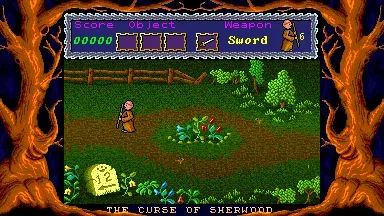
Sunteam's version retains the adventure's flick-screen structure, with the action presented from an elevated side-on viewpoint. Players move through a connected forest layout, progressing from screen to screen as they hunt for useful objects and work out how the different parts of the world fit together.
The major complication is inventory capacity. Friar Tuck can carry only three items at once. In a game built around locating artifacts and deciding where they need to be used, that restriction turns every discovery into a decision. Picking something up may mean leaving behind another object. Carrying an item for a possible later use may occupy a slot needed for an immediate problem. Returning to a previous area may be necessary simply because the player cannot transport everything in one trip.
That kind of limitation is fundamental to the game's retro-adventure identity. Rather than treating objects as an unlimited list in a menu, The Curse of Sherwood makes physical carrying capacity part of the puzzle design. Progress depends on observation, memory, route planning, and a willingness to reconsider earlier choices.
- Explore: Search the forest's separate flick-screen locations for routes, objects, and clues.
- Manage inventory: Choose which three items Friar Tuck should carry at any given time.
- Interpret the mystery: Use the Bishop's final clue and the artifacts found throughout Sherwood to work toward the cult's defeat.
- Survive hostile encounters: Avoid enemies and their attacks while travelling between objectives.
For players accustomed to contemporary games that mark every destination and allow huge inventories, this structure may feel deliberately uncompromising. But that friction is also where much of the appeal lies. The limited carrying system gives even small items weight, while the flick-screen layout encourages players to build a mental map of the forest instead of relying on automatic guidance.
Friar Tuck can fight back, but mistakes are costly
Sherwood's paths are not safe puzzle corridors. Hostile creatures populate the forest and will fire projectiles when given the opportunity. Contact with an enemy or one of its weapons costs Friar Tuck one of his three lives, making movement and timing as important as the adventure's item puzzles.
Friar Tuck is able to retaliate by throwing swords. As the journey continues, his equipment can be upgraded to stronger weaponry. That progression gives the game an arcade-action edge alongside its exploration and inventory problems: a player is not only figuring out what to take and where to go, but also trying to safely reach the next screen with limited lives.
The three-life setup reinforces the stakes of the original design. There is no suggestion of a relaxed sightseeing tour through a nostalgic medieval forest. Enemy placement, projectile avoidance, and cautious traversal are part of the overall challenge. A wrong decision can be inconvenient when it involves an inventory item; it can be much more serious when an enemy removes one of the few remaining chances to continue.
A PC remake rooted in 8-bit design
Remakes of old computer games can take many forms. Some preserve almost every limitation and quirk of the original, while others use a familiar name as a foundation for a broad reinvention. Based on the described design, Sunteam's The Curse of Sherwood is closely connected to its 8-bit source: its viewpoint, screen-by-screen exploration, object-based progression, and constrained resources all reflect an older style of home-computer adventure.
The original game's format history also makes the Spectrum focus notable. The ZX Spectrum, Commodore 64, and Amstrad CPC each had distinctive visual and audio characteristics, even when sharing the same game concept. By drawing particularly from the Spectrum version, the remake places its visual and mechanical identity alongside one specific branch of the original release rather than attempting to blend all versions into a single interpretation.
That approach may appeal both to players who remember the 1987 release and to those interested in games that preserve the logic of the period. Older titles often asked players to experiment without expansive tutorials, make notes, learn through repeated attempts, and accept that carefully managed resources were central to success. In The Curse of Sherwood, the small inventory and three-life threat appear to be core parts of that philosophy, not incidental callbacks.
Music disclosure addresses AI-assisted audio
Sunteam has also addressed the game's soundtrack and described it as AI-assisted. The team said it sourced music from Pixabay without realizing until close to release that the tune used AI. Because the music was already considered a strong fit for the game, it was retained rather than replaced.
The developer added that it intends to be more vigilant in the future and make an effort to source only human-made audio. The disclosure provides useful context for players who pay close attention to how game assets are created, particularly as questions around AI-generated material continue to affect game development and other creative fields.
It is also a reminder that a retro remake can involve both old and new production questions. The Curse of Sherwood is built around a design first seen in the 1980s, complete with flick-screen movement and severe limits on what the protagonist can carry. Yet its PC return arrives at a time when developers and players are increasingly examining asset provenance, disclosure, and the role of AI in creative work.
A return to a challenging cult classic format
The Curse of Sherwood gives a lesser-known 8-bit adventure a new PC life without abandoning the elements that defined it. Its story casts Friar Tuck in a high-stakes fight against a supernatural force; its world demands exploration and route knowledge; and its rules ensure that every item slot and every remaining life matters.
Players looking for a streamlined action game may find its older-school structure demanding. Those looking for a compact retro quest, however, can expect a game built around the kinds of decisions that once defined computer adventures: what to carry, what to leave behind, where to return, when to risk a dangerous route, and how to make a handful of lives last long enough to unravel Sherwood's final secret.
Community
Discussion
Start the conversation.
No comments have been posted yet.