

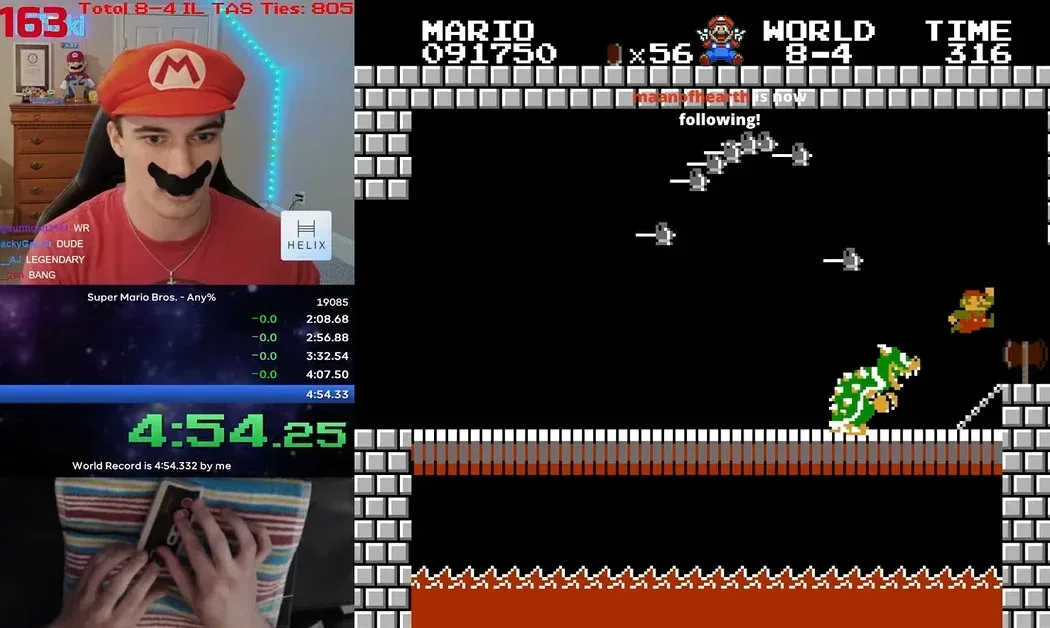
Super Mario Bros. speedrunner Niftski has set another any% world record, finishing Nintendo's 1985 classic in 4:54.299 during a Halloween stream. The new mark cuts 0.33 seconds from his previous record and puts one of gaming's most studied speedrunning categories tantalizingly close to its theoretical limit. It was also achieved under circumstances that could hardly have been more fitting: Niftski was dressed as Mario, sporting a mustache prop and increasingly committing to a Mario-style voice as the stream went on.
The performance is especially notable because of how little time remains to be found. Niftski's 4:54.299 is just two frames away from the category's so-called perfect time, a benchmark that represents the fastest known outcome possible under the run's established techniques and timing conditions. In a game where individual inputs, enemy positions and tiny movement optimizations have been examined for decades, a third of a second is a massive improvement.
For viewers, the record-setting attempt had the energy of a holiday stunt that suddenly became history. Niftski began the Halloween broadcast expecting a fun themed session rather than an immediate breakthrough. Before the run that would take the record, he even joked that getting the time that day would be absurd. Then he cleared World 8, defeated King Koopa, rescued the Princess, and stopped the timer at a number that moved the entire category forward once again.
Embedded X/Twitter post
A Record Run at 4:54.299
Niftski previously held the any% record with a 4:54.332 run set in August. His Halloween result reduces that time to 4:54.299, a difference of 0.033 seconds. On paper, that can look almost impossibly small. In Super Mario Bros. speedrunning, however, the margins have long since become microscopic. The game's top runners are no longer discovering broad minutes-saving routes through its eight worlds. They are competing over frames, execution consistency and whether every section is handled with nearly ideal precision.
For useful background on this topic, read Petit Planet Is Headed to Nintendo Switch 2 in 2027.
Any% is the category most associated with the famous sub-five-minute barrier, and it remains one of the most intense disciplines in classic-game speedrunning. The objective is to reach the ending as quickly as possible using the rules and strategies allowed by the category. It demands exceptional control through the game's familiar stages, but familiarity does not make it easy. The most efficient routes rely on difficult jumps, precise movement, favorable conditions and the ability to maintain composure throughout a run that can be lost in an instant.
Niftski said the two frames separating his new time from perfection were lost near the beginning of the game. That detail illustrates the extraordinary level now required at the top. A run can include world-class execution across nearly five minutes of play and still leave a measurable opening because of a brief early stretch. At this level, there is no harmless mistake and almost no room for a slower line through a stage.
The new record also reinforces Niftski's place at the center of the Super Mario Bros. leaderboard. At 22 years old, he has accumulated records across several major categories for Nintendo's original side-scrolling Mario adventure. Alongside any%, he is listed atop warpless and glitchless categories, each of which tests a different interpretation of mastering the game. That breadth matters: it demonstrates skill beyond one optimized route, spanning categories with their own demands, restrictions and strategies.
Why a Costume May Have Helped
The stream's most memorable element was not simply the time on the clock, but the performance surrounding it. Niftski had dressed as Mario for Halloween and tried to keep the character alive during the broadcast, including the recognizable mustache and an exaggerated voice. After sealing the record, he celebrated while still in character, seemingly astonished that the themed stream had become a milestone attempt.
Keeping the mustache attached was apparently part of the challenge. Niftski joked at one point that viewers could blame his mother for buying the facial-hair accessory. As the stream continued, though, the costume stopped looking like a mere distraction. He suggested that the whole routine may have taken pressure off the moment rather than adding to it.
By his own description, speaking in character made him feel unusually relaxed. The silliness of the bit reduced the nerves that can build around world-record attempts, making the run feel casual rather than overwhelming. That is a striking contrast for a category in which the difference between the best-ever performance and an almost-best performance is now measured in frames.
Speedrunning is often presented as a purely technical pursuit: practice the route, learn the inputs, understand the game's systems and repeat until execution aligns with opportunity. Those elements remain essential, especially in a mature category such as Super Mario Bros. any%. But mentality is equally important. A runner can possess the required skill and still struggle with the tension of a record pace. The Halloween costume may not have made Mario move faster, but it may have helped Niftski approach an extraordinarily high-pressure situation with less fear of making a mistake.
Super Mario Bros. Is Near Its Human Limit
Released in 1985, Super Mario Bros. remains one of the defining games in speedrunning culture. Its place is not sustained simply by nostalgia. The game is immediately recognizable, easy to understand from a spectator's perspective and brutally difficult to optimize. Someone watching for the first time can grasp the basic goal in seconds: Mario must get from the left side of each stage to the flagpole or castle as fast as possible. The depth only becomes visible once the viewer sees the speed, routing and precision needed to do that at a world-record level.
Over many years, runners have inspected the game's mechanics and uncovered every meaningful advantage they can find. Glitches, exploits, movement options and level-specific techniques have been thoroughly explored. That accumulated knowledge has transformed the category from one driven by obvious route discoveries into one defined by execution at the edge of what humans can reliably produce.
The sub-five-minute milestone, now the standard by which the category is widely recognized, was not crossed until around 2010. Andrew Gardikis helped reignite interest in the scene at that time by establishing a new approach that gave later runners a blueprint to improve upon. Since then, successive generations of players have refined the route and pushed the record ever closer to the game's apparent ceiling.
That history gives Niftski's latest result added weight. A 4:54.299 time is not just another small reduction in a long list of records. It is the product of more than a decade of refinement after the five-minute barrier first fell, plus the work of a competitive community that has repeatedly narrowed what was thought possible. Every remaining fraction of a second is difficult because earlier runners have already removed so much of the available waste.
Two Frames From the Perfect Time
The phrase "perfect run" can be misleading outside speedrunning. It does not mean a player has simply finished without dying or played a run that looks flawless to casual viewers. In this context, it refers to a time at or matching the theoretical optimum currently understood by the community. Niftski's record is two frames away from that target, leaving only three milliseconds between the new world record and the known ideal.
That does not necessarily mean the category is finished. Speedrunning history is full of moments when an apparent limit invited another round of innovation, whether through better consistency, refined execution or a fresh understanding of a mechanic. Yet the closer a game gets to its theoretical time, the more difficult further progress becomes. The remaining gain is no longer a broad opportunity waiting to be discovered; it is a tiny gap that must be approached with extraordinary precision.
For now, Niftski owns that space. His Halloween performance turned an entertaining costume stream into a landmark achievement for one of the medium's most enduring competitive games. Mario's first major platforming adventure has been analyzed for more than 40 years, and its top category is now separated from perfection by only two frames. Fittingly, the runner who brought it that close did it while dressed as the character whose name has defined the game for generations.
Community
Discussion
Start the conversation.
No comments have been posted yet.