

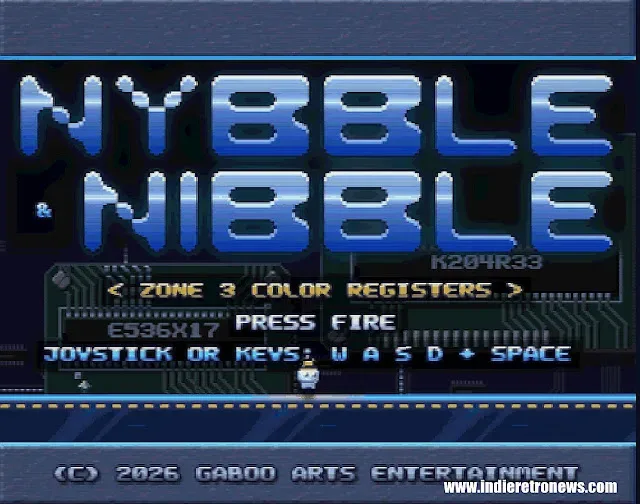
NYBBLE & NIBBLE, a Commodore Amiga adaptation of the original Commodore 64 adventure, is putting a new technical and artistic spin on a compact retro platforming journey. Developed by Gaboo Arts Entertainment, the release keeps the foundation of the C64 game intact: a tiny protagonist, a missing other half, and a 60-room quest built around exacting movement. On Amiga, however, that framework has been rebuilt with richer scenery, reworked presentation, bespoke music, and new sound effects designed around the machine's strengths.
The result is a game aimed squarely at enthusiasts of both classic home-computer gaming and modern indie-style precision platformers. Its premise is simple but fittingly digital. Players control Nybble, a small half-byte character traveling through glowing, fictional circuit-board environments in search of their absent counterpart. The journey unfolds across six zones, each made up of tightly constructed rooms that emphasize rhythm, timing, and understanding how Nybble moves through space.
A C64 Adventure Reimagined for Amiga
Rather than replacing the identity of the Commodore 64 original, NYBBLE & NIBBLE's Amiga edition is built around preserving what made that version work. Its platforming is still rooted in the same core mechanics, including precise wall-jumps and an eight-direction air dash. Those abilities give Nybble considerable control, but they also place an emphasis on deliberate inputs. Players are expected to read the layout of a room, commit to an approach, and use the character's mobility tools accurately.
That design makes the 60-room structure particularly important. The game is not described as a huge open-ended adventure; instead, its scale appears intentionally concentrated. Each room can function as a focused movement problem, with the six distinct areas creating a larger progression through the circuit-board world. This kind of design has long been a natural fit for home-computer action games, where a handful of well-developed mechanics can support a wide range of challenges without requiring sprawling levels.
For useful background on this topic, read Centipede Is Heading to Commodore Amiga in a New Arcade-Focused Port.
For the Amiga port, the major difference is how that journey is presented. The scenery has been enhanced beyond the C64 version, and the environments are intended to feel more alive through color, lighting, and sound. The electronic world is no longer merely a backdrop for the action: its glowing circuit-board setting is a central part of the game's atmosphere.
Movement First: Wall-Jumps and Eight-Way Dashes
NYBBLE & NIBBLE's defining feature is likely its movement system. Wall-jumping creates opportunities for vertical recovery and route planning, while the eight-direction aerial dash opens up horizontal, diagonal, and evasive options. Combining those tools can make even small rooms feel more complex, especially when a player must carry momentum, alter direction in the air, or reach a narrow landing point.
These are mechanics familiar to fans of contemporary indie platformers, but they take on a different character when implemented for original Amiga hardware. The appeal is not simply that an older system can run a platform game. It is that the game is attempting to offer a sense of responsiveness and inventiveness associated with newer releases while retaining the technical discipline of a machine from the late 1980s and early 1990s.
Early player discussion on the English Amiga Board forums has been positive, with players highlighting the game's polish and its modern indie-like feel. That reaction reflects the balance Gaboo Arts Entertainment is pursuing: NYBBLE & NIBBLE is a retro release in platform and presentation context, but its design language is not limited to nostalgia. Precise traversal, compact challenge rooms, and flexible air movement remain immediately recognizable ideas for current players.
Built for a Standard 1MB OCS Amiga
One of the most notable elements of the release is its modest hardware target. NYBBLE & NIBBLE is designed to run with just 1MB of RAM on a standard OCS Amiga configuration. That means it can run on an Amiga 500 with 512KB of Chip RAM paired with a 512KB expansion. It is also compatible with an Amiga 1200 equipped with 2MB of Chip RAM.
This matters because the game's screenshots and described visual effects suggest an experience that aims well beyond the plainest expectations people may have for a baseline Amiga setup. The port uses Copper-based PCHG techniques alongside standard HAM6 graphics and hardware sprites. In practical terms, these choices are used to place many colors on screen at the same time while also supporting more advanced lighting effects.
The Amiga's Copper coprocessor was famously useful for display tricks, allowing software to alter visual settings as the screen was drawn. PCHG, meanwhile, is associated with palette manipulation techniques that can create much richer color displays under the right conditions. HAM6 is another familiar Amiga display mode, capable of producing a broad range of colors by modifying color components across pixels, though it comes with constraints developers need to work around carefully. Hardware sprites add another important tool, allowing moving elements to be handled separately from much of the main display.
None of those techniques are automatic solutions. A game has to be planned around memory limits, display behavior, asset construction, performance, and visual clarity. NYBBLE & NIBBLE's technical interest comes from that careful combination of established Amiga capabilities. The game is not presenting itself as a title that needs expanded accelerator hardware or an unusually high-end configuration. Instead, it seeks to make an accessible OCS-class setup deliver a colorful and dynamic platforming experience.
Custom Music and Sound for the New Version
The visual overhaul is accompanied by custom Amiga music and sound effects. For a game built around rhythmic, room-by-room action, audio can do more than fill silence. Music helps define the tone of each zone, while sharp effects can reinforce jump timing, dash direction, impacts, and successful movement sequences. In a fictional electronic setting, the Amiga's audio hardware is also a natural match for the subject matter.
The original C64 adventure provides the gameplay blueprint, but the Amiga version's custom audiovisual work gives it a separate identity. This is not just a straight transfer with the same assets running on different hardware. The intention is to translate the original's mechanics into an Amiga-specific production, using the platform's graphics and sound capabilities to create a fuller version of the circuit-board world.
PAL, NTSC, Emulation, and THEA500 Mini Testing
NYBBLE & NIBBLE supports both PAL and NTSC modes, an important consideration for a game intended for the broader Amiga community. Historical Amiga software could behave differently depending on regional video timing, and action platformers are especially sensitive to timing and display behavior. Supporting both standards broadens the range of systems on which the game can be played as intended.
Testing has been carried out in WinUAE using Amiga 500 and Amiga 1200 configurations, including an NTSC playthrough. The game has also been tested on THEA500 Mini, providing another option for players who want an Amiga-focused hardware experience without setting up an original machine and RAM expansion.
That testing information is especially useful for a release targeting vintage platforms. Retro games can be played in many ways, from original computers to modern recreations and emulation, but compatibility can vary based on configuration. Calling out Amiga 500 and Amiga 1200 setups, PAL and NTSC support, WinUAE testing, and THEA500 Mini testing gives prospective players a clearer picture of the environments considered during development.
A Modern Approach to an Old Machine
Discussion around the project has also touched on AI, but the important distinction is that NYBBLE & NIBBLE is being presented as a crafted game rather than an automated content exercise. Its appeal rests on authored level design, a clearly defined movement model, hand-developed technical choices, and an adaptation tailored to specific Amiga hardware limitations. The visible work is in the details: fitting a colorful game into a 1MB target, developing custom sound and music, and building rooms around a familiar but demanding set of platforming abilities.
That makes NYBBLE & NIBBLE an intriguing release for several overlapping audiences. Commodore 64 players can see how its original adventure has been reinterpreted. Amiga enthusiasts can examine a project built to make practical use of OCS graphics features. And fans of concise precision platformers can look forward to a 60-room challenge driven by wall-jumps, directional air dashes, and repeated mastery of a small, flexible moveset.
In an era when retro hardware releases can range from simple curiosities to ambitious technical showcases, NYBBLE & NIBBLE appears to fall into the latter category. It is grounded in a pre-existing C64 design, but it uses the Amiga port as an opportunity to substantially reshape the audiovisual experience. With its low memory requirement, PAL and NTSC compatibility, and testing across emulation and THEA500 Mini hardware, it is also designed with the realities of today's Amiga-playing community in mind.
Community
Discussion
Start the conversation.
No comments have been posted yet.