

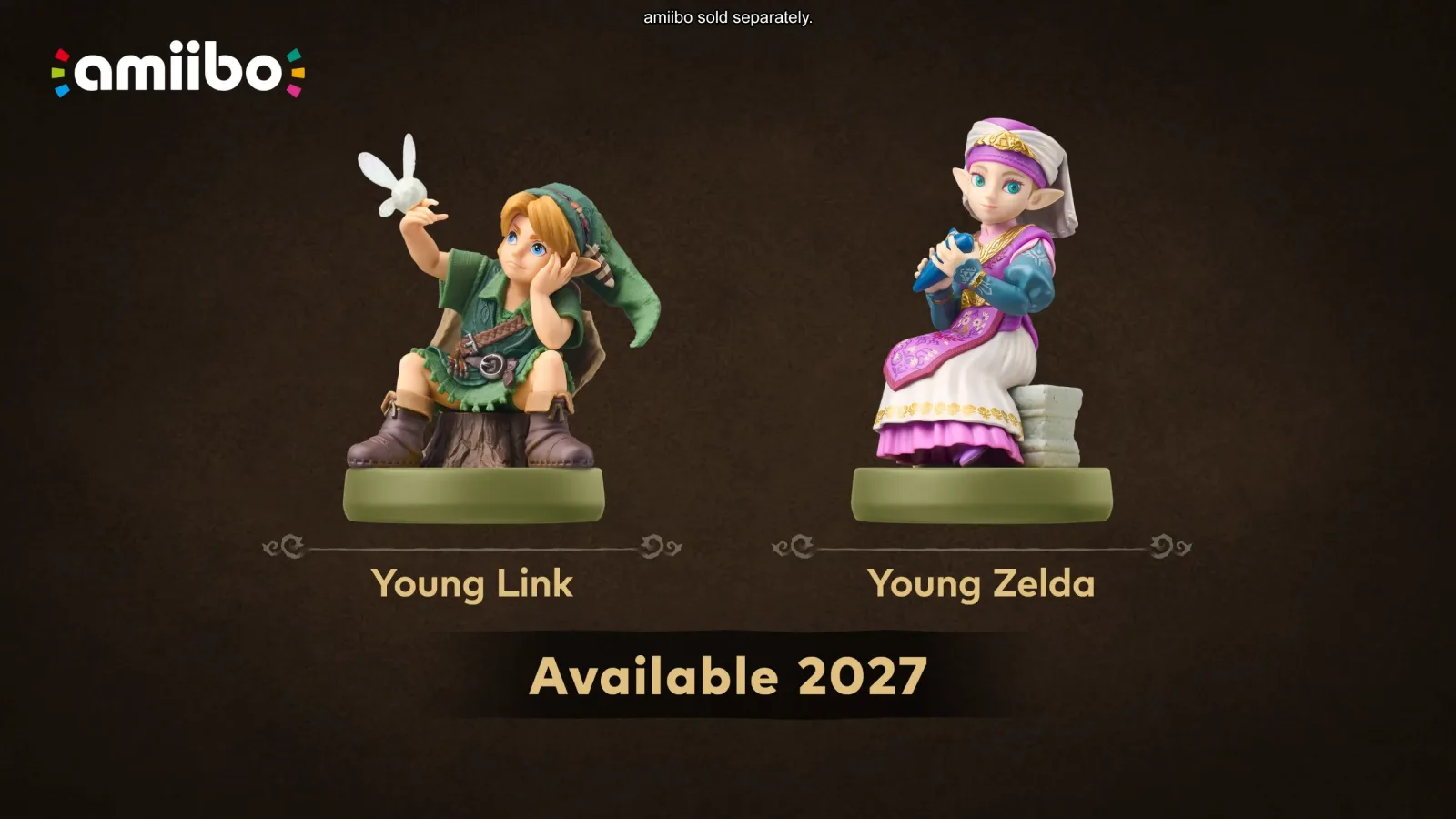
Nintendo's newly revealed Ocarina of Time remake amiibo are a striking tribute to one of the most beloved games in The Legend of Zelda series. The pair depicts Young Link and Young Zelda in scenes that evoke the Nintendo 64 original, and both figures appear to have the elaborate sculpting and display-worthy presentation collectors have come to expect from modern amiibo.
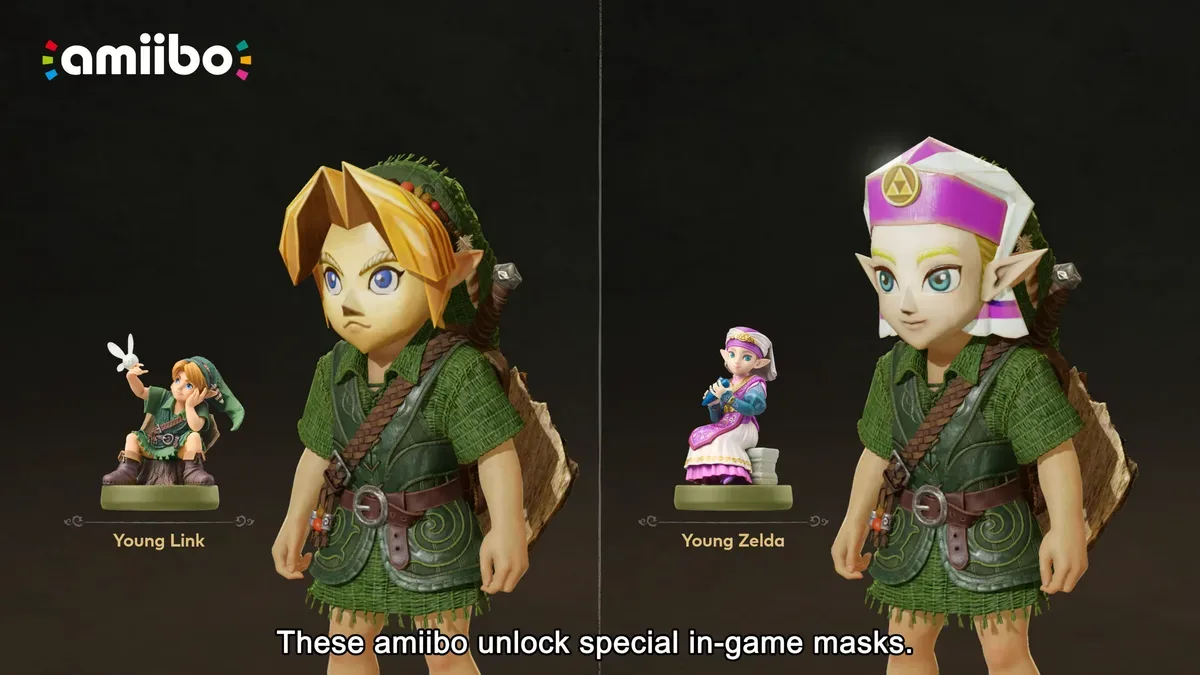
But while the physical figures look like affectionate celebrations of the past, their in-game rewards take nostalgia in a much stranger direction. Scanning the amiibo in the remake will unlock masks based on the original polygonal faces of Link and Zelda. That means players can apparently place the old Nintendo 64-era visages on the remake's far more detailed characters, creating a visual contrast that is equal parts funny, nostalgic, and a little unnerving.
The feature is especially odd in the context of Ocarina of Time. Masks are already an important visual idea in Zelda history, particularly because of Majora's Mask and its famously unsettling transformations. Yet there is something uniquely bizarre about Link wearing a rigid approximation of his own earlier face while exploring a newly rendered Hyrule. Rather than simply offering a retro costume or a low-poly character model, the amiibo rewards seem to isolate the old faces as accessories.
Two amiibo built around iconic Ocarina of Time imagery
The Young Link figure shows the hero sitting on a stump, with Navi perched on his hand. It is a clear callback to classic artwork associated with the original Ocarina of Time, turning a familiar piece of Zelda imagery into a small three-dimensional scene. Link is not shown in the middle of a battle or brandishing an item; instead, the pose gives the figure a calm, reflective quality that fits the sense of adventure and childhood wonder that surrounds his first journey through Hyrule.
For useful background on this topic, read Nintendo Reveals Zelda 40th Anniversary Switch 2 Console and Pro Controller.
Navi's inclusion is particularly notable. The fairy remains one of the game's most recognizable companions, whether players remember her warmly or still hear her famous calls for Link's attention in their minds. Having her balanced on Link's hand gives the amiibo more character than a standard standing pose and helps anchor it specifically to Ocarina of Time rather than Zelda in general.
The Young Zelda amiibo, meanwhile, depicts the princess playing what appears to be the Ocarina of Time itself. The choice is fitting for a character whose role in the story is deeply tied to the instrument, time, destiny, and the hidden identity of Sheik. Zelda collectibles often focus on royal imagery, magical power, or her various combat-ready incarnations. This figure instead appears to emphasize the more intimate and storybook-like side of her Ocarina of Time portrayal.
Together, the two amiibo feel designed as companion pieces. One captures the young hero at rest with his fairy guide, while the other centers Zelda and an object at the heart of the game's story. For fans who played the Nintendo 64 release, the designs carry a strong sense of recognition even before considering their functionality in the remake.
Retro faces become wearable masks
The more unusual part of the announcement is what happens after the figures are scanned. The amiibo unlock masks resembling the original versions of Link and Zelda, preserving the distinctive low-polygon look associated with their Nintendo 64 models. Their simplified geometry and distant expressions were once a necessary result of the hardware's limitations. Decades later, those same features have become instantly recognizable signs of an earlier 3D era.
In a fully remade Ocarina of Time, however, those faces will not be presented as the default look. Instead, they will be worn over the remake character models. The result, as shown during the Nintendo Direct presentation, is intentionally strange: crisp, modern bodies and animation paired with faces that look like they have been pulled directly out of the original game.
The difference in visual fidelity is what makes the masks memorable. A complete retro character skin might have looked like a straightforward throwback. A face mask is more surreal. Link wearing an old Link mask has an almost self-referential quality, while Zelda's equivalent turns a warm nostalgic reference into something closer to an eerie costume.
There does not appear to be an additional gameplay benefit tied to these masks. They seem to be cosmetic extras rather than tools that alter combat, exploration, puzzles, or progression. For players who want a practical advantage, that may make the rewards feel slight. For everyone else, the lack of mechanical importance may be part of the appeal: they are simply bizarre little commemorations of how these characters once looked.
Amiibo nostalgia works best when it embraces the oddities
Amiibo have always occupied an unusual space between collectible figure and game accessory. At their best, they can be attractive objects on their own while also providing an in-game bonus that feels suitably connected to the character or series. The new Ocarina of Time figures appear to follow that model, though the rewards are much more playful than substantial.
That may be an appropriate fit for a remake of a game so closely tied to a particular moment in 3D gaming history. Ocarina of Time is often remembered for its world design, dungeon structure, music, and groundbreaking targeting system, but its original character models are also part of its identity. Their angular facial features, stiff expressions, and compact proportions are artifacts of a period when developers were still defining what a fully 3D adventure could look like.
Modern remakes frequently smooth over those quirks in pursuit of detail and realism. The masks do the opposite. They preserve the awkwardness rather than hiding it, then deliberately place it in a much more advanced visual setting. It is a form of fan service that does not just say, "Remember this game?" It says, "Remember exactly how strange some of this game looked?"
For some longtime players, that will likely be the joke. The old models may not be conventionally pretty beside the remake's refined art direction, but they carry emotional weight. The mask unlocks transform technical limitations into costume pieces, allowing players to use a very specific type of nostalgia as part of their own playthrough.
More Zelda merchandise is on the way
The amiibo were not the only Legend of Zelda merchandise shown alongside the remake. Nintendo also revealed a new Lego set featuring Link and Epona, expanding the series' presence in brick form. Link and his horse are among the most enduring images in the franchise, and their addition to the Lego line gives collectors another way to display a version of Hyrule outside of a game screen.
Also shown were an electronic Master Sword and a playable ocarina. The Master Sword is perhaps the most obvious physical symbol of the Zelda series, but an electronic version suggests a product built around the weapon's audiovisual identity rather than a purely decorative replica. The playable ocarina, on the other hand, directly connects to the musical centerpiece of Ocarina of Time.
These products make the remake feel like more than a standalone game release. The surrounding merchandise is positioned to celebrate the broader cultural memory of Ocarina of Time: its hero, princess, horse, sacred sword, fairy companion, and musical instrument. The new amiibo may be the most interactive pieces in that collection because they bridge a shelf display and an in-game cosmetic reward, but the wider lineup clearly targets fans who want to bring some part of Zelda into the physical world.
Collectors get the polished tribute; players get the weird bonus
The best argument for these amiibo may ultimately be the figures themselves. Young Link's stump scene and Young Zelda's ocarina pose both sound carefully chosen, specific to the Nintendo 64 classic, and more expressive than a basic character statue. Even for people with no interest in scanning them, the pair should function as compact display pieces that represent a pivotal Zelda adventure.
The masks are the more divisive part. Some players will see them as an amusing novelty and a faithful nod to early 3D character design. Others may find the old expressions unsettling when attached to high-detail remake models. Both reactions are understandable, and Nintendo seems to be leaning into that tension rather than avoiding it.
There is a charming confidence in making the reward so unapologetically peculiar. The original Link and Zelda faces are not being presented as timeless ideals of character art. They are being remembered as they were: iconic, angular, unmistakable, and slightly haunted by the technological era that created them.
For an Ocarina of Time remake, that is an unexpectedly fitting approach. The adventure has endured because its core remains powerful, but its original presentation is inseparable from the memories many fans have of discovering Hyrule in 3D for the first time. These amiibo honor both sides of that legacy--the beautiful storybook imagery people cherish and the charmingly awkward polygons they will never quite forget.
Community
Discussion
Start the conversation.
No comments have been posted yet.