

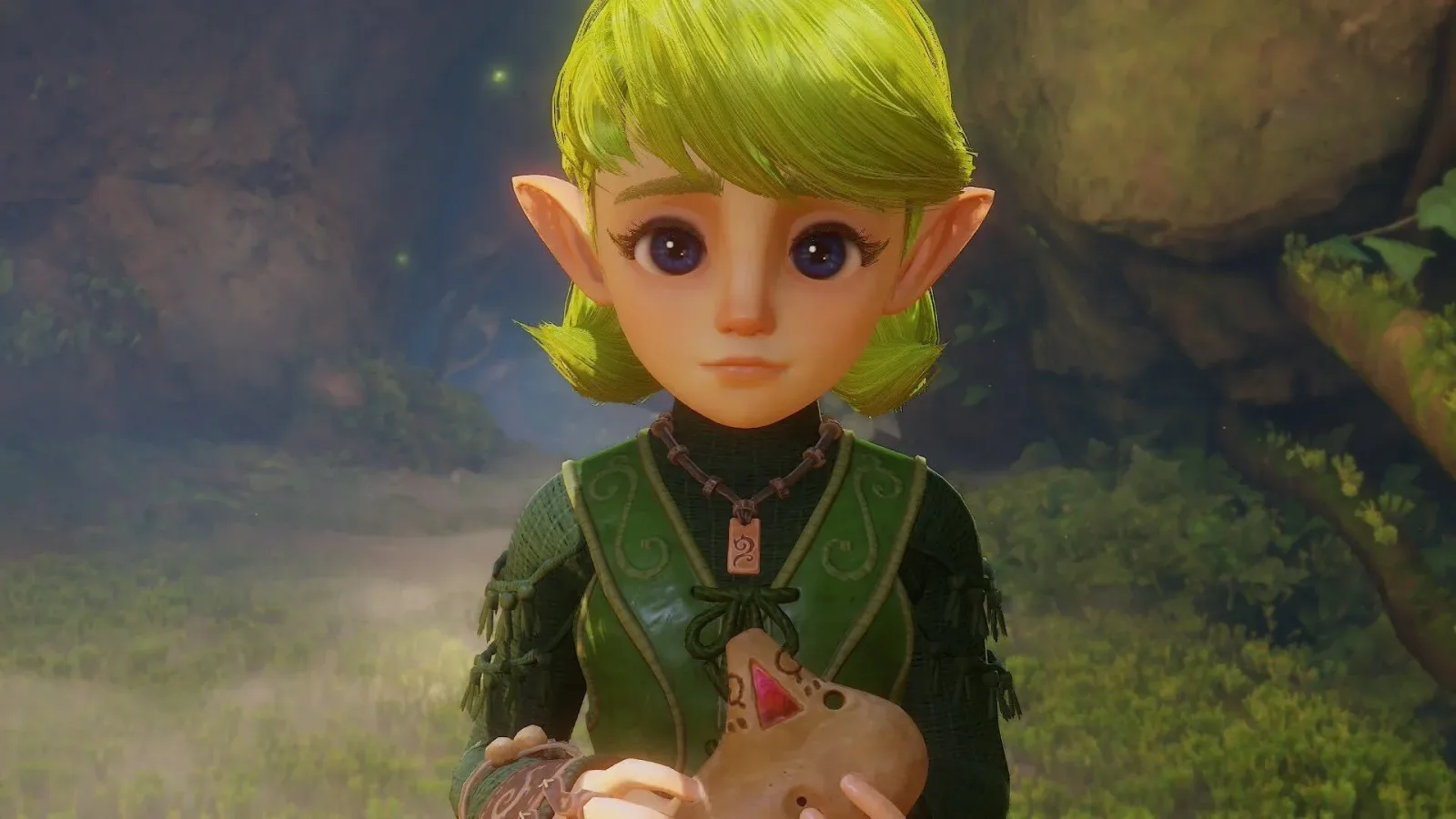
The Legend of Zelda: Ocarina of Time has always made music part of its adventure. Link's ocarina is not merely a themed item or a collectible novelty: it is a tool for opening paths, changing the world, calling help, and moving across Hyrule. The Switch 2 remake adds a new way to use that instrument, allowing players to hum or sing melodies into the system's built-in microphone rather than entering every note manually.
It is the kind of feature that sounds like a small modern convenience at first. If a player remembers a tune but not its precise button sequence, singing it may be enough for the game to recognize the intended song and have Link perform it. But early experiments suggest that the system is much more entertaining than a straightforward accessibility option. Players have been testing what the recognition feature will accept, and the answers include shouted melodies, real instruments, audio playing from another screen, and even interpretations that only loosely resemble the music Hyrule is expecting.
The result is a fittingly strange extension of one of gaming's most recognizable mechanics. Ocarina of Time's musical puzzles have endured for decades because the songs are concise, memorable, and tied directly to the player's relationship with the world. The microphone function preserves that idea while making the act of playing them feel less like entering a code and more like actually performing--or attempting to perform--a tune.
Embedded X/Twitter post
Embedded X/Twitter post
Embedded X/Twitter post
A New Way to Play Hyrule's Essential Songs
Throughout Ocarina of Time, Link learns songs that serve distinct purposes. Some help solve environmental puzzles. Others allow for fast travel to significant locations. One famous melody can summon Epona, Link's dependable horse. In the original structure of the game, players use the ocarina interface and input the relevant sequence of notes to make these effects happen.
For useful background on this topic, read Elder Scrolls 6: Sentinel May Not Become Gaming's Next GTA 6-Scale Event.
The Switch 2 remake's microphone support adds a second route. A player can vocalize a known melody into the console, and the game attempts to match it to one of Link's playable pieces. Once it identifies the song, it performs the tune. For someone who has the melodies lodged in their memory after years of replaying the adventure, this could make for an unusually natural shortcut.
That does not necessarily mean it is the fastest option every time. Veteran players who have committed the button inputs to muscle memory may still find traditional controls more immediate and reliable. Singing into a microphone also comes with practical considerations. Players may not want to vocalize in a quiet room, on public transport, or around people who are not prepared to hear repeated attempts at Epona's Song.
Still, speed is only part of the point. The feature makes room for a different sort of interaction with a classic game. Rather than recalling an abstract button pattern, players can recall the melody itself. That distinction matters for music designed to be hummable. It also makes the ocarina feel a little more like an instrument in Link's hands instead of a menu accessed through specific controller commands.
Players Are Discovering How Forgiving the Recognition Can Be
As people experiment with the microphone option, one clear takeaway has emerged: the sound recognition appears to be flexible. Humming and singing are the most obvious forms of input, but tests have shown that louder and less polished methods can work too. A person can yell a melody into the microphone and still have the game understand what they mean.
That is already amusing in isolation. Ocarina of Time is full of mystical moments built around calm, evocative music. There is an inherent comic contrast in watching a player enthusiastically shout a rough approximation of a sacred Hyrulean melody at a handheld console, only for the game to politely interpret it and let Link play the proper version.
The system's tolerance seems to extend beyond the human voice. Players have found that real instruments can be used as input, opening the door for cleaner performances, stranger arrangements, and highly committed musical experiments. Other tests indicate that the game can react to audio played through another monitor. One example involves an older Vine clip in which a person gives an extremely approximate rendition of something resembling Epona's Song. Even that kind of indirect and imperfect audio can apparently be enough to prompt recognition.
These examples give the feature a playful unpredictability. Its purpose may be to recognize melodies, but it also becomes a small audio challenge: how far can someone distort, relocate, amplify, or reinterpret a song before the game stops understanding? For a series whose songs are so familiar to longtime fans, that question is likely to keep producing inventive results.
When the Game Has to Make Its Best Guess
The most interesting part may be what happens when an input does not sound convincingly like any of the available songs. Rather than requiring a perfect performance in every case, the recognition system can seemingly make an educated guess about what the player was trying to play. That means a loose, uncertain, or off-key attempt may still lead to a result.
There are obvious limits to how useful that can be during a serious puzzle sequence. A game that makes guesses will occasionally guess wrong, and players who need a particular effect may prefer the certainty of manual note inputs. Yet the looseness is also what allows the mechanic to feel inviting rather than intimidating. Not every player sings accurately. Not every player is comfortable performing at all. A forgiving system lowers the barrier while encouraging experimentation.
It also aligns with the enduring appeal of Ocarina of Time's songs. They are not elaborate concert pieces. They are short musical phrases associated with places, people, and powers. Players can recognize them from just a few notes, and the microphone feature appears designed to meet players somewhere in that space between exact reproduction and recognizable memory.
The Original Ocarina Was Already a Creative Playground
Long before microphone recognition entered the picture, the ocarina system had a reputation as a surprisingly flexible toy. Its standard setup gives players a limited set of notes, but dedicated fans discovered ways to push beyond the immediately obvious scale. By moving the analog stick while playing, it is possible to transpose and access notes outside the usual five-note arrangement.
That depth has turned the instrument into a long-running outlet for fan creativity. Players who understand the inputs well enough can use Link's ocarina to attempt all kinds of recognizable music, not just the compositions required by the story. Some performances are genuinely impressive demonstrations of timing and mechanical knowledge. Others embrace absurdity, producing versions of songs that are technically recognizable but wonderfully cursed in context.
The Switch 2 microphone feature does not replace that older style of experimentation. If anything, it gives it a companion. Manual input remains the route for players who want precision and who enjoy the challenge of arranging outside music within the game's tonal limitations. Voice recognition, meanwhile, introduces an accessible and unpredictable way to engage with the same musical vocabulary.
One approach asks, "Can I make Link play this?" The other asks, "Will the game understand what I just did?" Both questions fit Ocarina of Time remarkably well. The game has always invited players to treat music as an active part of exploration rather than background decoration.
A Feature Made for Both Nostalgia and Comedy
For people who first played Ocarina of Time in the 1990s, the melodies can be inseparable from memory. A few notes can evoke a first trip across Hyrule Field, a favorite dungeon, the discovery of a warp point, or the simple satisfaction of calling Epona from a distance. Singing those songs into a new version of the game adds an unexpectedly personal layer to that nostalgia.
At the same time, the feature is built for the internet's instinct to test every system in the least conventional way possible. Once players learn that shouting, external audio, and instrumental performances may be recognized, the natural next step is to see what else works. That will likely mean increasingly odd recordings, deliberately terrible renditions, and creative musical detours that have little to do with efficient play.
There is value in that silliness. Remakes often face the difficult task of revisiting a beloved game without making familiar elements feel overly clinical or merely upgraded. A microphone-driven ocarina is a modern addition, but it is not disconnected from the original's spirit. It takes an already memorable mechanic and lets players interact with it in ways that are sincere, useful, technically curious, and occasionally ridiculous.
For players who know every input by heart, manual controls remain available. For everyone else, or for anyone eager to see whether an enthusiastic yell can summon a horse, Hyrule's music now has a much louder path forward.
Community
Discussion
Start the conversation.
No comments have been posted yet.