

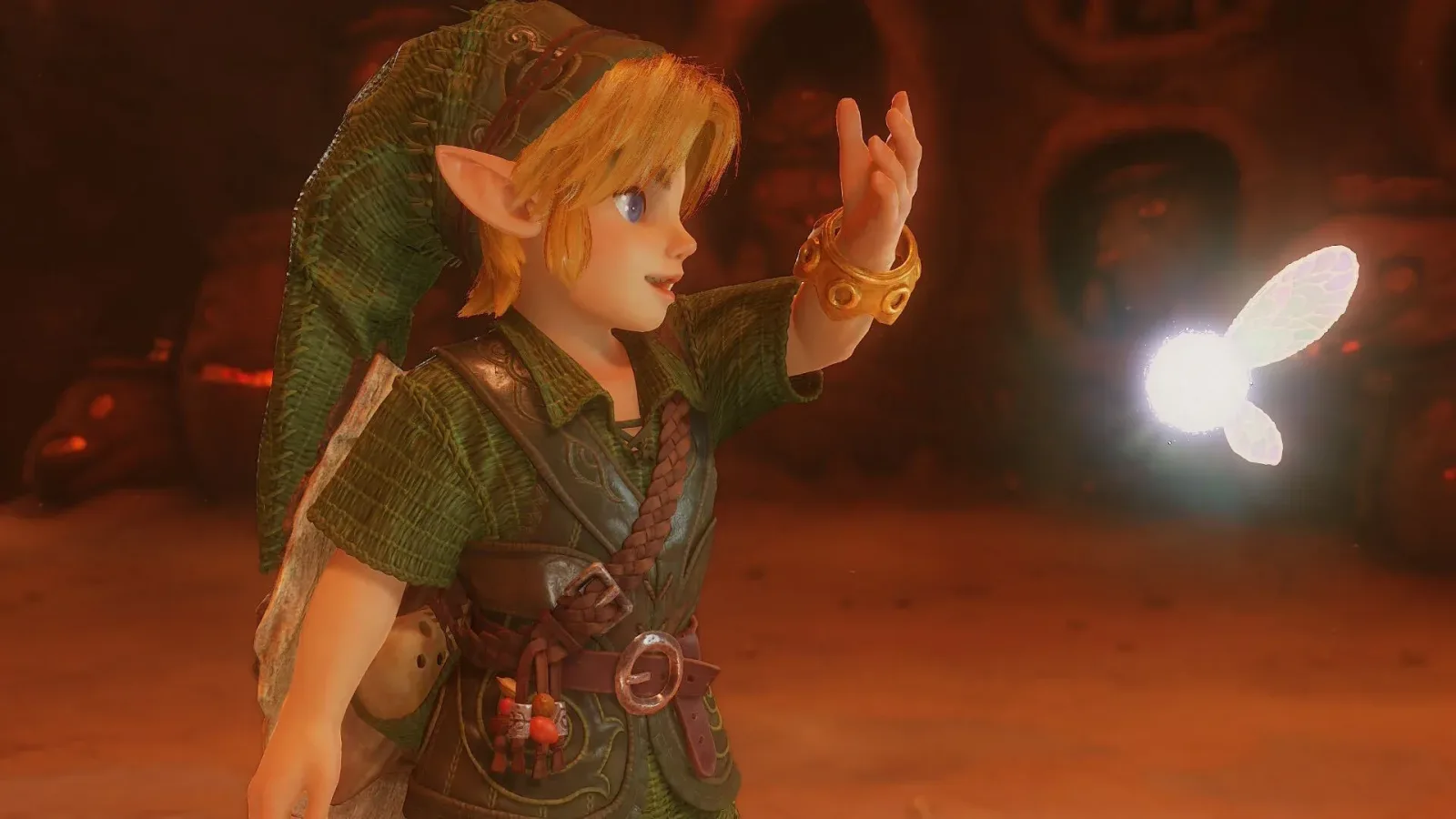
The newly released Switch 2 remake of The Legend of Zelda: Ocarina of Time is naturally drawing attention for its refreshed take on one of Nintendo's most celebrated adventures. But for a growing section of the Zelda community, the journey through Hyrule is also prompting a different question: is Nintendo laying groundwork for a remake of The Legend of Zelda: Majora's Mask?
It is an understandable line of speculation. The two Nintendo 64 games have always been closely linked, both creatively and historically. Majora's Mask followed Ocarina of Time in 2000, arriving only two years after its predecessor and using many of the same underlying assets, character models, and ideas. Nintendo repeated that sequence during the 3DS era as well: an Ocarina of Time remake came first, and a remake of Majora's Mask followed four years later.
That precedent does not confirm anything about Nintendo's current plans. Still, players examining the Switch 2 version have identified a handful of details that feel particularly evocative of Link's later trip to Termina. Some are genuine additions or revisions that could make a future follow-up technically and visually easier. Others, however, are details that have been part of Ocarina of Time all along--and are being reinterpreted now that fans have Majora's Mask on their minds.
Embedded X/Twitter post
Embedded X/Twitter post
Embedded X/Twitter post
The Skull Kid dialogue is not necessarily a tease
The most widely discussed supposed clue involves the Skull Kid found in the Lost Woods. Skull Kid is a crucial figure in Majora's Mask, where one of the creatures becomes the story's central antagonist after obtaining the powerful and dangerous Majora's Mask. Because of that role, any appearance by a Skull Kid in the remake is likely to attract extra scrutiny.
For useful background on this topic, read Snow Panic Brings Eight-Player Skiing Chaos to PC.
In Ocarina of Time, the Lost Woods Skull Kid speaks about feeling as if something is absent from his face and asks whether there might be something capable of relieving that empty feeling. Read without context, the wording can sound like a knowing reference to the mask-obsessed sequel. It is easy to see why players encountering the dialogue again in a major new remake might interpret it as Nintendo winking toward what could come next.
But the line is rooted in Ocarina of Time's own side content. It points players toward the trading and mask-related quest involving the Skull Mask. Link can provide that mask to the Skull Kid, resolving the immediate request. In other words, it is not new dialogue written to establish the plot of Majora's Mask; it is a long-standing part of the original game's quest structure.
That does not make the moment uninteresting. The original relationship between the two games means an Ocarina of Time reference can often carry associations that reach beyond Hyrule, even when it was never intended as sequel setup. Yet it is an important reminder that fan speculation should distinguish between an intentional new hint and a familiar detail that has gained new resonance.
The Happy Mask Salesman is a more intriguing detail
The Happy Mask Salesman offers a somewhat stronger, if still unconfirmed, point of discussion. In Ocarina of Time, he is initially presented as an unusual shopkeeper tied to the mask quest. In Majora's Mask, his role expands significantly. He becomes one of the sequel's most memorable supporting characters, serving as the person who sends Link after the stolen Majora's Mask and providing an eerie link between the game's playful surface and its darker themes.
His character model changed slightly between the two Nintendo 64 releases, reflecting that expanded importance. The Switch 2 remake of Ocarina of Time reportedly incorporates elements associated with his later appearance, including the golden bangles he wore in Majora's Mask. For fans looking for evidence of a shared remake initiative, that choice is understandably notable.
There are several possible explanations, though. The developers may simply have preferred the later design, or they may have wanted to create a more unified visual interpretation of a recurring character. It could also be an efficient production choice: creating a high-detail version of the Happy Mask Salesman that works across both games would make sense if a Majora's Mask project exists. Without an announcement from Nintendo, however, it remains a suggestive design decision rather than proof of a sequel remake.
A living clock could matter more than it seems
Another revision has fueled discussion because of how central time is to Majora's Mask. The Switch 2 version of Ocarina of Time updates the original game's day-and-night behavior, allowing time to keep passing even when Link is in towns and dungeons. In the Nintendo 64 original, the clock could pause in certain locations.
For Ocarina of Time on its own terms, this is a sensible modernization. A continuously changing world can make Hyrule feel more coherent and immersive, while lending weight to travel, exploration, and the passage of a full adventure day. It is also a relatively natural update for a remake looking to make the world feel less segmented than it did on older hardware.
Yet the system inevitably invites comparisons with Majora's Mask. That game is built around an urgent three-day loop in which residents of Clock Town and Termina follow specific schedules. Their movements, conversations, relationships, fears, and personal routines shift as the moon draws closer. Managing time is not merely an ambient feature in Majora's Mask; it is the heart of its structure.
A remake engine capable of maintaining time across more areas may not have been designed specifically for the sequel, but it could be useful preparation for one. A modern version of Termina would need a dependable way to coordinate an enormous number of character events across three increasingly tense days. Fans therefore see the revised time flow as potentially more meaningful than a cosmetic visual callback. Still, it is equally plausible that the change exists solely because it improves Ocarina of Time.
Why the demand for Termina remains so strong
Few Zelda games inspire discussion quite like Majora's Mask. Its three-day structure, transformation masks, doomed world, and unusual focus on individual townspeople set it apart from the series' more conventional heroic journeys. It is also a game whose atmosphere depends heavily on mood: the mounting dread of the falling moon, the uneasy cheerfulness of Clock Town, the lonely plains of Termina, and locations such as Ikana Canyon all leave a lasting impression.
That distinct identity is why the prospect of a visual overhaul is so appealing to many players. Fans have imagined how a modernized version might present the transformation sequences, the game's dramatic mask designs, and an expanded presentation of its music. The possibility of revisiting the title with the visual style and technical foundations of the new Ocarina of Time remake has led to particularly enthusiastic calls for Nintendo to continue the Nintendo 64 remake sequence.
There is also a practical argument for it. A return to Majora's Mask could provide Zelda fans with a major release while Nintendo develops the next all-new mainline installment. The Legend of Zelda: Tears of the Kingdom is three years old, and recent mainline Zelda projects have generally arrived after development gaps of roughly five or six years. A remake would not necessarily replace a new game, but it could occupy a useful place between major original entries.
Hope is not an announcement
For now, the best conclusion is that the Switch 2 remake has created fertile ground for Majora's Mask speculation, not that it has definitively revealed Nintendo's next Zelda project. The Skull Kid conversation is tied to an existing Ocarina of Time quest. The Happy Mask Salesman's updated details are interesting but open to interpretation. The flowing time system may be useful for a future Termina adventure, but it is also an understandable improvement to Hyrule itself.
There is a clear historical case for hoping Nintendo will revisit Majora's Mask after Ocarina of Time. There are also clear creative reasons why the game would benefit from a careful modern remake. But until Nintendo formally reveals its plans, players should treat the apparent connections as possibilities rather than promises.
In the meantime, the renewed attention on these two Nintendo 64 classics demonstrates why the pairing endures. Ocarina of Time remains a foundational fantasy adventure, while Majora's Mask remains one of Nintendo's boldest detours: stranger, more intimate, and built around a clock that never lets its world stand still.
Community
Discussion
Start the conversation.
No comments have been posted yet.