
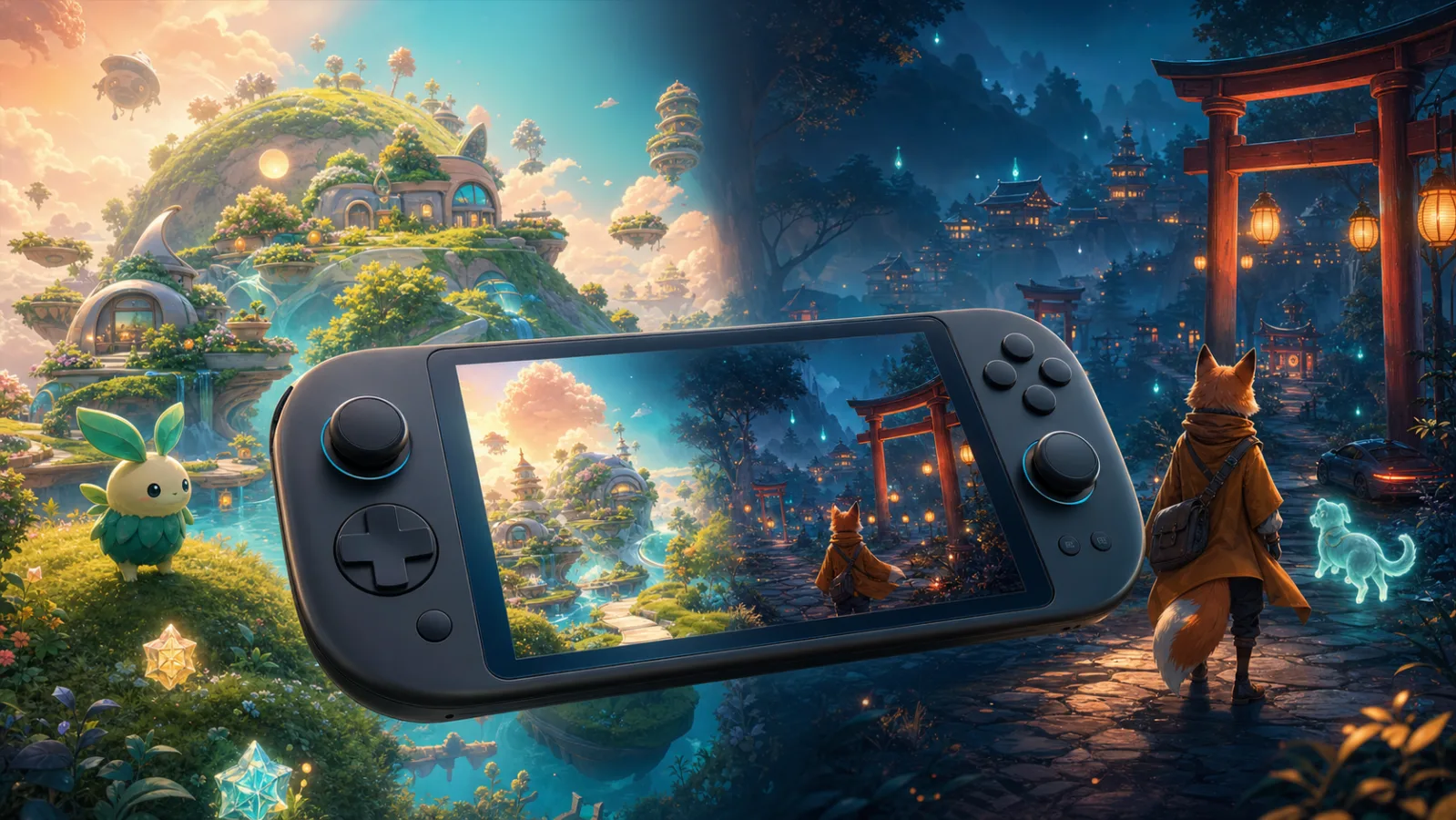
Handheld gaming is especially well suited to adventures that can meet players where they are: a few quiet minutes on the couch, a longer trip, or an evening spent gradually settling into a world. Petit Planet and Kitsune: The Journey of Adashino both seem positioned to offer that kind of escape, but their ideas of a satisfying journey are fundamentally different.
Petit Planet is a free-to-play, cross-platform cosmic life simulation built around making a home, sharing a planet with fuzzy neighbors, and discovering the possibilities in everyday life. Its announced platform list includes Android, iOS, Nintendo Switch 2, and PC. Kitsune: The Journey of Adashino is an indie adventure that follows a fox girl named Kitsune and her Frog companion across Adashino Island, a Japanese-inspired place illuminated by neon signs while an unseen threat gathers in the shadows. It is planned for Mac, Nintendo Switch, Nintendo Switch 2, and PC.
Neither game is simply a matter of one being better than the other. They address different needs. One prioritizes an ongoing home and community project that can be shared across devices; the other points toward a more focused atmosphere-first adventure with a defined pair of protagonists. For Nintendo players in particular, the comparison is useful because both games are planned for Switch 2, while Kitsune also includes the original Nintendo Switch and Petit Planet extends its reach to phones and tablets.
The short version is straightforward. Choose Petit Planet if you want to build, decorate, farm, craft, socialize, and return to a shared world over time. Choose Kitsune: The Journey of Adashino if you want an authored island journey, a companion-driven premise, and a mood that mixes colorful neon with an encroaching sense of mystery. The more useful answer, though, comes from looking closely at how those differences affect play sessions, platform choice, and long-term appeal.
The central contrast: making a life versus following a journey
Petit Planet's concept is broad by design. It combines adventure, role-playing, and simulation elements in a cosmic setting, with home-building and everyday community life at the center. The important word is possibility. Players are invited to shape a home and a planet, live alongside fuzzy neighbors, and explore activities that turn a setting into a personal routine. That framework suggests a game whose identity emerges from the player's own priorities: perhaps decorating, perhaps cultivating a social space, perhaps following the thread of discovery, or perhaps moving between all of those pursuits.
Looser simulation structures can be excellent handheld companions because they are naturally interruption-friendly. A player may feel accomplished after a small bit of customization or a brief visit with neighbors, without needing to maintain the concentration of a major story sequence. At the same time, a home-building game can absorb much longer sessions when inspiration strikes. Petit Planet's cross-platform design further supports the idea of a game intended to fit around a player's schedule rather than demand a single preferred device.
Kitsune starts from a much more specific narrative image. Kitsune and Frog travel together through Adashino Island, where neon signs bring light and color to Japanese-inspired surroundings. The suggestion of an unseen presence moving closer adds tension to what might otherwise be read as a purely scenic journey. Rather than asking players to establish a life in a broad social sandbox, it establishes characters, a place, and a problem. Its appeal rests on going forward: seeing the next portion of the island, learning what the atmosphere is concealing, and staying with the relationship between its two companions.
That does not mean Kitsune must be relentlessly intense. An adventure can still be gentle, exploratory, and suited to portable play. But its emotional center appears more directed. The player is likely choosing it for the feeling of entering a curated place and accompanying two characters through it, rather than for the open-ended satisfaction of arranging a home exactly as they wish.
Gameplay comparison: creative routine or atmospheric exploration
What Petit Planet is likely to satisfy
Petit Planet has the clearer pitch for players who enjoy systems working together. Building a home gives visual and personal expression. Sharing a planet with neighbors gives that construction a social context. Its simulator and role-playing labels point toward a world where day-to-day activity matters rather than acting only as a pause between set-piece story moments.
The cosmic framing is also meaningful. Cozy life games often lean on familiar towns, farms, or villages; Petit Planet puts domestic creativity in a larger, more fantastical setting. For players who like the comfort of arranging a space but want a setting that feels less ordinary, that combination could be its strongest distinction. The premise does not require interest in high-pressure action. Its stated focus is home, community, and discovery.
Because it is free-to-play, prospective players should approach Petit Planet with the expectation that its long-term engagement structure may matter. The supplied details do not specify how its free-to-play model works, so it would be unwise to assume particular progression, purchase, or content systems. What can be said is that free entry may make it an easy game to try for players interested in its life-sim premise, while personal preference about ongoing free-to-play games remains a valid buying consideration.
What Kitsune is likely to satisfy
Kitsune: The Journey of Adashino is the stronger match for someone who wants an adventure to lead the way. Its island setting and travel premise create a clean forward momentum: the journey itself is the reason to keep moving. The fox-girl protagonist and Frog companion add an immediate sense of partnership, which is often valuable in an adventure built around mood and exploration. Even before players know the full shape of Adashino Island, the game's contrast is easy to understand: luminous signs and inviting color on the surface, with a threat implied beyond the light.
The indie and adventure classification makes Kitsune feel potentially more concentrated than Petit Planet. That can be a benefit for players who do not want to manage a long list of simulation goals or social commitments. A focused game can deliver a stronger sense of place because each new location, encounter, and mystery can serve the journey's overall tone. If the idea of wandering an island at nightfall with a memorable companion sounds more compelling than constructing and maintaining your own virtual home, Kitsune has the more direct pitch.
There is an important limit to the comparison: the available details do not define Kitsune's combat, puzzle design, progression, or exact structure. Players should choose it for the confirmed strengths of its premise--exploration, atmosphere, its central duo, and a looming mystery--rather than assuming it will resemble any particular kind of action adventure.
Handheld and platform fit
Both games have a compelling relationship with Nintendo handheld-style play, but their platform strategies differ enough to influence the decision.
Petit Planet is planned for Nintendo Switch 2, Android, iOS, and PC. This is the better fit for someone who regards portability as flexibility rather than as one device. Mobile support is especially relevant to a life simulation game. A player who enjoys checking in on a home, neighbors, or creative projects in short windows may appreciate having phone and tablet options alongside a PC and Switch 2 version. Cross-platform design also fits a social world in principle, since it lets a player base approach the same game from different kinds of hardware. The supplied information identifies it as a cross-platform experience, though it does not spell out the details of progression sharing or multiplayer compatibility, so those specifics should not be presumed.
Kitsune is planned for Nintendo Switch, Nintendo Switch 2, Mac, and PC. For players who own an existing Nintendo Switch and are not planning an immediate hardware change, this is a major practical advantage. Its Nintendo Switch release keeps the adventure accessible to a wider portion of the handheld audience. It has no announced mobile version in the supplied details, which makes it less suitable for players who specifically want to play on a phone, but that absence also keeps the choice simple: it is an adventure built for Nintendo and computer platforms.
There is also a difference in how each game may fit a portable rhythm. Petit Planet's building and community focus seems naturally suited to small, repeatable sessions as well as prolonged creative ones. Kitsune may be best when a player has enough uninterrupted attention to absorb its island atmosphere and narrative momentum. This is not a judgment of quality; it is a question of how a game meets a routine. Someone with scattered daily breaks may gravitate to Petit Planet. Someone reserving an evening train ride or a weekend afternoon for an immersive journey may find Kitsune more attractive.
Social play and solitude
Petit Planet makes community a stated part of its identity. Sharing a planet with fuzzy neighbors implies that connection is not an incidental feature but part of the fantasy. For players who want their cozy game to be an evolving social place, that matters. The prospect of building a home within a larger shared cosmic setting offers a different emotional reward from simply completing an adventure. It can turn decoration, exploration, and routine into things that feel connected to other inhabitants of the world.
The game should appeal to players who enjoy giving a virtual space a personal signature. A home is not merely a checkpoint; it can become a project. The presence of neighbors gives those choices a sense of context. Even a player who is not looking for constant social interaction may appreciate a game world designed around coexistence rather than isolation.
Kitsune's supplied premise is more intimate. It centers on a pair: Kitsune and Frog. That makes it potentially ideal for players who prefer companionship inside the fiction rather than social obligations outside it. There is no confirmed multiplayer or shared-world component in the available information, and that can be a positive. A solo adventure with a clearly defined companion relationship can feel focused and restorative, especially for players who want to explore a strange place at their own pace.
In other words, Petit Planet is for the player who wants to inhabit a world with others around them. Kitsune is for the player who wants to travel through a world alongside a particular character. Both can be cozy in their own ways, but the first is communal and customizable, while the second is atmospheric and character-led.
Longevity: the better return game versus the better single journey
Longevity does not only mean the number of hours a game can occupy. It also means the reasons a player has to return after a first satisfying session.
Petit Planet has the more obvious potential for ongoing play. Home-building, everyday life, neighbors, discovery, and cross-platform access all point toward a game made to become part of a regular routine. Creative players can revisit a world whenever a new idea occurs to them. Community-oriented players can find reasons to check back because shared spaces are inherently less static than a solitary path. The simulation genre is often at its best when there is always one more small goal worth pursuing, and Petit Planet's premise is built around that possibility.
Still, open-ended longevity is only valuable if the player likes creating their own objectives. Players who find decoration, routine, or community simulation directionless may prefer a game with a stronger authored path. For them, Petit Planet could feel expansive rather than focused.
Kitsune's longevity may come from its setting and emotional impact rather than from endless activity. A memorable adventure does not need to offer an infinite loop to be worthwhile. Players can value the completeness of traveling through Adashino Island, spending time with Kitsune and Frog, and seeing a mystery through. Its neon-lit Japanese-inspired presentation gives it a distinctive identity, and distinctive places are often the games players remember long after they have reached an ending.
For some players, that is the preferable kind of value: a journey with shape, atmosphere, and a sense of conclusion. Kitsune is the stronger prospect for the person who would rather finish a crafted adventure than endlessly optimize a personal world. Petit Planet is the stronger prospect for the person who views the absence of a final stopping point as freedom.
Which game should you choose?
- Choose Petit Planet if you want creative ownership. Building a home and living on a planet with fuzzy neighbors is the heart of its appeal. It is the natural pick for players who want their actions to visibly reshape a personal space.
- Choose Petit Planet if mobile play is essential. Its announced Android and iOS versions make it the only one of the two with a phone-and-tablet route, alongside PC and Nintendo Switch 2.
- Choose Petit Planet if you enjoy social, ongoing games. Its community-oriented cosmic life-sim premise is better suited to players seeking a world to revisit over time.
- Choose Kitsune: The Journey of Adashino if you want a focused adventure. Its island journey, fox-girl lead, Frog companion, and gathering mystery offer a more directed reason to explore.
- Choose Kitsune if atmosphere comes first. The tension between colorful neon light and lurking shadows gives it a more mysterious, potentially moodier identity than Petit Planet's domestic cosmic setting.
- Choose Kitsune if you play on Nintendo Switch. It is planned for both Nintendo Switch and Nintendo Switch 2, while Petit Planet is listed for Switch 2 rather than the original Switch.
- Choose Kitsune if you prefer a solo-feeling experience. Its confirmed premise is about traveling with an in-world companion, not managing a shared social planet.
Final verdict: two promising portable escapes for different moods
Petit Planet and Kitsune: The Journey of Adashino are best treated as complementary kinds of handheld adventure, not direct substitutes. Petit Planet is the larger lifestyle proposition: a free-to-play, cross-platform cosmic world where home-building, neighbors, and discovery can support an ongoing personal routine. Its greatest strengths are flexibility, creativity, and the prospect of belonging to a shared place.
Kitsune: The Journey of Adashino is the more deliberately framed trip: a Japanese-inspired island, neon in the darkness, a fox girl and Frog traveling together, and an unseen presence that gives the journey a mysterious edge. Its greatest strengths are its specific atmosphere, focused premise, and original Nintendo Switch support.
If your ideal handheld game is one you can keep returning to in brief bursts, gradually turning a virtual space into your own, start with Petit Planet. If your ideal handheld game is an adventure you can sink into when you want to be carried somewhere unfamiliar, follow Kitsune and Frog across Adashino Island. Both understand that portable play is about more than convenience. It is about having another world ready when you need it--whether that world feels like home or like a road leading into the glow of distant neon.
Community
Discussion
Start the conversation.
No comments have been posted yet.