

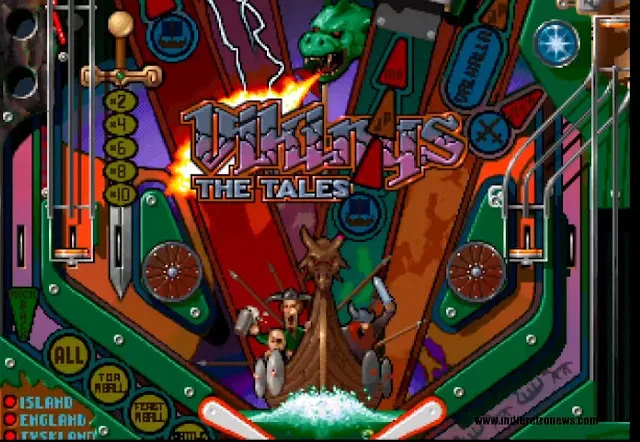
Pinball Illusions is receiving an unexpected expansion on the Amiga A1200. A work-in-progress fan conversion is bringing The Vikings, the Norse-themed fourth table that appeared in the PC version but not the 1995 Amiga release, to Amiga AGA systems. The project aims to make the table feel like a genuine part of the original game rather than a separate add-on, placing it directly within the classic menu alongside the three tables Amiga players already know.
The conversion is being developed by MrDig, who has used Claude AI as part of the process of migrating data from the PC release. It remains unofficial and unfinished, but it has already reached a meaningful stage: The Vikings is reportedly playable with stable results on both original Amiga 1200 hardware and the FS-UAE emulator. That is an encouraging milestone for a project dealing with a title whose Amiga and PC editions did not have identical content.
A Fourth Table for the Amiga Version
When Pinball Illusions arrived on Amiga in 1995, it offered three tables. The PC release, however, included an additional table called The Vikings. For years, that made the Norse-themed board one of the notable pieces of content unavailable to players using the original Amiga version.
This new project attempts to close that gap by converting the PC table so it can run natively through the original Amiga engine. The distinction matters. Rather than simply presenting an external recreation with a different interface or technical framework, the work is intended to preserve the look and behavior of the Amiga game's established structure.
For useful background on this topic, read Wing Commander II Dx Teased for Amiga AGA in New AcidBottle Test Build.
The Vikings is now integrated as a proper fourth selection in the game's menu. The implementation also includes a dedicated high-score list, a menu image for the table, and custom information text. Those details may sound secondary to the physical pinball action, but they are important to the overall goal. A new board is much more convincing when it has been accounted for across the game's presentation, scoring records, and menu flow.
Core Pinball Features Are Already Functioning
The work-in-progress build is not merely a static table layout. Its primary gameplay systems are operating, including several of the features that define The Vikings on PC. The dot-matrix ship mini-game is working, as are the Thor and Labrador multiball modes and the table's end-of-ball bonuses.
Those systems are especially significant because pinball software relies on more than ball movement and collision detection. A table's identity is built from event triggers, score logic, display sequences, sound effects, timed modes, bonus calculations, and the rapid chain of feedback that follows a successful shot. Getting its major mechanics active on Amiga hardware suggests the conversion has advanced beyond an early proof of concept.
For another perspective on this story, read Pinball Illusions' PC-Only Vikings Table Is Being Brought to Amiga AGA as an Unofficial Fourth Table.
Players can currently run the table through a hard-disk installation and with WHDLoad. The files are intended for use with the "PinballIllusions v2.2 AGA" WHDLoad version, with installation guidance supplied in the accompanying readme. As with any community project still under development, users should be prepared for rough edges and follow the included instructions carefully.
Memory-Saving Work for Original Hardware
Making an additional table operate on a period-correct Amiga is not simply a matter of moving files from one release to another. The Amiga A1200 has finite resources, and chip RAM is particularly valuable in games using detailed graphics, animation, music, effects, and fast on-screen action.
To help fit the conversion within those limits, the project uses Imploder compression. The packing approach is intended to save chip RAM while retaining the data needed for the table to operate. This is one of the practical technical considerations that separates an Amiga-targeted conversion from a modern fan patch where memory and storage constraints are usually far less restrictive.
The reported stability on physical A1200 systems is another key point. Emulation is useful for development, preservation, testing, and accessibility, but behavior on real machines remains the essential test for a conversion designed around original AGA hardware. Having the gameplay run reliably in both FS-UAE and on an actual Amiga 1200 gives the project a stronger foundation as development continues.
What Still Needs Work
The Vikings conversion is playable, but it is not being presented as final. Remaining work includes polishing animations and bringing audio behavior into closer alignment with the PC original. Pinball tables depend heavily on audiovisual timing: flashing elements, dot-matrix messages, mechanical effects, music cues, and speech or sound stings all help communicate what the player has activated. Even when scoring systems are correct, incomplete timing or animation can noticeably change the feel of a table.
The developer is also exploring an optional screen-centering feature for modern monitors. That could be useful for players who run original hardware through contemporary displays or use setups that do not naturally position the game image as expected. At this stage, it is described as an option under consideration rather than a confirmed finished feature.
As a WIP release, bugs are expected. Players testing the current files are encouraged to document problems with screenshots or video where possible. Clear reports can be particularly valuable for issues involving specific shots, table states, display behavior, sound timing, multiball interactions, or hardware and emulator differences. Detailed reproduction steps are often the fastest route to resolving faults in a complex game conversion.
An Interesting Use of AI-Assisted Development
The project is also notable for its use of Claude AI during the data migration process. AI assistance is increasingly discussed in game development, but retro conversion work presents a distinctive case. The goal is not to generate a new game from scratch; it is to help interpret, transform, and adapt existing PC-side data so it can function within the constraints and architecture of an older platform.
That does not eliminate the need for conventional development, testing, and technical judgment. The remaining animation, synchronization, interface, compression, and compatibility work demonstrates how much hands-on iteration is still involved. In this context, AI appears to be one tool in a wider workflow rather than a shortcut around the challenges of making a 1990s game engine accept content it was not originally shipped with.
There is also a useful preservation angle to the effort. Different releases of the same game can contain meaningful variations, especially in the era when Amiga, DOS, console, and home-computer versions regularly diverged in content and technical design. Bringing a PC-only table to the Amiga does not replace the historical original, but it gives enthusiasts another way to experience a piece of content long associated with a different edition.
Why The Vikings Matters to Pinball Illusions Fans
Pinball Illusions remains well regarded among fans of 1990s computer pinball for its elaborate tables, playful themes, and dense mode design. The Vikings has a particular appeal because it was not simply an alternate skin or a minor revision. Its Norse setting, mini-game, multiball events, and table-specific presentation gave PC players an extra board that Amiga owners missed.
For longtime A1200 users, the prospect of selecting The Vikings from the familiar menu carries a certain historical curiosity. It is a chance to see what the Amiga version might have looked like with a fourth table at the time, while also acknowledging that this is a modern unofficial addition rather than a recovered commercial release.
The project's emphasis on native engine integration makes that curiosity more compelling. A standalone recreation would still be welcome, but fitting the table into the original game's menu, score infrastructure, and play environment makes the result feel closer to an expanded edition. If the remaining audiovisual and polish tasks are completed successfully, it could become a particularly appealing enhancement for owners of Amiga AGA hardware, WHDLoad users, and retro-computing enthusiasts.
How to Approach the Current Build
Anyone interested in trying the work-in-progress version should treat it as a test build, not a final replacement for the released game. The available table data is designed to be placed into the WHDLoad installation of PinballIllusions v2.2 AGA, and the supplied readme contains the relevant setup steps.
- Use the specified WHDLoad version and read the included instructions before copying files.
- Expect unfinished animation and audio details.
- Test on either an Amiga A1200 or a supported emulation setup such as FS-UAE.
- When reporting bugs, include screenshots or video if possible.
- Describe the exact table mode, shot, scoring state, and setup involved when an issue occurs.
The Vikings conversion is an ambitious example of retro community development: a long-missing table is being adapted for the machine whose version of Pinball Illusions originally went without it. There is still work to do, and the developer is openly seeking feedback, but stable core gameplay on real A1200 hardware means this unofficial fourth table has already moved well beyond a distant wish for Amiga pinball fans.
Community
Discussion
Start the conversation.
No comments have been posted yet.