

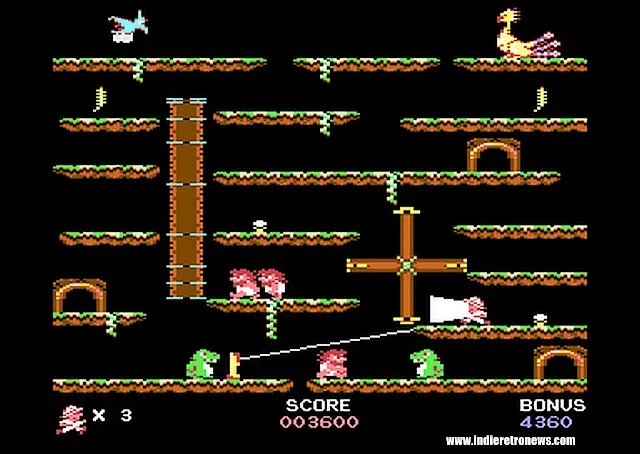
Roc'n Rope, Konami's unusual 1983 arcade climbing game, is being brought to the Commodore 64 by Broken Bytes. The project aims to reproduce the fast, vertically focused action of the coin-op while making a notable technical showing on Commodore's classic 8-bit machine. Its approach includes a full-screen 320×248 play area that extends into the C64's borders, PAL-specific timing, sub-pixel movement, and rope handling designed to remain fluid even when the screen is packed with hazards.
The conversion is credited to a small team with Antonio Savona on code, Steve Day on graphics, and Aldo Chiummo on music and sound. Broken Bytes has emphasized that the project was made without AI. A download is listed for the conversion, giving retro players a chance to see how this distinctive arcade game translates to the home computer.
A different kind of arcade ascent
Roc'n Rope arrived during an era when arcade games were often built around a single immediately understandable objective, then made demanding through enemy patterns, timing, and score pressure. Rather than putting players in a spaceship, maze, or conventional platform layout, Konami's game asks them to scale a succession of dangerous vertical environments in pursuit of a phoenix.
The hero's defining tool is a harpoon gun. It is not simply a weapon: it is the means of traversal. Players fire the harpoon toward an overhead ledge, establish a rope across a gap, and climb it to reach a safer position or push farther upward. That fundamental loop gives Roc'n Rope a personality distinct from more traditional ladder-based climbers. Progress depends on reading the geometry above, committing to a route, and deciding whether there is enough time to make a climb before danger closes in.
For useful background on this topic, read Why SNES Games Remain So Expensive in 2026.
Every route is contested. Falling rocks create immediate threats from above, while dinosaurs and hostile cavemen turn platforms into active danger zones. The arcade game's tension comes from the combination of these problems: a player may know where they need to go, but still have to pause for an enemy, avoid a falling obstacle, or change plans when a promising rope line becomes unsafe.
That makes Roc'n Rope more than a simple race to the top. It is a game of maintaining momentum without treating speed as the only priority. A reckless ascent can put the character directly in harm's way, but excessive caution can also make it harder to keep a run productive and protect a high-score opportunity.
Tools, pickups and the chase for a better score
The harpoon is central to reaching higher platforms, but the player has additional ways to manage the hazards around them. A flashlight can blind enemies, briefly creating the room needed to advance or get out of an awkward position. It is a useful defensive option in a game whose stage layouts and enemy activity can make direct movement feel precarious.
Power pills and feathers also appear as collectible advantages. These pickups support the game's score-driven structure, where strong play is not only about surviving a stage but about sustaining an effective sequence of actions. By keeping the bonus active and chaining together movement, pickups, and enemy management, players can pursue the kind of escalating score that defined the competitive appeal of arcade design in the early 1980s.
For a Commodore 64 version, preserving that balance will matter as much as presenting recognizable visuals. Roc'n Rope depends on responsive control and readable cause-and-effect. The player needs to trust the moment a harpoon is fired, understand the placement of a rope, and feel that a narrow escape happened because of a well-timed decision rather than a sluggish response.
Roc'n Rope's central challenge is deceptively straightforward: create a path upward, then survive long enough to use it.
That clarity is one reason the game remains an appealing target for a modern C64 conversion. Its rules are accessible, but its layered hazards leave room for practice and mastery. A player returning to a level can refine routes, improve scoring decisions, and learn when using a flashlight or detouring for an item is worth the risk.
Four environments for the climb
The conversion includes the game's four major settings, each designed to give the ascent a different visual identity. Players climb through jungle ledges, icy caves, spinning wheels, and a towering waterfall. These areas are more than palette swaps in concept: the shifting scenery reinforces the sensation that the player is pursuing the phoenix through a strange and increasingly dramatic world.
- Jungle ledges establish the prehistoric adventure mood with natural platforms and lurking threats.
- Icy caves bring a colder setting to the vertical action.
- Spinning wheels add a more mechanical and visually unusual backdrop to the ascent.
- The waterfall provides a towering finale-like environment for the climb.
Broken Bytes' version makes use of the Commodore 64 palette across all four worlds. For a game built around constantly looking upward and planning the next move, visual distinction is important. The environment needs to look appealing, certainly, but it also must preserve clarity between platforms, hazards, enemies, ropes, and collectible items.
The project's presentation is especially notable for its use of full-screen overscan. The active playfield measures 320×248 pixels and reaches into the C64 border area instead of being confined to a smaller central display. The heads-up display is placed beneath the main action, leaving the climbing space less obstructed. On a machine famous for both its visual strengths and strict display constraints, that decision gives the game a larger, more arcade-like stage for its vertical design.
Technical work behind the ropes
A port of Roc'n Rope faces an obvious challenge: ropes are not static ladders. They are created by the player, can appear in different locations, and must work convincingly amid scrolling action, platforms, enemies, and other on-screen objects. Broken Bytes has addressed this with dynamic rope mechanics intended to keep climbing smooth while managing the limitations of the Commodore 64.
When the display becomes crowded with prehistoric enemies and other activity, anchored rope segments are shifted into bitmap data. This is a practical technical solution with a visible gameplay goal: preserve a functioning rope system without allowing busy scenes to undermine the action. In a game where a rope can be an escape route, a scoring route, or the only line toward the next ledge, it cannot feel like an afterthought.
The code also uses sub-pixel positioning and frame timing tailored for PAL refresh rates. Sub-pixel movement allows objects to move with more precision than whole-pixel steps alone would permit, helping movement look and feel less coarse. PAL-focused timing, meanwhile, is intended to recreate the cabinet's sense of pacing on the C64 hardware.
These details may sound specialized, but they go directly to the heart of arcade conversion work. A faithful version is not defined solely by matching character art or including the right stages. It must capture the rhythm of movement, the timing of danger, and the sensation of firing a harpoon at precisely the right moment. If the character's climb is too slow, if enemy behavior does not align with the player's expectations, or if rope placement lacks precision, the game can feel fundamentally different even when its screen looks accurate.
A C64 project built around authenticity
The Commodore 64 remains fertile ground for new versions of arcade games, homebrew originals, and ambitious technical experiments. Its community has spent decades learning new ways to stretch the machine, whether through improved display tricks, careful sprite management, music drivers, or techniques that make busy scenes more convincing. Roc'n Rope is well suited to that tradition because its premise is simple enough to understand at a glance while its implementation demands a lot from both code and presentation.
Broken Bytes' conversion appears focused on respecting the original game's defining qualities rather than merely adapting its premise. The four environments, hostile creatures, falling rocks, flashlight, power items, score systems, and pursuit of the phoenix are all part of the intended experience. At the same time, the C64 edition has its own technical identity through its expanded display area and methods for handling ropes during crowded action.
For players who know the arcade original, the appeal is the prospect of a home-computer version that takes its feel seriously. For those encountering Roc'n Rope for the first time, it offers a compact slice of early-1980s arcade design: direct objectives, memorable mechanics, increasingly dangerous screens, and a constant invitation to improve one more run.
With Antonio Savona handling code, Steve Day creating the graphics, and Aldo Chiummo responsible for music and sound, the project brings a full four-world climb to the Commodore 64. It is a reminder that the system still has room for inventive arcade recreations--and that even a game built around one harpoon gun and a length of rope can demand a surprising amount of precision.
Community
Discussion
Start the conversation.
No comments have been posted yet.