

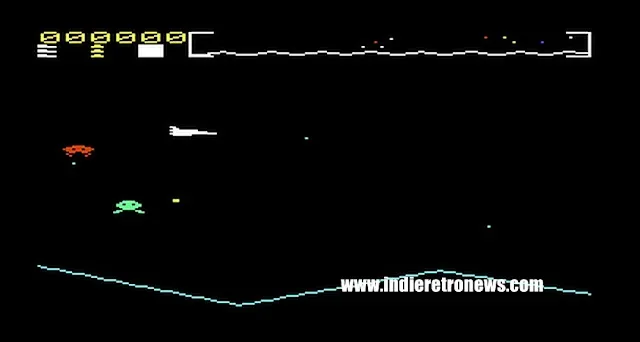
Stargate, the celebrated arcade follow-up to Defender, is being recreated for the Commodore VIC-20 in an ambitious new homebrew project. Built from the ground up without official corporate involvement, the game seeks to bring the original's rapid-fire alien battles, airborne rescues and famously demanding controls to one of Commodore's earliest home computers.
The VIC-20 is not a platform usually associated with arcade conversions on this scale. Its place in computing history is secure, but the machine's technical limits make a fast, crowded action game a substantial undertaking. This version has been written entirely in machine language, an approach intended to get as much performance as possible from the hardware while retaining the frantic character that made Stargate a fixture of arcade culture.
Rather than treating the project as a loose game inspired by the Williams original, its stated goal is a recreation of the core experience. Players take control of a spacecraft defending vulnerable humanoids against repeated waves of extraterrestrial attackers. Staying alive means doing far more than shooting: players must monitor the action across the landscape, intercept enemies, recover civilians in danger and react instantly when the screen becomes overwhelmed.
An arcade challenge built around speed and rescue
At its heart, Stargate is designed around pressure. Enemy forces continually threaten the humanoids the player is meant to protect, turning every encounter into a decision about priority. An opponent may need to be eliminated immediately, but a falling citizen may demand a risky change of direction. The tension comes from trying to preserve the population while keeping the ship out of danger and maintaining awareness of attacks arriving from multiple directions.
For useful background on this topic, read Wolf Duology Modernizes ZeeWolf and ZeeWolf 2 for PC With Ultrawide Support.
That rescue element is one of the defining features being carried into the VIC-20 version. Pilots can perform mid-air saves, catching citizens before they are lost and returning them to safety. It is a mechanic that asks players to navigate precisely under pressure rather than simply clear a screen of targets. In a game known for its high speed, even a successful rescue can create another hazard if the player's ship is suddenly exposed to incoming enemies.
The homebrew also aims for responsive controls and smooth scrolling, both crucial to making this style of game work. Stargate's action depends on immediate movement, sharp reversals and confident positioning. If its conversion can preserve those qualities on the VIC-20, it will offer a particularly striking example of how much can still be attempted on hardware that predates many of the home systems most commonly linked with arcade shooters.
Sound is another part of that identity. The project is described as using the VIC-20's distinctive audio character while evoking the arcade atmosphere. That does not mean the machine can duplicate every aspect of dedicated coin-op hardware, but it does point to a version tailored to the personality of the computer rather than one that ignores its limitations. For retro players, those machine-specific touches are often an important part of the appeal.
For another perspective on this story, read Stargate Brings Arcade-Style Action to the Commodore VIC-20.
Familiar tools for surviving escalating waves
The VIC-20 recreation includes several of Stargate's most recognizable gameplay concepts. Among them is the tactical hyperspace function: a powerful emergency option for those moments when conventional movement is no longer enough. Hyperspace has always carried an element of panic and uncertainty, making it a fitting tool for a game where a single bad situation can become unmanageable in seconds.
The Stargate itself is also part of the planned experience. As in the arcade design that inspired the project, this reality-bending feature gives the game a sense that the battlefield is larger and less predictable than the visible screen. It is one of the elements that separates Stargate from a straightforward fixed-area shooter. Players are not merely holding a line; they are coping with a volatile conflict whose pace and structure can change abruptly.
Enemy behavior is described as intelligent enough to keep fights unpredictable. That goal matters because memorable arcade action is not only about having many targets on screen. The pressure comes from how opponents interact with the player's priorities, how they disrupt rescue attempts and how their patterns force rapid tactical adjustments. A faithful-feeling adaptation needs to maintain that sense of chaos without reducing the action to random noise.
Difficulty should naturally rise as players continue, emphasizing the endurance-run structure associated with classic arcade games. Every successful wave is less a final victory than permission to face a more demanding one. That structure suits the VIC-20 project especially well: the focus is on learning systems, refining reactions and chasing a better performance on the next attempt.
Two-player options add another dimension
In addition to solo play, the game is set to offer two-player support in cooperative or competitive forms. The distinction is significant. Cooperative play can turn the demanding rescue-and-defense loop into a shared effort, with each participant covering a different part of the action or responding to threats their partner cannot reach quickly enough.
Competitive play, meanwhile, brings a different kind of energy. Even when players are confronting the same invasion, score chasing and survival comparisons can make the action feel more personal. Classic arcade games have always worked well as social challenges, and a two-player option can give the VIC-20 version value beyond the solitary pursuit of a high score.
The inclusion of both approaches suggests that the project is looking beyond a basic technical demonstration. A port or recreation is more convincing when it supports the reasons people return to the original style of game: mastery, rivalry, shared excitement and the occasional spectacular recovery from a near-disaster. Those are difficult qualities to express with a feature list alone, but they are central to why fast arcade games continue to inspire new versions decades later.
A notable fit for Commodore's early computer
The Commodore VIC-20 occupies a distinctive position in retro computing. It was an accessible home machine with a passionate following, yet its capabilities demand careful choices from developers. Modern homebrew work often revisits such systems precisely because their constraints create a clear design challenge. Getting an idea to run is one achievement; getting it to feel energetic, readable and satisfying is another.
Writing the game in pure machine language reflects the project's emphasis on efficiency. Low-level development can provide the close hardware control needed for an action title that relies on quick input, scrolling environments, enemy activity and audiovisual feedback. It is a labor-intensive route, but it is also a natural one for developers trying to push older machines beyond what their original commercial libraries might have suggested was practical.
This is why a game like Stargate is an especially interesting choice. The Williams arcade original is remembered not simply as a shooter but as a dense system of movement, risk management and rescue mechanics. Translating that identity to the VIC-20 requires careful prioritization. The result does not need to be identical to arcade hardware to be worthwhile; its success will be in preserving the urgent decisions and kinetic feel that define the game while making the experience work on Commodore's platform.
The project's central promise is simple but ambitious: defend the humanoids, survive the invaders and keep moving when the screen turns hostile.
Another reminder of homebrew's role in preservation
Unofficial retro projects occupy an important space in game preservation and appreciation. They can introduce old game concepts to communities built around different hardware, while also encouraging renewed interest in the technical and creative possibilities of classic machines. In this case, Stargate is not presented as an official release, but as a fan-driven effort made out of enthusiasm for both the arcade game and the VIC-20.
That enthusiasm is evident in the scope of the feature set described for the conversion. Fast combat, rescue sequences, scrolling playfields, signature emergency systems, distinctive sound and two-player modes all point toward an attempt to capture a full arcade-style loop rather than a simplified homage. Whether players approach it as a nostalgic return to Williams-style design or as a showcase for VIC-20 programming, the project has a clear identity.
For owners, collectors and enthusiasts still using the VIC-20, the game represents a fresh reason to revisit the system. For everyone else, it is a reminder that retro platforms are not frozen museum pieces. Dedicated developers continue to explore them, reinterpret familiar ideas and find new ways to make decades-old hardware feel immediate.
Stargate for the Commodore VIC-20 is an unofficial homebrew recreation, built in machine language and focused on the high-speed defense, rescue and survival action associated with the arcade classic. With single-player endurance play plus cooperative and competitive two-player options, it aims to give one of gaming's most intense arcade concepts a new home on a compact 8-bit machine.
Community
Discussion
Start the conversation.
No comments have been posted yet.