

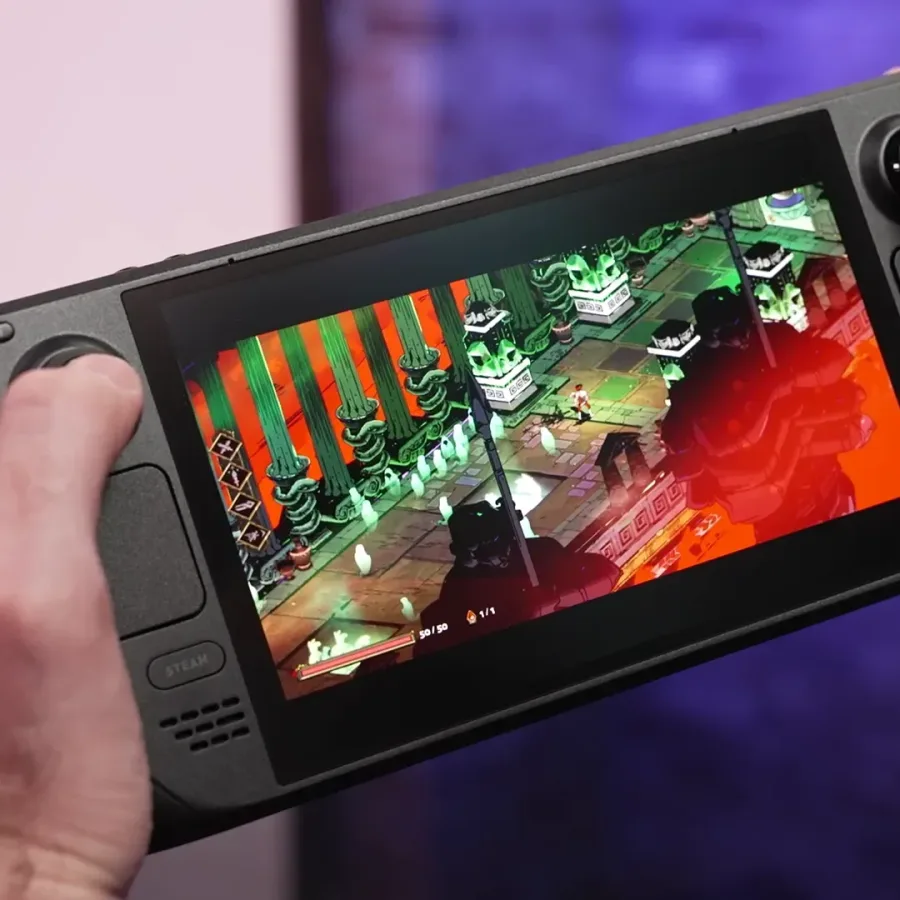
The Steam Deck has spent four years building a reputation as a remarkably flexible handheld gaming PC, but one recent use case is a reminder that its potential extends well beyond a player's game library. At an Airbus facility in the UK, the device has been used during testing of an ExoMars rover prototype, putting Valve's portable hardware in the hands of engineers working on a machine designed for Mars exploration.
The unusual application was shown in a video by Tom Scott, who visited a simulated Martian testing environment and was guided through the development work taking place there. The footage presents several stages of rover operation, from laptop-based local control to a more immediately recognizable setup: a Steam Deck running a custom application that can steer a prototype rover in real time.
It is an eye-catching example of gaming hardware crossing into a highly specialized technical field. The Steam Deck is not being presented as the rover's final onboard computer or as a retail, off-the-shelf Mars-control solution. Instead, it appears to be a practical control device for local testing, making use of the handheld's built-in sticks, buttons, triggers, screen, and full PC architecture.
A handheld PC in a simulated Mars environment
Rover testing has to address a difficult reality: Mars is far too distant from Earth for a human operator to drive a vehicle moment by moment in the way someone might control a remote-control car. The delay in communications means a mission rover ultimately needs a substantial degree of autonomous capability. In the ExoMars testing work shown in the video, mounted 3D cameras are part of the system intended to support that eventual autonomous operation.
For useful background on this topic, read Northernlion Criticizes Dan Gheesling's U.S. Army Twitch Sponsorship.
Before a rover can work independently, however, engineers need ways to test its hardware, movement, sensors, and software safely and repeatedly. That is where a terrestrial Mars-like environment and local control tools come in. An Airbus senior engineer initially demonstrates giving a rover prototype a straightforward instruction through a laptop, including directing it to move forward.
Later, Scott is given a Steam Deck loaded with an unspecified custom program. Using the handheld's physical controls, he operates another prototype rover live. The video does not detail the precise software package, operating configuration, connection method, or interface running on the device. That missing technical detail leaves plenty of unanswered questions, but the basic result is clear: the Deck can serve as an intuitive mobile controller for robotics testing.
For anyone familiar with the Steam Deck as a gaming machine, the fit is not especially mysterious. A rover test operator needs responsive directional inputs and a portable display showing relevant feedback. A modern handheld PC already combines those features in one compact chassis. The Deck's controller layout offers dual analog sticks, trackpads, face buttons, triggers, shoulder controls, and a touchscreen, while its PC foundation allows developers to create or install purpose-built applications.
Why the Steam Deck makes sense for specialist work
The appeal is likely less about any single gaming-specific feature and more about the complete package. Traditional industrial control equipment can be purpose-built, ruggedized, and expensive. A Steam Deck, by comparison, is a broadly available computer with integrated controls that many users already understand. For a prototype environment, that can make it a useful starting point for quickly developing and testing an operator interface.
Its form factor also matters. A laptop can run powerful software and connect to specialized equipment, but it generally needs an external mouse, keyboard, or controller for certain kinds of hands-on operation. The Deck provides a display and an unusually broad input set in a unit intended to be held comfortably. That may be valuable when an engineer needs to move around a test area while retaining direct control of a machine.
The Steam Deck's Linux-based, open-ended design is another important factor. Valve has not locked the system into playing games purchased through Steam, and users can install other programs or even replace the operating system. That freedom makes the hardware useful to hobbyists, developers, researchers, and businesses that need an affordable small PC with controls already attached.
There is no indication that Valve designed the Deck specifically with Mars rover development in mind. Still, this kind of repurposing aligns with the wider philosophy behind a general-purpose PC. A device capable of running games can often run creative tools, coding environments, visualization software, simulation applications, and bespoke control programs as well. The requirements overlap more than they may initially seem: responsive hardware, useful graphics capabilities, flexible software, storage, networking, and familiar input methods can benefit both entertainment and engineering tasks.
A good PC can be a good gaming device because many of the technical problems involved are closely related.
That broader principle has been echoed by Valve personnel in discussions around the company's PC gaming hardware. Good hardware is not limited to one category simply because it was marketed toward games. The Steam Deck's use in rover testing gives that idea a particularly memorable real-world illustration.
Not the first robotics appearance
This is not the first time observers have spotted Steam Deck hardware helping control a robotic system. A few years earlier, fans noticed operators using Steam Deck units to control droids at Galaxy's Edge. That sighting similarly suggested that teams working with physical machines saw value in the handheld's combination of portability and comprehensive controls.
Neither example means the Steam Deck has quietly become a standard robotics platform. There are countless specialist devices, custom controllers, industrial PCs, and proprietary systems used across robotics. But both cases show why the Deck can find a place in experimental and operational setups where a conventional controller is useful but a standard game console would be too restrictive.
For a robotics team, a handheld PC offers options. Software can be tailored to the machine being tested. Input mappings can be adjusted for individual functions. Data views can be designed around cameras, navigation information, diagnostics, or test objectives. If a team needs a different operating environment, the platform's openness makes that possible too. The extent of Airbus' specific implementation has not been detailed, but the flexibility itself is likely central to the appeal.
The cost of openness
The same unrestricted approach that enables unconventional uses also creates a business trade-off. Closed gaming platforms often rely on tightly managed ecosystems, software stores, licensing arrangements, and fixed hardware rules. Valve's portable PC does not impose that kind of barrier. Someone can buy a Steam Deck to play games, to run personal PC software, or to use it as part of a robotics project without ever becoming a customer of the Steam store.
That freedom can make hardware more difficult to subsidize through software sales. Yet it also gives the Deck a longer and more varied life than a device confined to a single service. A player might use it for a back-catalog of PC games, while a student could use it to learn Linux, and an engineering team could potentially adapt it as a controller for a prototype. Those uses are very different, but they grow from the same basic decision: the device is a PC first, not a sealed appliance.
For gaming audiences, that can be seen as part of the Steam Deck's enduring appeal. It is built for playing PC games, including demanding releases and smaller indie projects, but it invites experimentation. The fact that it can show up in a rover test facility is a dramatic version of what many owners already do at home: install non-gaming software, customize controls, connect peripherals, and find a purpose that goes beyond Valve's default interface.
What future Valve hardware could enable
The rover testing demonstration also raises interesting questions about the wider family of open Valve hardware. Steam Machine and Steam Frame devices share the same broad premise that users should be able to install software freely rather than remain locked to a narrowly defined entertainment environment.
Steam Frame is especially intriguing in this context because a VR headset equipped with motion tracking could offer possibilities far beyond playing virtual reality games. Researchers and developers may be able to experiment with immersive visualization, remote-operation interfaces, spatial training tools, and new ways to monitor or manipulate robotic systems. None of that confirms a particular future scientific application, and it remains to be seen how the hardware will be adopted. Still, the Steam Deck's appearance in ExoMars rover testing demonstrates the sort of unexpected direction an open platform can take.
For now, the most important detail is simple: a consumer handheld associated with PC gaming has been used to help test a rover prototype intended for one of humanity's most challenging exploration environments. The Steam Deck may still be best known for putting a large PC game library in people's hands, but its controls and adaptable software foundation have proven useful in a setting that is about as far removed from the living-room couch as possible.
Community
Discussion
Start the conversation.
No comments have been posted yet.