

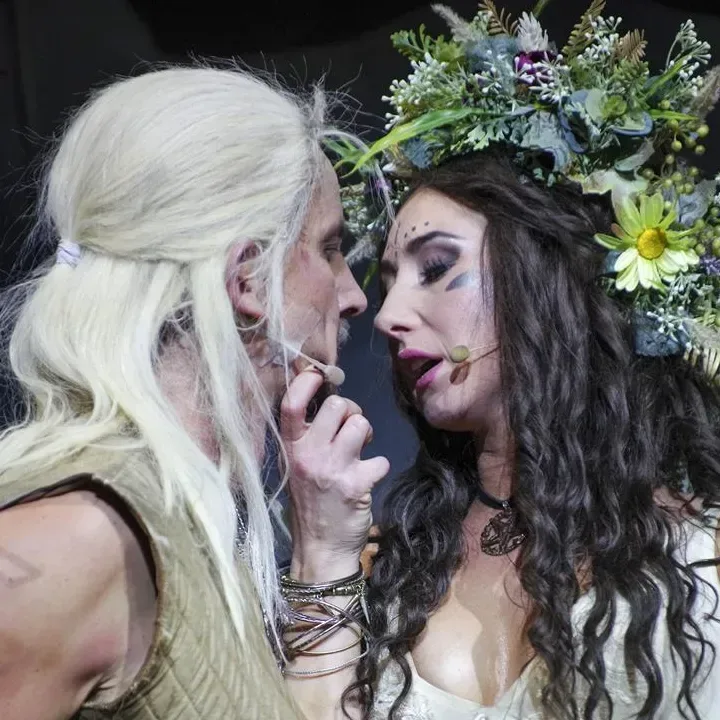
The Witcher has spent decades growing far beyond the pages where Geralt of Rivia first appeared, and creator Andrzej Sapkowski does not seem interested in placing firm limits on where the fantasy universe can go next. When asked about the prospect of more experimental adaptations, including a large-scale stage production, Sapkowski said he is open to suggestions--even unusual ones.
It is a fittingly broad answer for a property that has already taken many forms. Sapkowski's stories have inspired internationally successful video games, a live-action television series, animated projects, comic books, and audio productions. Yet the writer noted that theatrical territory is not entirely new for Geralt and the Continent. In response to the question of whether a stage show could be in The Witcher's future, he asked whether a musical would qualify, adding that there have already been two.
"I am open to suggestions. Even unconventional ones," Sapkowski said.
That leaves the door open without confirming any particular project. There is no announced major Witcher stage production at this time, and Sapkowski did not identify a preferred format, partner, or story that should be adapted next. Still, his response signals a willingness to see the setting explored outside the familiar lanes of games, television, and prose.
For useful background on this topic, read Northernlion Criticizes Dan Gheesling's U.S. Army Twitch Sponsorship.
A fantasy world built for different formats
The Witcher's ability to move between media is one of its defining strengths. Sapkowski's original work blends monster hunting, political maneuvering, dark humor, folklore, and character-driven drama. That combination gives different adaptations different material to emphasize. A game can make the audience feel like a professional monster slayer taking contracts across a dangerous countryside. Television can focus on intersecting destinies and courtly intrigue. Animation can embrace creatures, magic, and locations with fewer practical limitations.
A stage production would face its own creative challenges, but it also offers possibilities not available elsewhere. Geralt's adventures are often intimate despite the enormous stakes around them. Tavern conversations, confrontations with powerful figures, traveling companions, and morally complicated choices can all work well in a live setting. Music, stylized combat, practical creature effects, and theatrical lighting could give the Continent a distinctive identity separate from any screen adaptation.
The mention of past Polish Witcher musicals also matters because it underlines that the franchise's history is larger than the globally visible versions many newer fans may know best. Before the games became a defining force in modern RPGs and before the streaming series brought the characters to a massive TV audience, Sapkowski's fiction had already developed a cultural life in its home country. The existence of those productions demonstrates that the idea of putting Geralt's world on a stage is not merely hypothetical.
Whether a future theatrical project would adapt a specific book, tell an original story, or take a more celebratory approach remains completely unknown. Sapkowski's answer should not be read as an announcement. It is instead a statement of creative openness from the author at a moment when The Witcher is preparing for another busy stretch across multiple media.
Games remain a major part of The Witcher's future
For gaming audiences, several projects are already shaping the franchise's near-term roadmap. The Witcher 3: Remastered is due to arrive on September 29. The game remains one of the most important entries in the series' history, both for the critical reception it received and for the way it broadened Geralt's reach among players worldwide.
There is also a newly announced expansion, Songs of the Past, planned for 2027. Details about its scope and content have not been established here, but its announcement indicates that the world of The Witcher 3 still has room for further exploration. That is notable for a series whose video game adaptations have often expanded the sense of scale surrounding Sapkowski's characters and regions.
Further ahead, The Witcher 4 is currently targeting a 2028 release. Ciri is set to take the starring role, a shift that could mark a significant new chapter for the games. Ciri has long been central to The Witcher's larger mythology, relationships, and themes, but placing her at the center of a new mainline game promises a different perspective from Geralt's established role.
The move is especially interesting in light of Sapkowski's continued interest in the earlier portions of Geralt's life. The franchise can apparently look in more than one direction at once: forward through Ciri's future as a lead character in the games, and backward through new writing that may explore periods before Geralt became the figure readers and players recognize.
More Witcher stories are coming in audio and print
The literary side is also set to expand. Full-cast audio drama adaptations of Sapkowski's books are scheduled to arrive across 2026 and 2027. The rollout begins with Crossroads of Ravens, followed by The Last Wish and Sword of Destiny.
That sequence places fresh emphasis on the short fiction that established much of The Witcher's identity. The Last Wish and Sword of Destiny are particularly important to the foundation of Geralt's story, introducing key characters, relationships, and the tone that later grew into a sprawling saga. Full-cast audio dramas may offer longtime fans a new way to experience those tales while providing an accessible entry point for people who know the property mainly from games or screen adaptations.
Sapkowski himself is not finished adding to the canon, either. He has confirmed that he is writing his next Witcher novel and is aiming to complete it in 2027. At this stage, there are no firm story details to establish exactly where it will fit within the wider timeline or which characters will be central.
However, the author has also discussed the possibility of eventually returning to the short-story form. That is a potentially significant idea because The Witcher began with shorter adventures rather than a long-running novel sequence. Short stories allow the setting to move more freely between monsters, local legends, chance encounters, and pivotal moments in Geralt's personal history. They can also leave room for stories that do not need to carry the full weight of an epic, world-altering plot.
When asked whether there was still room to explore Geralt's younger years, Sapkowski offered an expansive answer: "Sky is the limit." It does not confirm that the next novel will focus on a young Geralt, but it makes clear that the author does not view that era as creatively exhausted.
The television adaptation approaches its ending
Meanwhile, the live-action version of The Witcher is heading toward its fifth and final season. The season is now expected in 2027 after a reported delay. Its conclusion will close one major branch of the franchise's screen history, but it is unlikely to end wider interest in adapting the Continent.
That broader perspective is what makes Sapkowski's remarks about unconventional formats stand out. A final TV season is approaching, but the brand is not winding down. A remastered game, a new expansion, a future mainline game starring Ciri, audio dramas, and another novel all point to sustained activity. Adding the possibility of a future stage-oriented or otherwise unexpected adaptation makes the franchise's next phase feel even less predictable.
For now, fans should treat the author's comments as an invitation to imagine possibilities rather than confirmation of a new production. The Witcher has repeatedly changed shape while retaining its core appeal: difficult choices, dangerous magic, memorable monsters, and characters trying to find their place in a world that rarely makes that easy. If another unconventional adaptation eventually emerges, it will join a legacy that has already proven unusually adaptable.
Community
Discussion
Start the conversation.
No comments have been posted yet.