

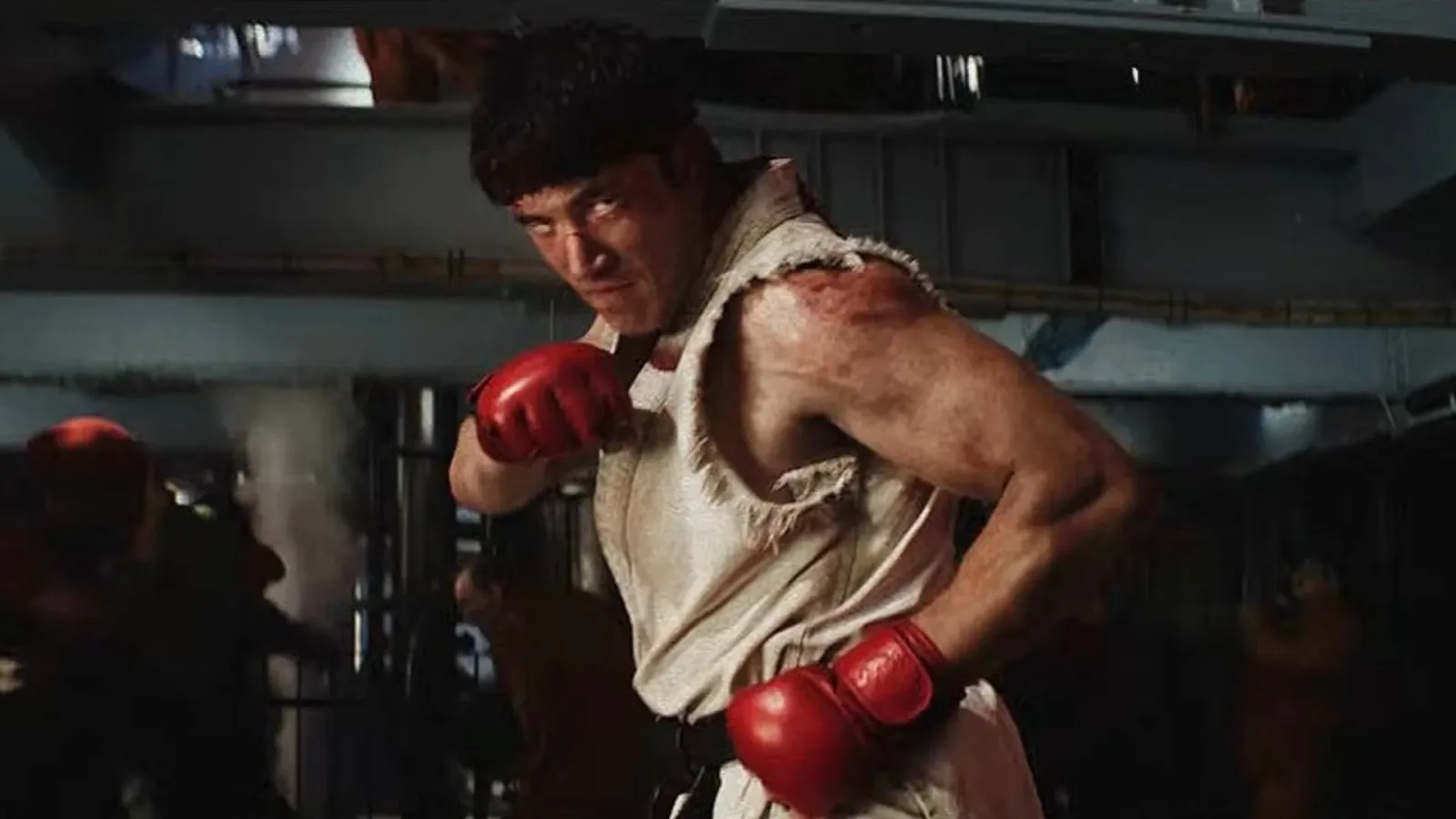
The upcoming Street Fighter movie is preparing to pay tribute to one of the most celebrated moments in competitive fighting-game history. Fighting game community veteran Justin Wong is set to make a cameo in the film, and his appearance includes a particularly meaningful detail: a tattoo bearing the number 37.
For longtime Street Fighter players, tournament viewers, and anyone who has spent time down the internet's deepest fighting-game rabbit holes, that number needs little explanation. It is a direct salute to Evo Moment 37, the extraordinary Street Fighter III: 3rd Strike comeback between Wong and Daigo Umehara at the 2004 Evolution Championship Series tournament. The match's final seconds remain one of the most replayed and discussed sequences not only in Street Fighter, but in esports history as a whole.
Wong revealed on his YouTube channel that he will play a prisoner who comments on a fight in the movie. He also explained that Capcom approached him about appearing in the production. The role is a small one, but the inclusion carries real significance. Wong is not merely a recognizable name being placed in the background for fans to spot. He was one of the two players involved in the real-life event the film is referencing.
Why Evo Moment 37 Still Matters
Evo Moment 37 came from a 2004 match in Street Fighter III: 3rd Strike, with Wong controlling Chun-Li and Umehara using Ken. In the decisive stretch, Umehara had almost no health remaining. Wong activated Chun-Li's Super Art, Houyoku-sen, putting Umehara in a situation where blocking was not enough. With such little life left, he would have been defeated by the unavoidable chip damage that can occur when attacks are guarded.
For useful background on this topic, read Signal Veil Brings 90s Anime Horror to a Haunted High School.
Umehara's response was to parry every hit. A parry in 3rd Strike requires a player to tap toward an incoming high or mid attack at the precise moment it connects. It is a risky mechanic under ordinary circumstances. Executing it once in a tense tournament set can be difficult. Doing it repeatedly against Chun-Li's rapid multi-hit Super, while the audience is already reacting to the possibility of an upset, is why the moment became legendary.
Umehara successfully parried all 15 hits, then jumped to parry the final kick in the air before launching his own counterattack. The comeback ended with Ken winning the round, triggering a thunderous audience reaction. The scene has been viewed hundreds of millions of times across the decades since, traveling far beyond the community that first watched it unfold.
Its endurance is easy to understand. The footage is dramatic even for viewers who do not know the mechanics. There is a clear sense of danger, an impossible-looking response, a crowd that realizes what it is seeing in real time, and an immediate reversal of fortune. For players, the clip represents the appeal of Street Fighter III: 3rd Strike's parry system at its most electrifying: defense turned into offense through composure, timing, knowledge, and nerve.
For the broader fighting game community, Evo Moment 37 has become a kind of shared language. It is invoked whenever a competitor escapes a seemingly hopeless position, makes an astonishing defensive read, or turns a single opening into a victory. The number on Wong's character is therefore an unusually thoughtful Easter egg. It recognizes a historic match, but it also recognizes the communal memory surrounding that match.
Justin Wong's Place in Fighting-Game History
Wong's cameo is especially fitting because his competitive legacy extends far beyond that famous loss to Umehara. He has been one of the most durable and respected competitors in fighting games, known for elite results across multiple games and eras. While Evo Moment 37 is often framed as Daigo Umehara's defining highlight, Wong's Chun-Li was the other half of the confrontation--and one of the reasons the clip is so memorable in the first place.
The movie's decision to place him in a scene involving fight commentary also suggests an appreciation for tournament culture rather than just the characters and moves. Competitive Street Fighter has always had its own atmosphere: crowded venues, sharply timed reactions, commentary that can turn a clutch sequence into an unforgettable call, and spectators who understand the stakes of a split-second decision. A prison setting does not recreate an Evo stage, of course, but having Wong observe and react to a fight offers the adaptation a chance to echo that culture from within its own world.
Wong has additionally said that viewers can expect references spanning all six mainline Street Fighter games. That is a broad promise, particularly for a franchise whose identity has shifted dramatically over the years. Street Fighter began as an arcade series focused on one-on-one martial arts bouts, became a global phenomenon through Street Fighter II, embraced experimental systems in Street Fighter III, pushed spectacle in Street Fighter IV, continued its competitive evolution in Street Fighter V, and most recently expanded its modes and presentation with Street Fighter 6.
The statement does not identify every reference or explain how deeply each game will be represented. Still, it indicates that the movie is not looking only to the most universally familiar imagery from Street Fighter II. There may be room for visual details, techniques, costumes, locations, dialogue, tournament references, or background elements that speak to different generations of players.
Chun-Li's Moves and the Work Behind the Character
The film's attention to Street Fighter history is also reflected in the preparation described by Callina Liang, who plays Chun-Li. Liang recently discussed the work she undertook to better capture one of the series' most recognizable fighters, explaining that she downloaded every version of Street Fighter onto a PlayStation 5. She then recorded Chun-Li's fighting moves in slow motion on her phone, allowing her to study the animation and movement in detail.
"Chun-Li is all kicks," Liang said while discussing the physical demands of the part.
That simple description gets to the core of the character. Chun-Li's fighting style has always been defined by speed, flexibility, balance, and a strikingly powerful lower-body offense. From the Hyakuretsukyaku lightning kicks to airborne attacks and spinning techniques, her move set presents a challenge for a live-action performer. The character cannot simply resemble Chun-Li in costume; the posture, rhythm, range, and force of her movement all matter if the action is to feel convincing to people who have spent years watching the games' animations.
Liang said her preparation included taekwondo, Muay Thai, and wushu training, with two hours of training per day. She also made major dietary changes while building strength for the role. Liang said she ate 12 eggs per day during the bulking process, had to eat every two hours, and found the regimen difficult to maintain. By the end of filming, she said that each of her thighs had grown by six-and-a-half centimeters.
The details are notable because Chun-Li's powerful legs are among the character's most enduring visual traits. In the games, that design has always been linked directly to how she fights. Liang's account suggests the production sought a physical foundation for the character rather than relying solely on editing, camera angles, or digital enhancement to convey impact.
A Different Kind of Video Game Adaptation Challenge
Street Fighter has a distinct challenge as a live-action adaptation. It is not built around a single linear campaign with one protagonist moving through a fixed story. The franchise is a vast roster of rivalries, nationalities, fighting styles, secret organizations, personal motives, and tournament-scale conflicts. Fans often bring very different associations to the same series: arcade cabinets, local multiplayer, tournament streams, character specialists, combo videos, animated adaptations, or memories of a particular numbered entry.
That makes small details meaningful. A reference to Evo Moment 37 is not just nostalgia for an old viral clip. It acknowledges the competitive scene that helped Street Fighter remain culturally central between releases. Likewise, the stated effort to include material from six mainline games recognizes that there is no single version of Street Fighter shared by every fan.
There is also a pleasing connection between the two major details currently known about the film. Wong's tattoo points to a moment remembered for mechanical precision under immense pressure. Liang's preparation speaks to a performer studying mechanical precision in order to embody a game character physically. One concerns a player mastering the timing of a fictional fighter; the other concerns an actor learning how that fighter's motions should look and feel outside the game.
Whether audiences catch every reference remains to be seen. Some nods may be immediately obvious, while others could be aimed at players who recognize a particular move, color palette, character connection, or competitive in-joke. The "37" tattoo should be among the easier ones for fighting-game fans to identify, especially given the unique place that match occupies in Street Fighter history.
Street Fighter Arrives October 16
The new Street Fighter film is scheduled to hit theaters on October 16. With Justin Wong's cameo confirmed, references said to cover the six mainline games, and a cast member putting extensive time into studying Chun-Li's movements, the adaptation is signaling that it wants to engage with more than the series' surface-level iconography.
For longtime fans, Evo Moment 37 is an ambitious reference point. It represents the point where technical skill, dramatic tension, live audience energy, and Street Fighter's underlying design all came together in a few unforgettable seconds. Bringing Wong into the movie and marking the appearance with "37" is a concise but meaningful way to honor that legacy.
And for anyone unfamiliar with the history, the cameo may encourage a new audience to seek out the original match. More than 20 years later, the parries still look unreal, the crowd reaction still lands, and the finish still captures why a fighting game can create sporting drama unlike anything else.
Community
Discussion
Start the conversation.
No comments have been posted yet.