

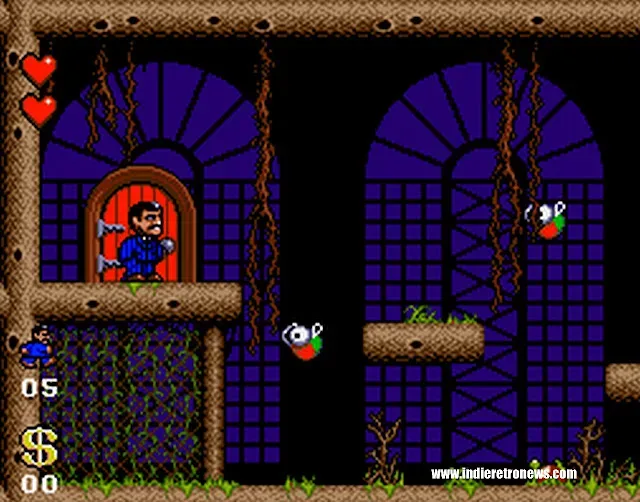
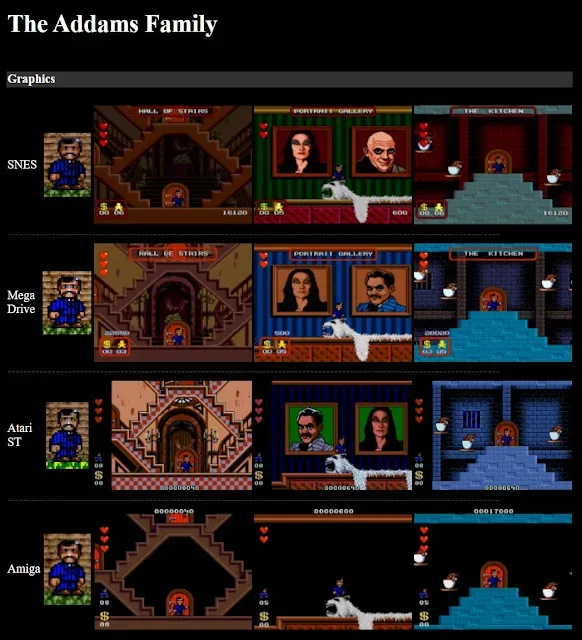
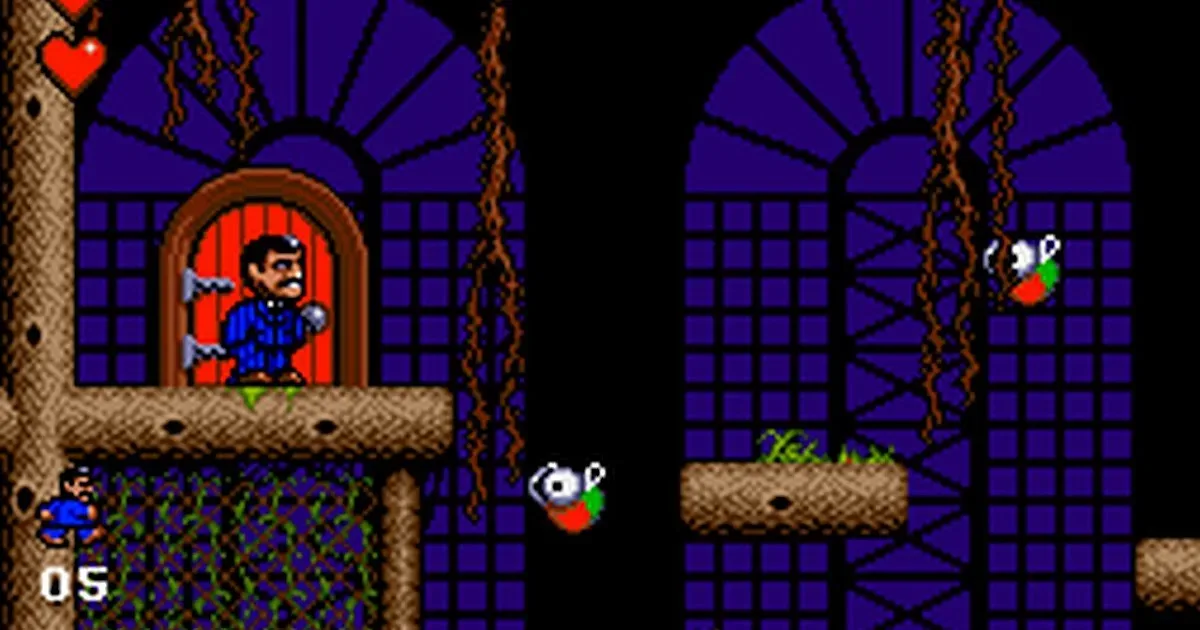
The Addams Family Backgrounds Edition, a substantial reworking of Ocean's 1992 licensed platform game for Commodore Amiga computers, is planned for release in October 2026. The project tackles one of the best-known visual compromises in the Amiga version: its missing level backgrounds. While other 16-bit editions of The Addams Family displayed detailed scenery behind Gomez Addams' platforming adventure, the Amiga port largely presented its action against plain backdrops.
That absence has long been viewed as an unfortunate limitation of the conversion, especially because the game itself was otherwise a prominent release for the machine. Now, developer DJ Mike has revealed that the lost artwork was not simply omitted because it could never function on Amiga hardware. After examining and reverse-engineering the game's code, the developer found that the original program included work intended to draw the backgrounds, only for later operations to ignore and overwrite that output before it reached the display.
The result is a restoration project with ambitions beyond a simple graphics hack. The new edition is being built for both standard OCS Amigas and later AGA-equipped machines, but the two hardware families will not receive exactly the same presentation. OCS systems are set to gain the restored scenery while retaining smooth gameplay, whereas AGA machines such as the Amiga 1200 and Amiga 4000 are intended to receive a more elaborate parallax effect closer to what the original developers appear to have envisioned.
A decades-old omission receives a second chance
The Addams Family arrived during an era when film and television tie-ins were routinely adapted for a wide range of home computers and consoles. Ocean's game placed players in control of Gomez, sending him through the Addams residence and its surrounding locations to rescue members of his family. Its structure leaned heavily on exploration, precision jumping, hazards, hidden routes and item collection, making it a notably demanding platformer by the standards of the period.
For useful background on this topic, read Ghosts'n Goblins Gets an Enhanced Commodore Amiga AGA Release.
The game made its way to several systems, but ports could vary dramatically based on their target hardware. On Amiga, the missing background art became a conspicuous difference. Foreground tiles, characters and obstacles remained, so the game was playable and recognizable, but the atmosphere of rooms and outdoor areas was significantly reduced. A mansion, crypt or garden feels very different when the detail that establishes its setting has been removed.
Background artwork is not merely decorative in a platform game. It establishes contrast between collision-relevant foreground objects and distant scenery, helps communicate the identity of an area, and contributes to the mood of every screen. This is especially important for a property such as The Addams Family, where the gothic, offbeat personality of the world is central to its appeal. Restoring that layer of imagery could therefore make the Amiga edition feel much more complete without changing its core controls, level layouts or challenge.
DJ Mike's discovery also changes the historical story behind the port. Rather than showing that the Amiga conversion had no background system at all, the code indicates that the feature had been considered and implemented to a meaningful degree before being prevented from appearing in the final output. That distinction matters. It suggests an unfinished or compromised implementation rather than a wholly absent design goal, giving the Backgrounds Edition a clear restoration focus.
For another perspective on this story, read The Addams Family Backgrounds Edition Targets October for Amiga.
Why adding the artwork is more difficult than it sounds
Bringing backgrounds back is not as straightforward as loading image data and placing it behind the playfield. Amiga graphics hardware, especially the Original Chip Set used by earlier models, has strict limits involving colour depth, memory and display operations. The foreground action in the original game already makes heavy use of the available graphical resources. In particular, standard OCS hardware reaches its 32-colour bitplane capacity with the visible action layer.
This creates a serious obstacle for a conventional dual-playfield solution. A dual-playfield approach can allow separate layers to move independently, which is the foundation of many parallax-scrolling effects. However, attempting that arrangement under these conditions would come with a severe performance cost. The result could be visual slowdown, an unacceptable trade-off for a game that demands responsive movement and accurate jumps.
Instead, the OCS version of the Backgrounds Edition is designed to keep the recovered artwork moving at the same speed as the level itself. In practical terms, that means players on standard OCS Amigas should see the newly restored scenery while the game maintains the smooth performance necessary for its platforming. It is a compromise, but it is a purposeful one: the project prioritizes making the game look richer without turning the visual enhancement into a gameplay regression.
That decision reflects the broader appeal of skilled retro development. The goal is not always to force every machine into producing the most elaborate possible effect. Often, the better result comes from understanding the original system's limits and choosing an implementation that preserves playability. For OCS owners, the restoration alone should represent a major improvement over the original Amiga release.
AGA hardware is positioned for the full parallax effect
The later AGA chipset opens the door to a more ambitious version of the feature. On AGA-equipped Amigas, including the Amiga 1200 and Amiga 4000, the planned edition is expected to use 32-bit FMODE graphics capabilities to achieve half-speed background scrolling. This means the scenery can drift more slowly than the foreground level as Gomez moves, producing the depth effect that is commonly associated with parallax scrolling.
Parallax is a familiar visual technique, but it is particularly impressive when implemented on hardware from the early 1990s within a game that was not originally shipped with the effect enabled. When foreground platforms move quickly while the distant environment shifts at a slower pace, the scene acquires a stronger sense of scale. Corridors feel deeper, exterior areas feel broader, and the world appears less like a sequence of tiles moving in a single plane.
Achieving the effect on AGA is still a demanding technical task. The approach involves holding 32 separate copies of the background in memory at once, pushing up against the 2MB Chip RAM boundary. Chip RAM is a crucial part of the Amiga architecture because the custom chips responsible for graphics and audio access it directly. Its use needs to be planned extremely carefully, particularly when a game must accommodate playable characters, animation frames, maps, interface elements and audio alongside large visual assets.
That memory strategy underscores how much restructuring was required. This is not presented as a light cosmetic patch that swaps a few files; the modification required extensive changes to code and careful management of a tightly constrained memory budget. The AGA version is therefore positioned as the premium visual option, while the OCS release ensures that the restoration remains available to owners of the older machines for which the game was originally associated.
A restoration rather than a replacement
The most interesting quality of The Addams Family Backgrounds Edition is its relationship with the original game. Its purpose is not to reinvent Ocean's platformer into a modern remake, redesign its levels, or remove the famously punishing elements that longtime players remember. The stated focus is the missing environmental artwork and the background-scrolling behavior that appears to have been part of the developers' plans.
That makes it an appealing project for preservation-minded Amiga fans. Retro game preservation is often discussed in terms of keeping original releases accessible, but there is another valuable layer: investigating unused data, dormant code and features that did not survive the journey to a commercial final build. Projects such as this can reveal what developers were attempting, while also giving players a chance to experience a version that better realizes those intentions.
There is also a useful distinction between "original" and "complete." The 1992 Amiga release remains the historical commercial version, with all of its technical and production compromises. The Backgrounds Edition does not replace that history. Instead, it offers an alternate way to play--one informed by the original code, the recovered visual material and decades of additional technical understanding from the Amiga community.
What Amiga players should expect
With an October 2026 target in place, the key expectation is a release tailored to two different levels of Amiga hardware. Owners of OCS machines are expected to receive the essential restoration: the detailed backgrounds that were previously hidden from view, scrolling in step with the level to avoid the performance issues of a more complex layered setup.
AGA users, meanwhile, are expected to see the intended half-speed parallax treatment. By making use of AGA's expanded graphical modes and an unusually memory-intensive method of handling the background data, that edition aims to deliver the fullest visual result. The difference should make it particularly interesting for players comparing the same game across classic Amiga configurations.
- OCS Amigas: restored background art with scrolling matched to the foreground action for smooth performance.
- AGA Amigas: restored scenery plus half-speed parallax scrolling, intended for machines such as the Amiga 1200 and Amiga 4000.
- Project focus: recovering visual work apparently present in the game code but suppressed in the released Amiga version.
- Current target: October 2026.
For fans of Commodore's classic platform library, the project offers more than a novelty. It revisits a visible shortcoming in a famous conversion, investigates why it happened, and applies a hardware-aware solution rather than ignoring the limitations that shaped the original. If the planned release reaches its October window, The Addams Family Backgrounds Edition could become a notable example of how dedicated reverse engineering can improve a beloved retro game while remaining faithful to the era and the machines that defined it.
Community
Discussion
Start the conversation.
No comments have been posted yet.