

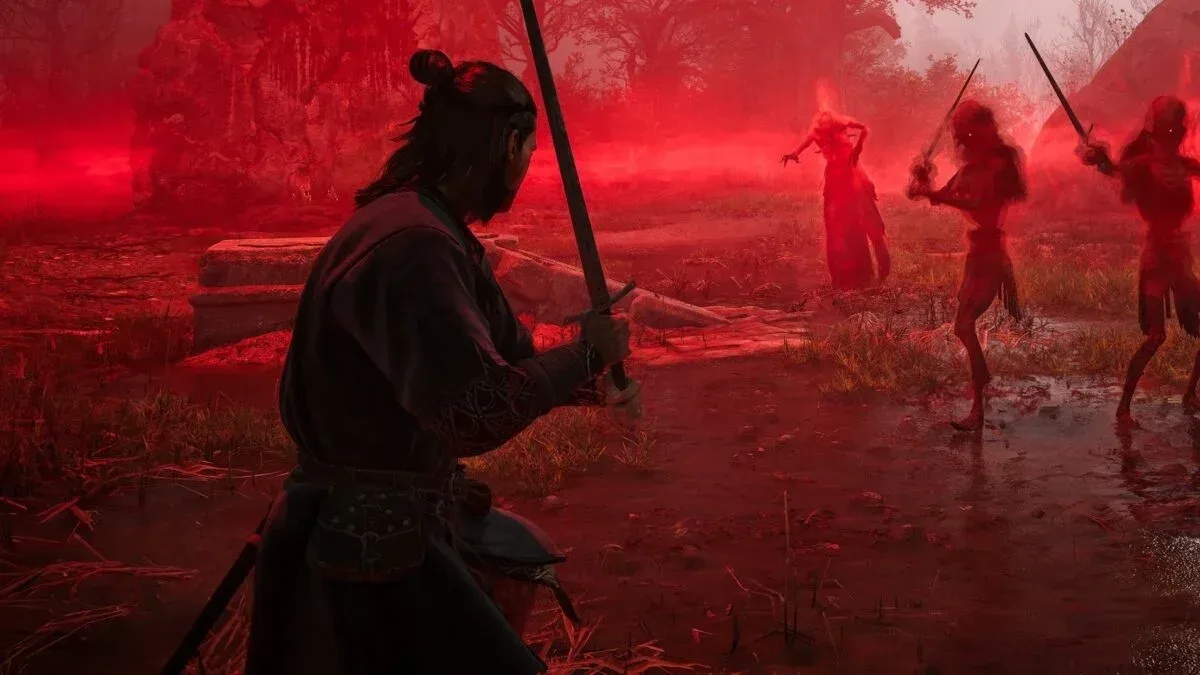
The Blood of Dawnwalker has emerged as one of 2026's more surprising RPG success stories. The vampire-focused action RPG has not escaped criticism, and its rougher edges have been part of the conversation around it. But the areas where it succeeds--particularly its commitment to a distinct fantasy, a consequential day-night structure, and a world players cannot simply exhaust in one visit--have apparently been enough to turn a first release from Rebel Wolves into a dark-horse Game of the Year discussion point.
Its reported production circumstances make that result more notable. Rebel Wolves is said to have made the game with a development budget of roughly $40 million, funded by NetEase in return for a 26 percent stake in the Polish studio. In an era when large-scale role-playing games can demand enormous teams, years of iteration, and budgets that climb far beyond that number, the reported figure puts the project in a different category from the industry's biggest blockbuster bets.
That does not mean $40 million is a small sum, especially for a new studio. It is a serious investment and one that had to support a team that has grown to around 160 people. Still, compared with the financial scale often associated with ambitious third-person open-world RPGs, it suggests Rebel Wolves found ways to focus its resources rather than trying to compete on every possible front. The game's early commercial performance adds to that picture: it reportedly reached 1 million sales during one of the year's most crowded release periods.
A debut built by experienced RPG developers
Rebel Wolves may be a first-time studio, but it was not assembled by people new to the genre. Several of its co-founders previously worked at CD Projekt Red, including Mateusz Tomaszkiewicz, known for directing The Witcher 3. That background gave the team useful experience with the construction of expansive, character-driven action RPGs, even if the new company still had to prove it could ship a major original game under its own identity.
For useful background on this topic, read Steam Frame Reservation Scalping Appears Online as Community Pushes Back.
Tomaszkiewicz reportedly financed the project's first year of development himself in 2022. From there, the studio built toward a 2026 launch while trying to avoid a common problem for new teams: allowing an initially clear pitch to become unrecognizable as production continues. Scope growth can arrive gradually. A promising system prompts another system to support it, more content is added to make every path feel equally complete, and a game that began with a sharp premise can end up carrying the cost of dozens of competing priorities.
Rebel Wolves instead appears to have treated the original concept as a set of boundaries. Tomaszkiewicz said the team made a deliberate effort not to alter the game's foundational pillars, explaining that those foundations remained consistent with the early pitch deck. His reasoning was straightforward: changing the core concept would ripple outward and affect the entire production.
"We decided we'd do everything to not change the foundations of the game," Tomaszkiewicz said. "And the foundations right now are the same as they were in the pitch deck. Because we knew if we changed those pillars, it'll impact the whole game."
For another perspective on this story, read The Blood of Dawnwalker's Reported $40 Million Budget Shows the Value of Holding the Line on a Core RPG Idea.
That stance may sound simple, but it is especially meaningful in a genre where games are often judged by sheer scale. Players frequently expect long quest lists, sprawling maps, exhaustive dialogue trees, and enough optional content to consume hundreds of hours. Building all of that is expensive. More importantly, it can work against a game whose appeal rests on limitation, pressure, and the idea that no single playthrough should contain every possible outcome.
The vampire premise is also a production principle
The Blood of Dawnwalker's defining systems reportedly grew directly from its original design rather than being added late to differentiate the project. Its day-night cycle changes how the protagonist's vampire abilities function, while a time limit prevents players from seeing the entire world and every storyline in one run. These are not merely atmospheric details. They establish a rhythm for decision-making and give the RPG a different relationship with completion.
Many open-world games train players to assume that patience eventually solves every problem. If a mission is unavailable, return later. If a choice closes off content, start another save or consult a guide. If there is a map marker, the expectation is often that it can eventually be cleared. Rebel Wolves' approach appears more willing to say that opportunity has a cost. Choosing one path means losing another, and spending time in one direction may mean that an event elsewhere passes by.
That can create friction, especially for players who prefer exhaustive exploration. It can also make the game's world feel more responsive because the clock is not simply decorative. The day-night cycle reinforces the vampire concept mechanically, while the time pressure makes the setting feel less like a theme park waiting indefinitely for the player's attention. The two systems support the same wider goal: making the central premise matter during play rather than just in cutscenes or character descriptions.
From a development perspective, this structure may have been equally valuable. Designing a game around meaningful tradeoffs can allow a studio to concentrate on the paths it chooses to include instead of attempting to make every area, quest, and activity endlessly accessible. That does not automatically make development easy, and it certainly does not erase the cost of writing, combat design, world building, performance work, and testing. But it can prevent the team from chasing a version of the game that needs to be everything at once.
Using familiar genre foundations without losing identity
The studio's prior experience also seems to have mattered in another practical way. The third-person action-RPG blueprint behind The Witcher 3 had already established many of the genre's basic lessons: how to structure exploration, how to frame player choice, how to pace combat and story material, and how to build a world around quests instead of simply filling space with activities. Rebel Wolves did not need to reinvent each of those fundamentals from the ground up.
Borrowing useful design knowledge is different from repeating an old game. The Blood of Dawnwalker's most memorable ideas are tied to its vampire identity and its restrictions on time and access. But being able to begin with lessons learned from previous RPG work likely freed the team to spend more of its effort on the elements that would distinguish its own project. For a new studio, knowing where not to innovate can be as important as knowing where to take a risk.
This is one reason the reported $40 million figure is drawing attention. It suggests that a polished, ambitious RPG does not necessarily need an unlimited budget to find an audience, provided its creators have a focused concept and enough discipline to protect it. The conclusion should not be that every team can make a comparable game for the same amount, or that money no longer matters. Team size, regional costs, technology choices, experience, publisher support, marketing, and the complexity of a project all shape the final number.
Instead, the more useful lesson is about alignment. A game's systems, narrative premise, production plan, and commercial expectations need to point in the same direction. A vampire RPG about shifting power between day and night benefits from a world structured around passing time. A story about consequential choices benefits from accepting that some content will be missed. And a new studio with finite resources benefits from refusing to rebuild core foundations halfway through development.
Why the result matters beyond one game
The Blood of Dawnwalker still has flaws, and the positive response around its strongest ideas does not make those weaknesses disappear. Yet that mixture may be part of why its reception stands out. It is not being discussed as a flawless, all-purpose blockbuster. It is being discussed as a game with a firm point of view--one that lands hard when its systems, setting, and player choices meet.
For Rebel Wolves, surpassing 1 million sales with its debut establishes an important early benchmark. New franchises have a difficult path in a market dominated by familiar names, long-running series, and projects backed by established brand recognition. Launching during a busy period raises the challenge further. If the reported sales figure holds as the game continues its run, it will demonstrate that players were willing to take a chance on a fresh RPG universe despite those conditions.
For the wider business, its reported development story is a reminder that restraint can be a competitive advantage. The industry regularly rewards scale, but scale alone does not create identity. Rebel Wolves' apparent decision to preserve the day-night vampire design and the time-limited structure from pitch to release gave The Blood of Dawnwalker a recognizable shape. That clarity may be as important to its success as the budget behind it.
The studio now has the more difficult task of building on that foundation without losing the focus that made its first game resonate. But for the moment, The Blood of Dawnwalker offers a compelling case study: a new team, a reported $40 million production budget, experienced RPG talent, and a willingness to let a restrictive central idea remain restrictive. In a genre often tempted to promise players everything, that commitment to a defined vision may have been its most valuable feature.
Community
Discussion
Start the conversation.
No comments have been posted yet.