

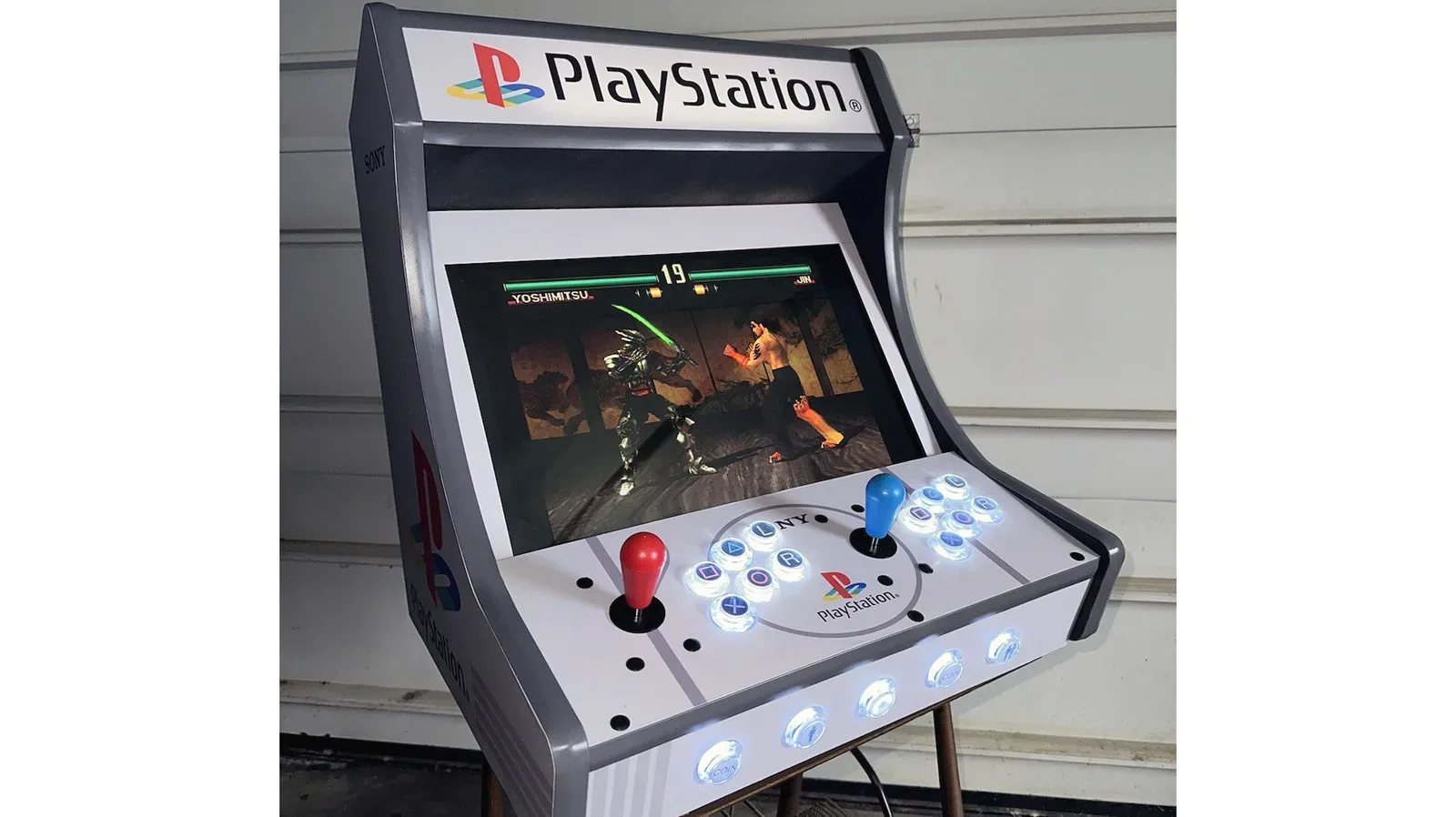
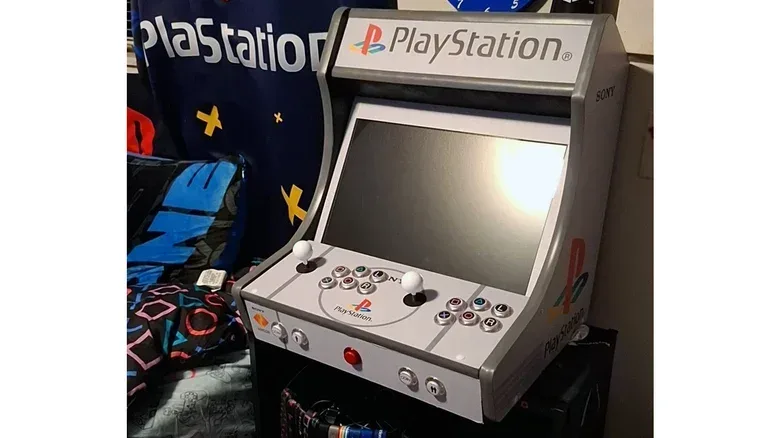
There is an immediate, almost irresistible appeal to a PlayStation-branded arcade cabinet. The gray plastic aesthetic, the familiar face-button symbols, and the visual language of Sony's first console all look surprisingly natural on a full-size upright machine. It is the kind of object that can make a retro game room feel more complete before anyone has even pressed Start.
That feeling is built on a slightly invented memory. PlayStation games certainly appeared in arcades, and the original console's library overlaps heavily with genres that once defined the arcade floor. But Sony never released a standard PlayStation home arcade cabinet in the 1990s. The machine now being sold is a hobbyist-built creation: an attractive blend of arcade-cabinet nostalgia and PlayStation iconography rather than a recovered piece of gaming history.
As a conversation piece, it is undeniably effective. As a practical way to play PlayStation games, however, the compromises become difficult to ignore--especially at a listed price of $1,030, plus $120 for shipping.
A polished-looking custom build, not an official PlayStation product
The first point matters because the cabinet's presentation could easily give a different impression at a glance. It is not made or licensed by Sony. It is a custom system dressed in PlayStation logos, button symbols, and themed artwork, built around readily available emulation hardware.
For useful background on this topic, read Xbox Series X vs. PS5 Pro: Eight Features Microsoft's Console Still Does Differently.
Inside is a Raspberry Pi 4, a compact single-board computer commonly used for hobby projects and retro-game emulation. The base configuration is described as having 128GB of storage, while a 512GB storage upgrade is offered for another $100. The system uses RetroPie, an open-source front end and software collection that brings together emulators for Raspberry Pi-class hardware.
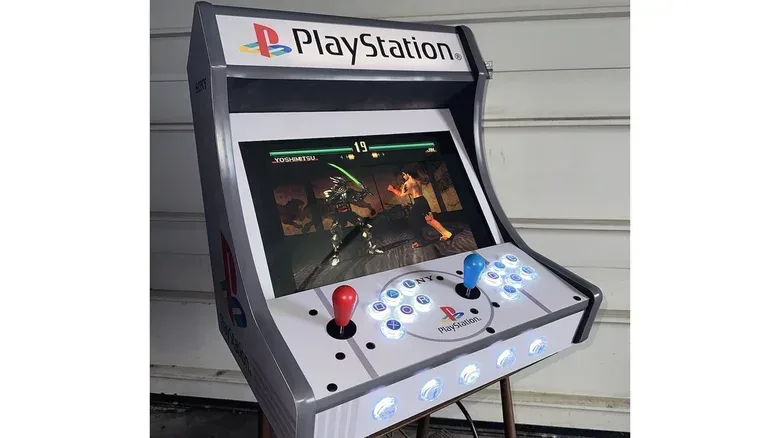
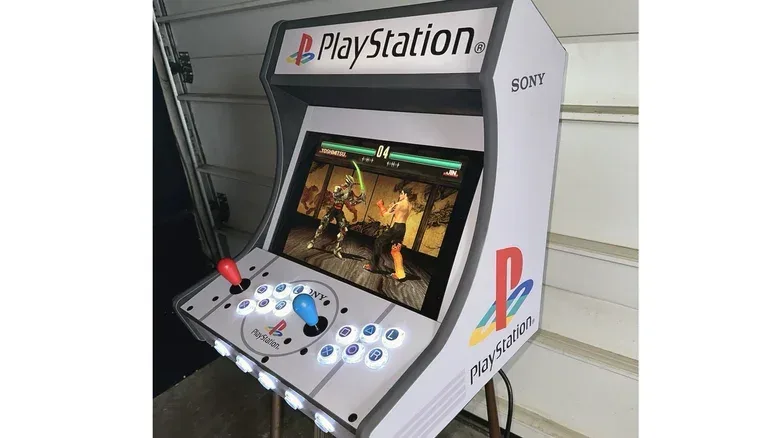
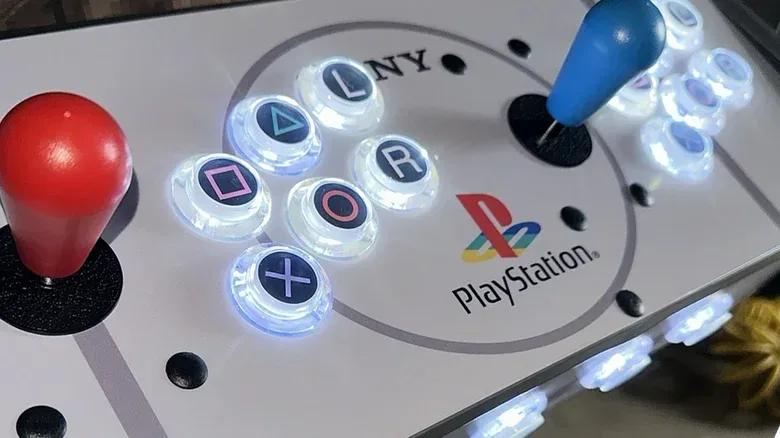
The cabinet also includes a 19-inch LCD, LED lighting, two 4-inch speakers, and joystick-and-button controls described as Sanwa-style clones. The exterior artwork appears to be one of its strongest features. Laminated vinyl panels and carefully applied PlayStation imagery turn a generic cabinet format into something that looks far more purposeful than a typical DIY emulation box.
That visual effort is why the concept is so tempting. An ordinary small computer connected to a television may play the same software, but it does not have the physical presence of an arcade machine. This cabinet has that presence. The problem is that the original PlayStation was not designed around arcade controls, and the differences are more than cosmetic.
The control layout does not match what PlayStation games need
An arcade cabinet is best when its controls align with the games it is meant to run. Fighting games, shoot-'em-ups, puzzle games, and many older arcade titles thrive with a joystick and a row of large buttons. The original PlayStation controller had a different purpose.
Its standard pad included a directional pad, four face buttons, four shoulder buttons, and Select and Start. Later PlayStation controllers added two analog sticks, expanding the kinds of 3D experiences developers could make. This cabinet, by contrast, provides one joystick and six action buttons for each player.
That is enough for certain games, but it is not a full substitute for a PlayStation pad. A machine with this configuration should be expected to work best with titles that can comfortably translate to a traditional arcade layout. Mega Man-style 2D platformers and fighting games such as Tekken, Street Fighter, and Mortal Kombat are among the clearest fits.
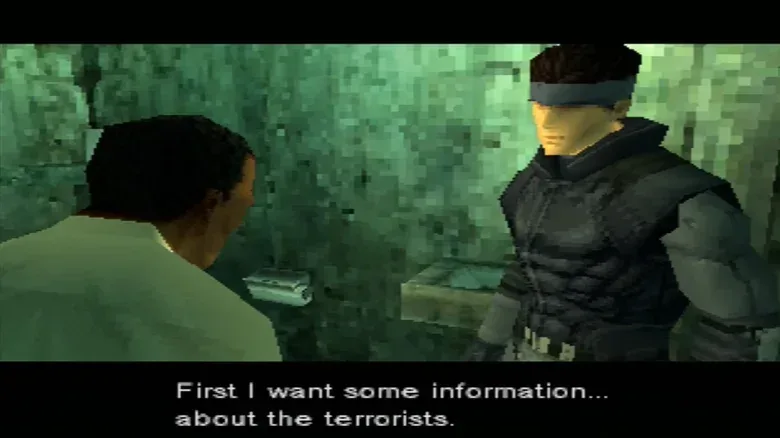
Many of the console's most celebrated releases are a much worse match. A game such as Metal Gear Solid makes extensive use of shoulder inputs and a controller layout that was never intended to be reduced to a basic arcade panel. Resident Evil can be played with a directional input, but its overall design and pacing are rooted in sitting down with a controller. Other defining PlayStation games rely on analog movement, extra buttons, menu navigation, or input combinations that would be awkward at best on this cabinet.
In other words, the machine may contain a large library, but that does not mean its physical interface is suitable for the whole library. The distinction is important. A broad game list is not the same as broad playability.
A widescreen screen creates another retro mismatch
The cabinet's 19-inch LCD introduces a second issue. Original PlayStation games were made for the 4:3 televisions common during the console's life. A modern widescreen panel can still display them, but there is no ideal solution without changing the image.
Keeping the original aspect ratio means black bars at the sides of the screen. Stretching the picture fills more of the display, but distorts characters, environments, and interface elements. Some players may not mind, particularly in fast-moving arcade-style games, but it is another reminder that the cabinet prioritizes a contemporary visual silhouette over a faithful recreation of the original setup.
There is also the question of comfort. Arcade cabinets are designed for shorter, energetic sessions: one more match, one more credit, one more attempt at a high score. The PlayStation was home-console hardware with games meant for long evenings on a sofa. Standing in front of an upright machine for a lengthy role-playing game or a 40-hour adventure is a very different experience from relaxing with a controller.
That does not make the form factor inherently bad. It simply makes it specialized. The cabinet is a better fit for quick rounds of fighting games than for a full playthrough of Final Fantasy.
"Thousands of games" brings legal and support concerns
The seller advertises the cabinet as ready to use with thousands of games and no setup or configuration needed. That convenience is likely part of the appeal for buyers who do not want to learn the technical side of emulation. It is also where the product becomes more complicated.
Emulation software itself can be legal, and retro enthusiasts use it for many legitimate purposes. The legal status of game ROMs and system BIOS files depends on how they were obtained, the laws in a given territory, and the permissions held by the user. Preloading a commercial product with a huge collection of games is a different matter from an individual setting up their own system with software and files they are entitled to use.
For a buyer, the most immediate practical concern may be support. A listing built around unlicensed branded imagery and a preconfigured game library could be vulnerable to removal. If that happens, future buyers may find it harder to contact the seller, obtain help, or resolve issues tied to the product.
The return policy is not especially comforting for an item this large. Returns are accepted, but the customer is responsible for return shipping and a 15 percent restocking fee applies. Shipping an arcade cabinet is not a trivial expense, so discovering that the controls or software setup are not what you expected could become costly.
There are cheaper and better ways to play PlayStation classics
The most frustrating part of this cabinet is that its core technology is not particularly expensive. A Raspberry Pi setup or a small PC connected to a television can offer a more flexible emulation experience for substantially less money. Pair either with a proper controller and the original PlayStation control scheme is preserved rather than approximated.
Existing devices can also be an option for users comfortable with emulation. Software such as DuckStation is built around playing PlayStation titles with appropriate controller mappings, display settings, and other options that can better fit the games than an arcade panel does.
For enthusiasts who want hardware specifically focused on the original console, Retro Remake's Superstation One is another route. Priced at $249, it uses FPGA technology to recreate original PlayStation hardware behavior more directly than standard software emulation. It is not an arcade cabinet, but it is much closer to the way PlayStation games were intended to be played.
Buyers looking for an actual arcade experience can also find officially licensed arcade machines for far less than the custom PlayStation unit. Arcade1Up cabinets, including machines based around games such as Street Fighter II and Mortal Kombat, are often around half the cost. Those games were designed for this kind of control panel in the first place.
A great-looking novelty with a narrow audience
There is no denying the imagination behind the PlayStation arcade cabinet. It takes a console identity that many players still love and places it in a format that instantly commands attention. For someone with a dedicated game room, a large budget, and a fondness for novelty hardware, it could be a memorable decorative centerpiece.
But its best use is also its narrowest one: short sessions with games that naturally suit arcade controls. At more than $1,000 before delivery, it asks buyers to accept a limited control layout, a mismatched display format, standing play for console-length games, and potential uncertainty around its preloaded software.
It is a compelling fantasy of an alternate '90s, one where Sony put a PlayStation cabinet beside the pinball tables and fighting-game machines. That fantasy is fun to look at. For most players, though, it is wiser to admire the idea and spend the money on a setup that lets the PlayStation library work as it was designed to.
Community
Discussion
Start the conversation.
No comments have been posted yet.