

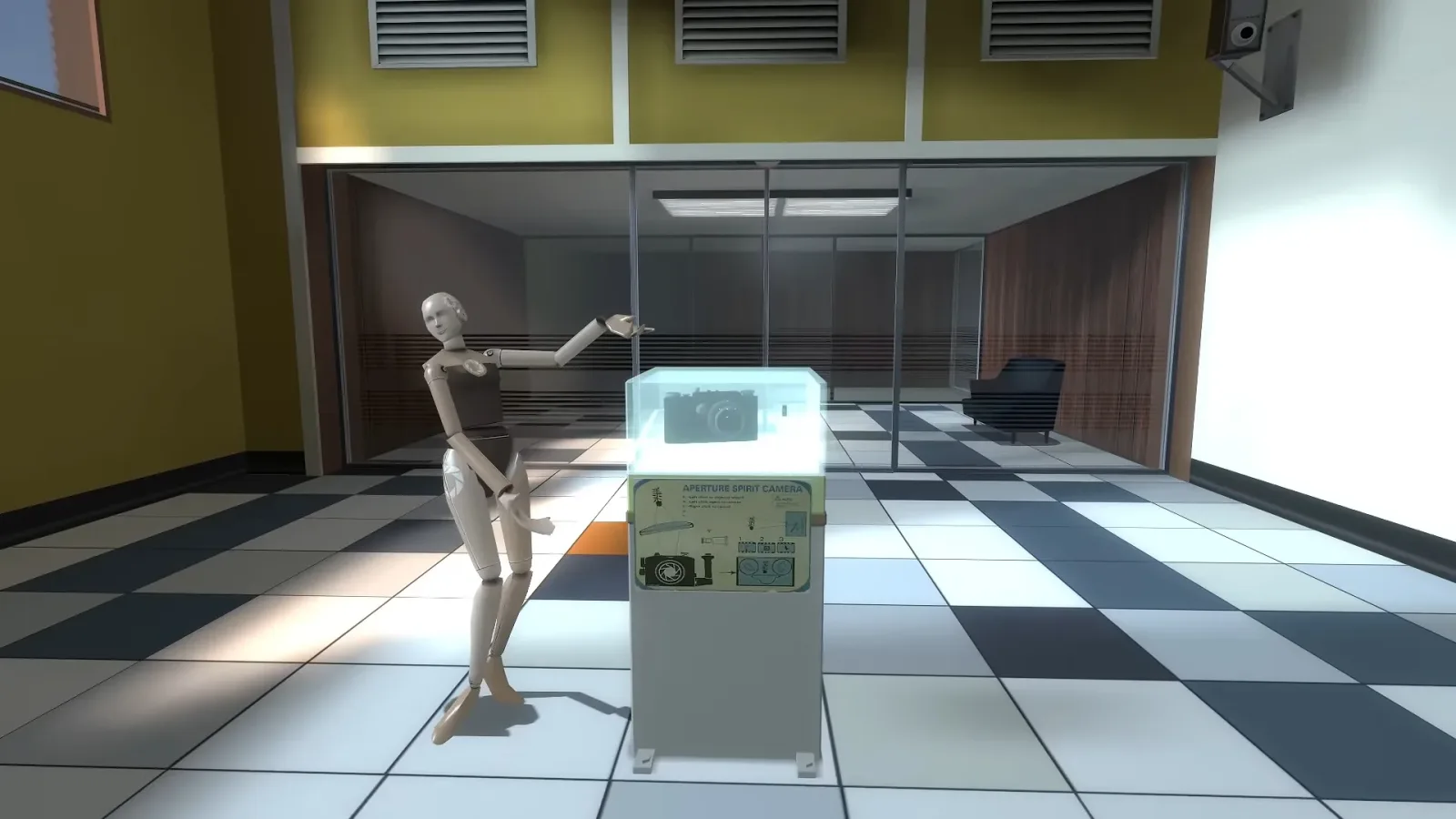
A lost piece of Valve history has reportedly become playable at last. F-Stop, the cancelled experimental project once intended to serve as a prequel to Portal, has been reconstructed by community preservation efforts after material from several separate leaks was brought together.
The result is said to be an almost complete playable build of the game, rather than a small collection of unfinished rooms, isolated assets, or a technical prototype. Players examining the reconstruction have reported a handful of absent assets and missing dialogue lines, but have broadly characterized the build as roughly 99 percent complete. For a project Valve cancelled nearly two decades ago, that is an extraordinary change from the fragments that had previously been publicly known.
F-Stop has long held a special place in the lore surrounding Valve's unused projects. It was not simply an early version of Portal 2, nor was it a conventional sequel. Instead, it was an attempt to take the ideas behind Aperture Science puzzle-solving in a very different direction, using a camera-based mechanic that could manipulate perspective itself.
What F-Stop Was Meant to Be
The project dates back to 2007, when Valve divided staff into five smaller groups for a short period of internal experimentation. The initiative was later described by Valve co-founder Gabe Newell as the Directed Design Experiments. Each team was tasked with developing a distinct game concept, with F-Stop emerging as one of those experiments.
For useful background on this topic, read Overwatch Director Leaves Door Open for PvE Return, but Full Campaign Would Need a New Game.
Its premise positioned it as a prequel to the original Portal. Rather than handing players the familiar portal gun, F-Stop centered on an experimental Aperture Science camera. The camera's intended function was to let players alter their understanding of space, scale, and perspective to overcome puzzle chambers.
That design idea is easy to see as a precursor to the kinds of perspective-driven puzzles that later found an audience in other games, but F-Stop's approach was tied directly to the unsettling corporate laboratories of Aperture Science. It apparently retained the series' interest in clinical test environments, strange technology, and dialogue-driven comedy, while presenting a mechanical foundation markedly different from the two released Portal games.
Newell was reportedly enthusiastic about the work. Playtest feedback, however, did not match that enthusiasm. F-Stop was ultimately shelved, and Valve redirected pieces of its development into what would become Portal 2. Elements including ideas for dialogue, characters, and mechanics were reworked rather than discarded outright, making F-Stop an important part of the creative bridge between the first Portal and its larger 2011 follow-up.
Three Sets of Material, One Playable Reconstruction
The newly playable version was not recovered from one intact archive. It reportedly required three separate sets of leaked material to be combined.
The first major component emerged in late August through a leak commonly referred to as Steam2. That release was said to include around 13 terabytes of Steam depot data spanning the period from 2003 through 2013. Among the enormous collection were assets associated with F-Stop, an unexpected discovery given how little of the cancelled game had been available previously.
Assets alone were not enough to make the project run in a meaningful form. The Steam2 material reportedly did not contain F-Stop's source code or its mapsrc data. In Valve development terminology, mapsrc refers to map source files: the underlying level data needed to work with and reconstruct the game's environments properly.
Those missing pieces reportedly surfaced over the following 48 hours through the Discord community connected to the Valve Cut Content project, a group focused on researching and preserving unused Valve material. Moderators within that community said that the person who initially provided the F-Stop map source data had asked for $1,000, but later released the files without payment.
After the source files were shared, the Valve Cut Content team said it had verified the map data's authenticity. With the earlier asset collection, the newly available code, and the map source material in hand, members of the community were able to assemble the disparate components into a functioning version of F-Stop.
More Than a Curiosity for Portal Fans
The significance of this reconstruction goes beyond the novelty of playing an unreleased Valve game. F-Stop offers a rare look at how one of the industry's most influential studios explored ideas before deciding what belonged in a finished release.
Valve is famously associated with iterations that changed drastically during development. The company's released games often feel polished and decisive, but they are also the end products of concepts that may have been revised, merged, or abandoned along the way. F-Stop appears to be a particularly revealing example because it was built around a strong central mechanic and was far enough along to be playable, yet still failed to clear the internal and external feedback needed to continue.
For players, this could make the build valuable even if it is rough around the edges. An unfinished game does not need to be judged by the same standards as a commercial release to be historically interesting. Missing voice lines, placeholder elements, incomplete polish, and occasional absent assets are part of the record of how the project existed when development stopped.
It may also clarify the relationship between F-Stop and Portal 2. Fans have spent years identifying concepts that appear to have evolved from the cancelled experiment into Valve's eventual sequel. A playable version can provide far more context than concept art, descriptions, or isolated video clips. It allows the puzzle flow, pacing, environment design, and camera mechanic to be considered as parts of an actual game structure.
A Preservation Milestone With Important Caveats
There are still important limitations around the reconstruction. It is reportedly close to complete, but it is not necessarily equivalent to a version Valve would have considered ready for public release. A finished commercial build would likely have received additional bug fixing, visual refinement, audio work, and balancing before launch.
That distinction matters. A reconstructed build can tell audiences a great deal about the project's direction, but it should not be treated as definitive evidence of every final creative decision Valve might have made. Cancelled games are snapshots of a process interrupted, and F-Stop is no exception.
There is also no indication that Valve has plans to officially release F-Stop. The appearance of playable material comes from an unofficial community effort based on leaked development files, not from a formal archival release by the company. Anyone discussing or documenting the project should keep that context in mind, particularly as details surrounding leaks can be incomplete or change over time.
Even with those caveats, the reported reconstruction is a major event for Valve historians and Portal fans. For years, F-Stop existed primarily as an intriguing what-if: an Aperture Science game that could have taken the series down a path built around camera tricks and altered perspective instead of portals.
Now, it can reportedly be experienced as something much closer to the game Valve's experimental team was actually building in 2007. Its survival gives players a new way to examine a formative period for the studio, and a reminder that some of gaming's most fascinating ideas are found not only in the games that ship, but also in the ambitious projects left behind.
Community
Discussion
Start the conversation.
No comments have been posted yet.