

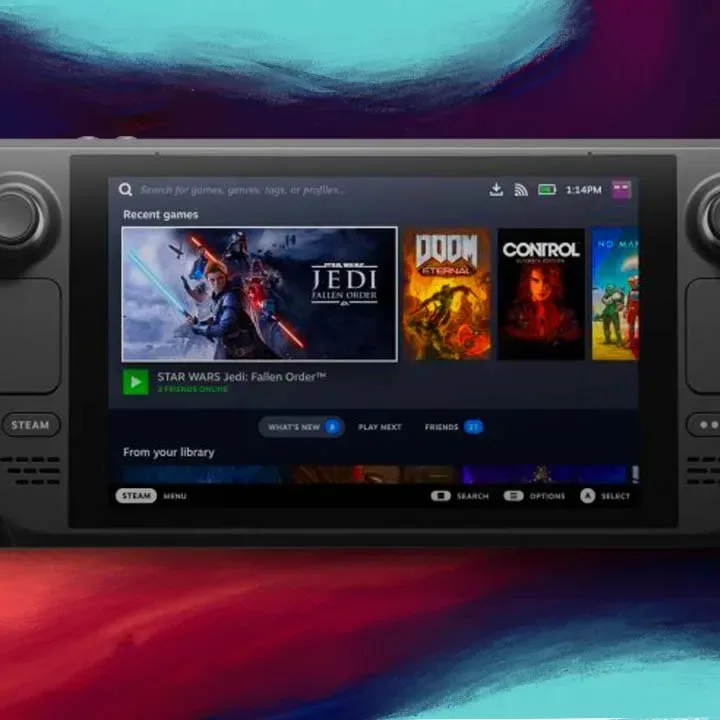
Valve says its broad plans for a Steam Deck 2 have not changed despite continuing pressure on RAM supplies and the higher component costs affecting consumer hardware. The company is still focused on delivering a distinctly more capable handheld rather than issuing a routine refresh, although its comments leave open the possibility that market conditions will help determine when a successor is ready to reach players.
For several years, Valve has maintained that it is working toward a next-generation Steam Deck while resisting the temptation to chase every incremental advance in handheld PC performance. That approach remains in place. The objective is not simply a machine that posts somewhat better benchmark numbers, but one that feels like a genuine new generation while preserving the practical appeal that made the original Steam Deck such a significant device for PC gaming.
That balance has become more complicated as memory pricing and broader hardware costs rise. Handheld PCs depend on a tightly coordinated set of parts, including the processor, integrated graphics, storage, display, battery, cooling, and memory. Any major increase in one area can alter the final price of a device substantially. For a product designed around accessibility as much as raw performance, that creates an obvious challenge.
Valve's target is still a meaningful generational leap
Valve software developers Pierre-Loup Griffais and Jeff Leinbaugh addressed the situation in a recent conversation about the company's hardware plans. Asked whether the ongoing RAM shortage had changed the outlook for a future Steam Deck, Griffais indicated that it had not meaningfully shifted the team's core direction.
For useful background on this topic, read Wonders of O Trademark May Reveal the Name of the Next Lies of P Game.
"Not really," Griffais said, explaining that Valve is still looking for a clearly defined improvement in performance for a future Steam Deck.
He added that Valve is assessing present-day conditions and considering how and when it can provide that sort of product, but said its user-experience aims and the nature of the device it wants to build remain broadly similar. In short, the specification target appears to be intact even if the route and timetable toward it cannot be treated as fixed.
That distinction matters. A company can continue developing hardware, software features, industrial design ideas, and operating-system improvements without committing to a near-term retail launch. Valve's statement is reassuring for players waiting for a Steam Deck 2, but it is not a release-date announcement. No launch window, pricing, specifications, or final configuration was provided.
It does, however, reinforce the philosophy Valve has expressed since the original Steam Deck arrived: a sequel should offer enough additional capability to justify asking existing owners to consider upgrading. In the rapidly evolving handheld PC market, that is a more demanding standard than merely adopting a newer chip generation.
Why memory costs matter so much for handheld PCs
RAM is an especially important consideration in devices such as the Steam Deck because the processor and graphics hardware draw from shared system memory. That memory has to support the operating system, desktop applications, game data, and graphics workloads within a compact machine constrained by power consumption and heat. Higher-performance memory can be central to overall responsiveness and gaming performance, but it can also raise manufacturing costs.
Those pressures do not exist in isolation. Rising costs tied to memory can affect graphics cards, consoles, PCs, and portable gaming systems across the industry. For Valve, the concern is particularly visible because the Steam Deck's identity has always involved offering a capable PC gaming handheld at a price more approachable than many premium alternatives.
More powerful Windows-based handheld gaming PCs have arrived since the first Steam Deck launched, demonstrating that increased performance is possible in a portable form factor. Yet those systems frequently sit at moderately higher or dramatically higher prices. Their presence illustrates the tradeoff Valve is attempting to avoid: pushing specifications forward is easier than delivering those specifications at a price that makes sense for a wide audience.
A Steam Deck 2 therefore needs more than faster parts. It needs a configuration that can meet Valve's performance expectations, fit a handheld power and thermal envelope, work smoothly with SteamOS and the company's controller-focused interface, and still be sold at a price that does not undermine the platform's value proposition.
The price-to-performance question remains central
Valve's current comments suggest that price-to-performance remains the decisive issue. The company is not signaling that the RAM situation has cancelled or fundamentally redirected Steam Deck 2 work. Instead, it is emphasizing that external conditions remain part of the calculation behind a launch.
That is a sensible position for a device whose success has been closely connected to its balance of capability and cost. The Steam Deck was never solely about having the absolute fastest portable PC hardware. Its appeal also came from SteamOS, console-like controls, a flexible PC library, repairability considerations, and the prospect of playing many existing Steam games away from a desk. Still, value was a major part of the package.
There is evidence of how sensitive that equation can be. The 512GB Steam Deck OLED model, which previously cost $549, has reportedly risen as high as $789 amid ballooning hardware prices. A jump of that size can narrow the audience for a device that initially stood out as a comparatively attainable entry point into PC handheld gaming.
For Valve, releasing a Steam Deck 2 before costs are in a more favorable place could create a difficult choice. It could absorb some of the expense, limit certain specifications, or pass costs to buyers. None of those options is ideal if the goal is to create an obvious performance advance without making the system feel prohibitively expensive.
Valve's more recent hardware activity also shows that it can take a different approach when appropriate. The Steam Machine and Steam Frame indicate that the company is willing to sell products in an environment of elevated component prices rather than waiting indefinitely for costs to fall. But that does not mean every product category should be treated the same way. A higher-priced piece of hardware can occupy a different role from the Steam Deck, which has built much of its reputation around delivering a portable PC experience at a relatively consumer-friendly level.
A sequel should not be confused with an annual refresh
The absence of a rapid Steam Deck replacement has occasionally stood out amid competitors that move quickly to newer processors and revised models. Valve's strategy appears deliberately different. Rather than trying to establish an annualized cycle, it is waiting for technology that can create a clear separation between the first-generation system and the next one.
That approach offers some benefits for current owners. A meaningful generational transition is easier for developers and consumers to understand than a long sequence of modestly faster revisions. It also reduces the risk that early Steam Deck buyers will feel their hardware has been immediately superseded by a marginal update.
There are tradeoffs, of course. New games continue to become more demanding, and rival handheld systems will continue to market better performance figures. Valve will need to decide when the gap between the original Deck and available technology is large enough, affordable enough, and efficient enough to meet its stated threshold.
The company's comments make clear that it is not simply ignoring that race. It is evaluating the hardware landscape through a different lens, one that places equal weight on the experience delivered to players and the economic reality of building the machine.
Valve's hardware lineup is already expanding
While Steam Deck 2 remains a future project without a confirmed launch date, Valve is not short on hardware presence. Its 2026 slate of devices is now out in the wild, including the Steam Machine and Steam Frame. That wider lineup gives the company additional places to experiment with PC gaming hardware and the Steam ecosystem while it continues planning the next step for its handheld.
The Steam Frame, in particular, is part of a period in which Valve is showing renewed willingness to explore different hardware categories. That does not reveal the Steam Deck 2's exact design or specifications, but it does underline that the company continues to invest in the broader experience around Steam, SteamOS, and dedicated gaming devices.
For prospective buyers, the practical takeaway is straightforward. Valve has reaffirmed the direction of Steam Deck 2 development, but there is still no reason to expect an immediate announcement simply because the project remains active. The company wants a major performance jump, and it wants to find a path to delivering that jump under real-world component and pricing conditions.
Until those two requirements align, the existing Steam Deck family remains Valve's handheld offering. When a successor does arrive, Valve's latest comments suggest it will be intended as more than a minor technical revision: it is being positioned as a deliberate generational step forward, shaped as much by affordability and usability as by the pursuit of higher frame rates.
Community
Discussion
Start the conversation.
No comments have been posted yet.