

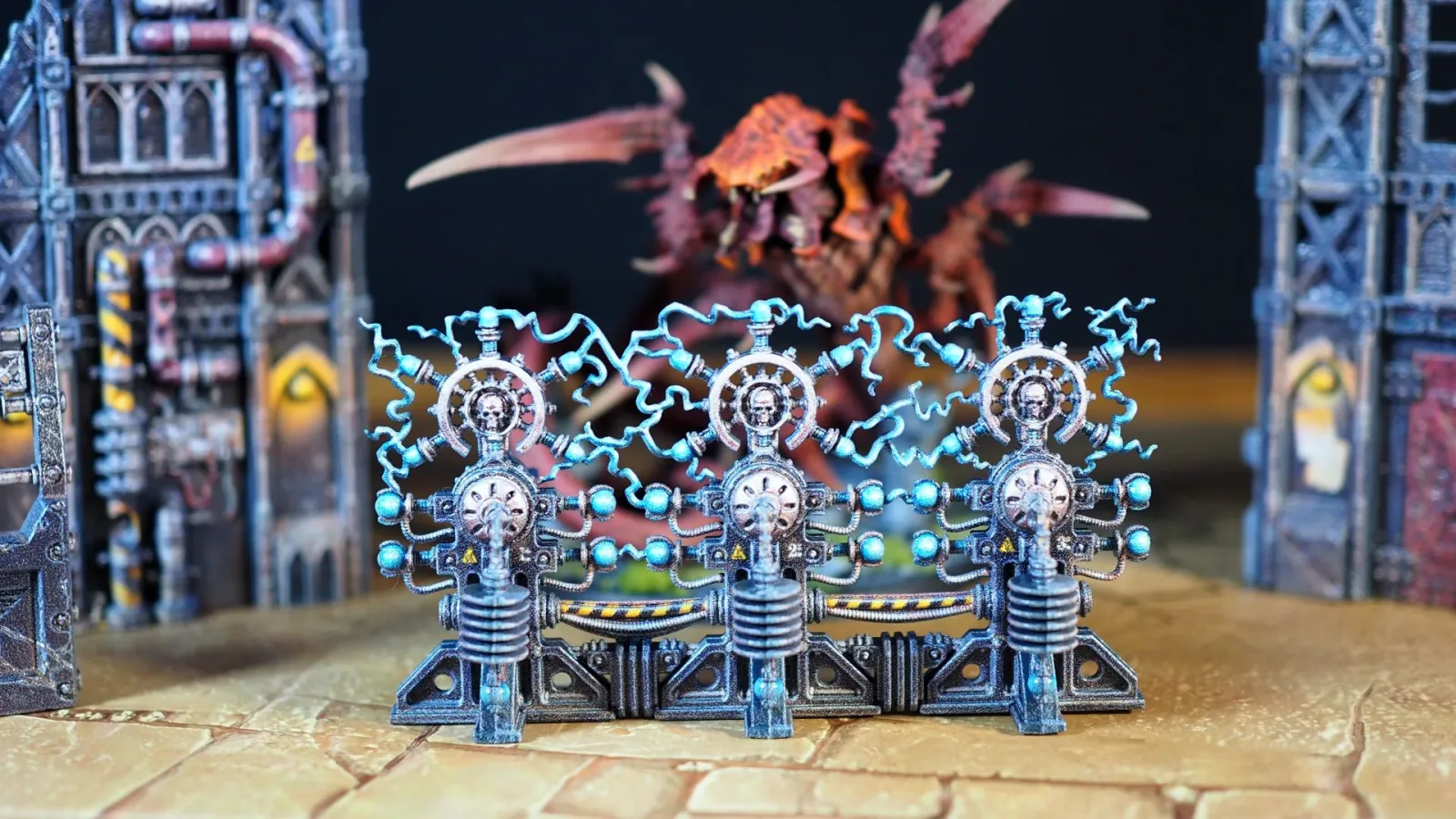
Building a Warhammer 40,000 army is already a serious commitment. Players must choose a faction, assemble dozens of miniatures, paint them, learn their rules, and find the time to actually get games on the table. Terrain is often the last job on the list--not because it is unimportant, but because making a full board of scenery can feel like beginning an entirely separate hobby project.
Warhammer 40,000 Battlefields: Armageddon is designed to reduce that barrier dramatically. The new boxed terrain collection contains pre-painted scenery that arrives on sprues, with parts intended to be clipped out and assembled without glue. Rather than asking players to construct bare ruins and then spend days painting industrial walls, rubble, pipes, and weathering, the set seeks to provide a usable battlefield almost immediately.
It is an ambitious idea for a game where a table's appearance can be as intimidating to newcomers as an army's price and painting demands. Early hands-on impressions suggest the execution is convincing: it is not a replacement for a fully custom display board created by an experienced hobbyist, but it may be one of the quickest ways to make a standard 40K game look appropriately dramatic.
A battlefield without the long painting queue
The central appeal is simple. Warhammer terrain has traditionally required the same sequence as miniatures: cut parts from sprues, clean mold lines and connection points, glue the model together, prime it, apply base colors, add details, shade it, drybrush it, and potentially add weathering or scenic effects. A single building can take a while. A collection large enough to cover an entire board can take months when fitted around normal life and army painting.
For useful background on this topic, read Konami President Downplays AI's Potential to Transform Game Development.
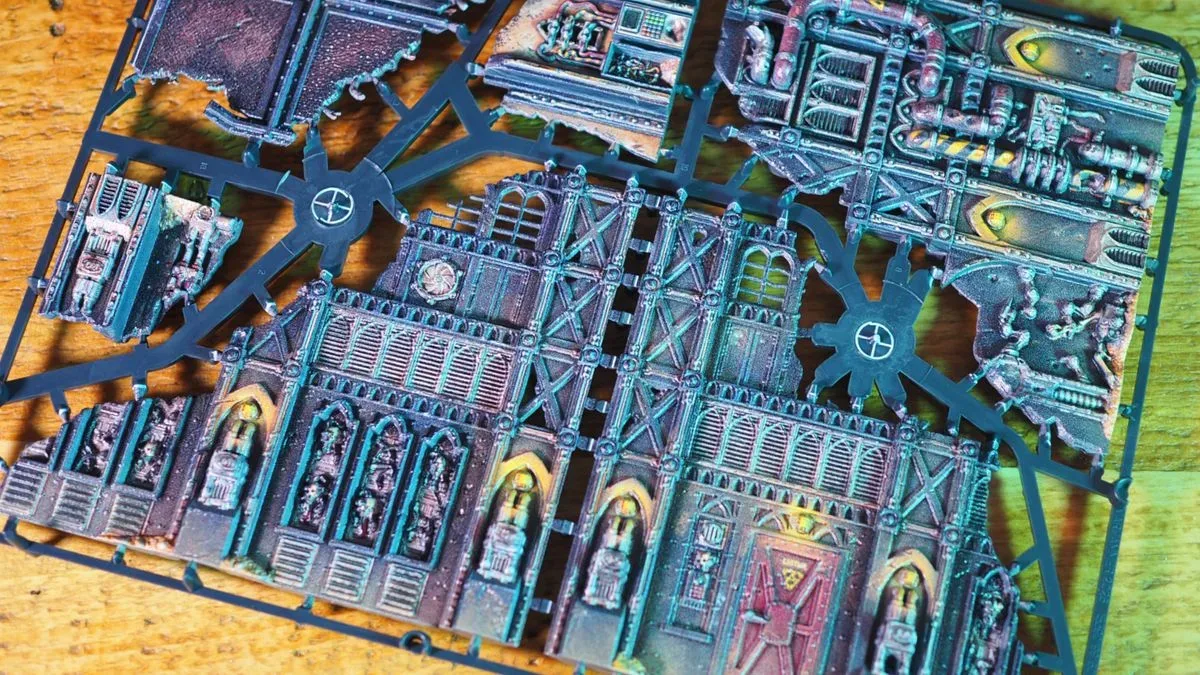
Battlefields: Armageddon changes the process by putting painted color directly onto the plastic while it is still on the sprue. Players still have some assembly work to do, and the contents are substantial enough that putting everything together will not literally take only a few minutes. Expecting at least an hour or two for clipping and construction is more realistic for a complete set.
That is nevertheless a vastly different proposition from preparing and painting every item from scratch. The box is built around push-fit construction, meaning glue is not required for the basic assembly. For players who want scenery that can move from packaging to gaming table in a single session, that convenience is the point.
It could be especially valuable for people starting a new force, preparing for regular games with friends, organizing a club table, or assembling a home setup where painted scenery has remained an unresolved project for years. A fully realized board changes the character of a match. It creates clearer sightlines, provides cover and movement challenges, and makes the miniatures feel as though they belong in a real conflict zone rather than on a mostly empty surface.
The Armageddon look suits the technology
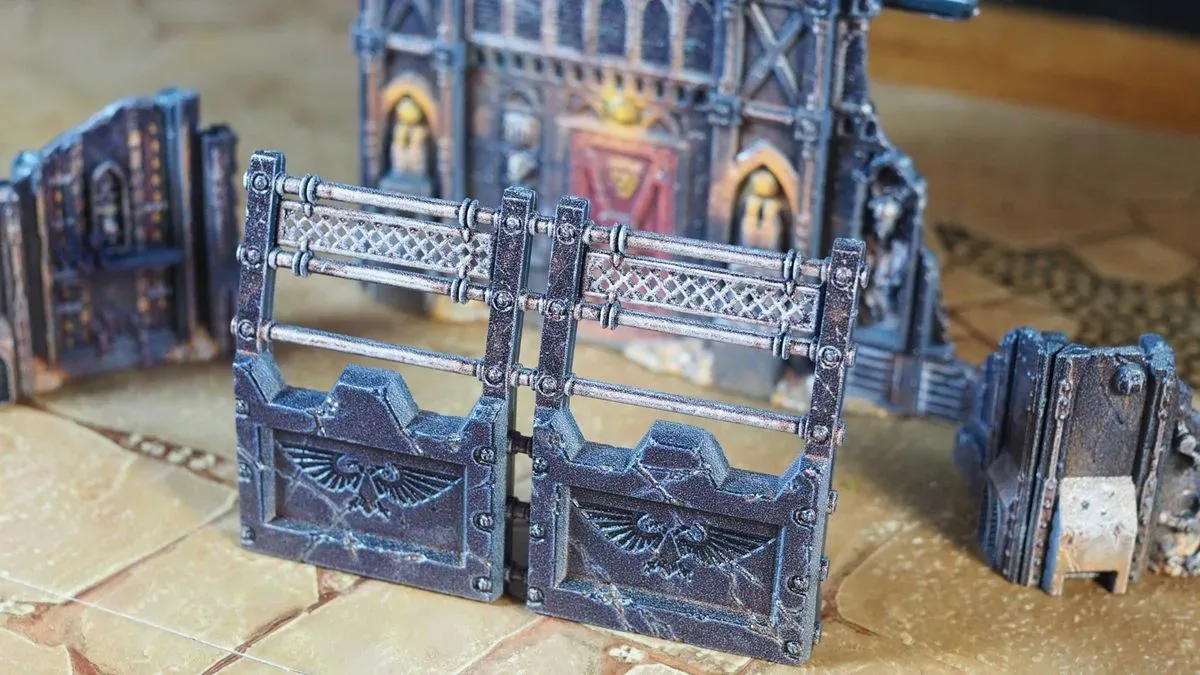
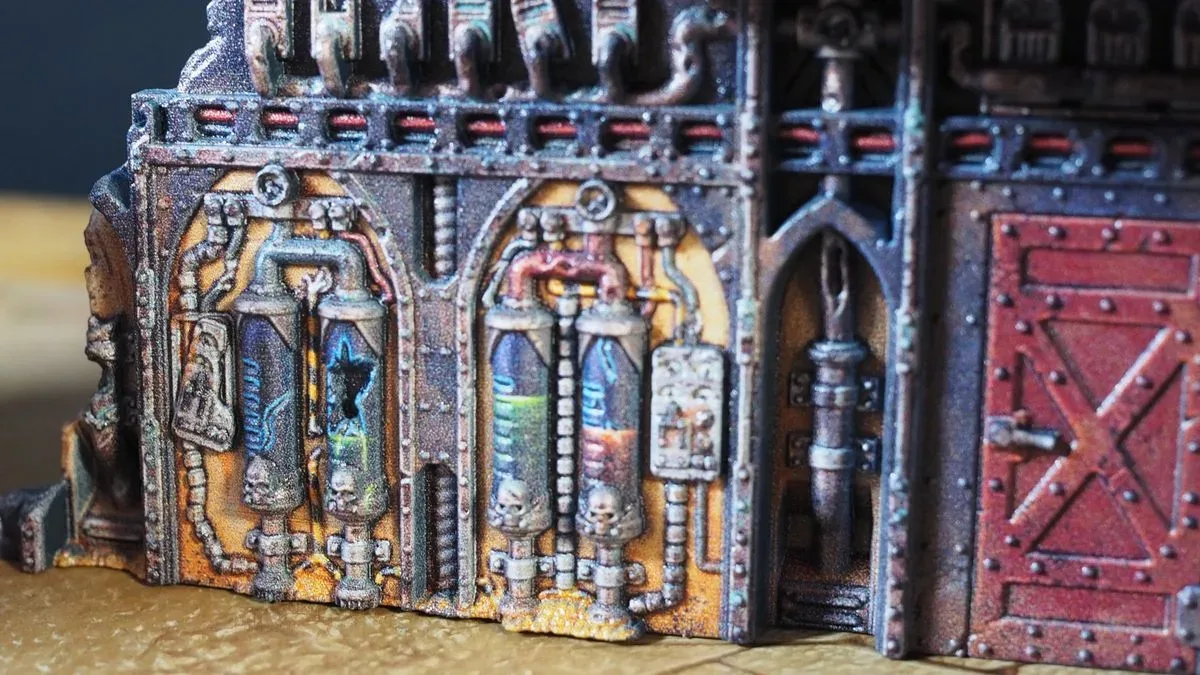
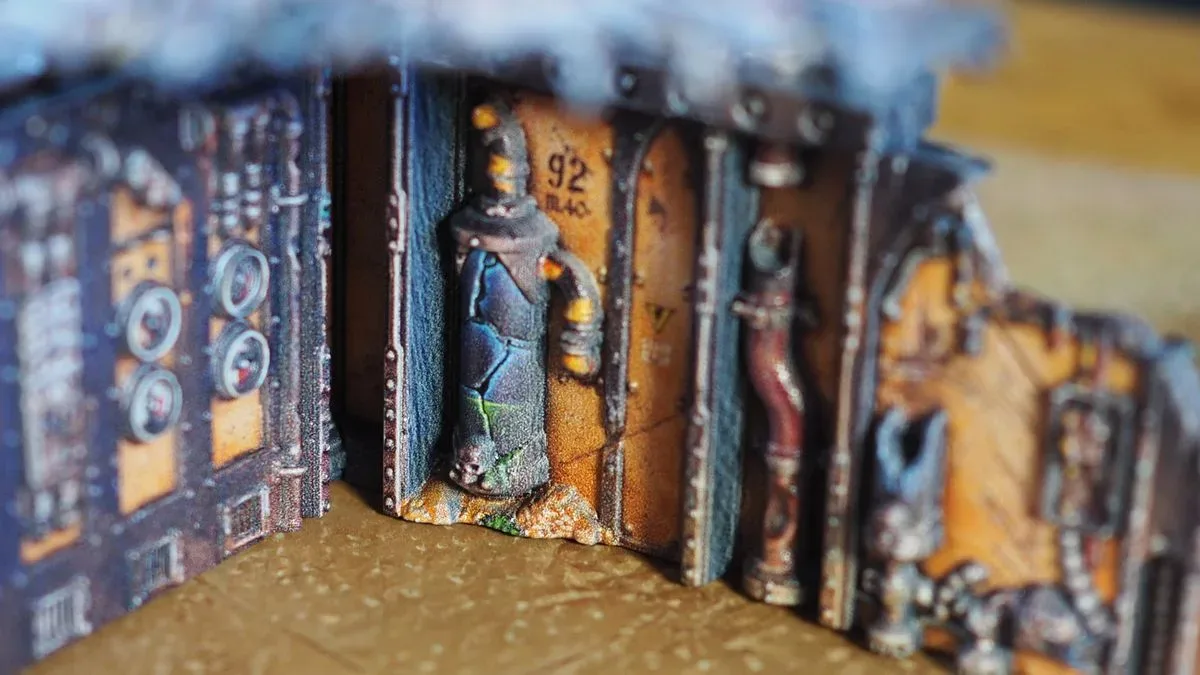
The pre-painted finish uses UV printing, a process in which paint is applied and cured quickly with ultraviolet light. There are limits to what that method can replicate compared with a meticulous hand-painted finish. The result has a somewhat grainy quality, and some of the smallest visual details do not carry the same depth a hobbyist might achieve with a brush, washes, and carefully placed highlights.
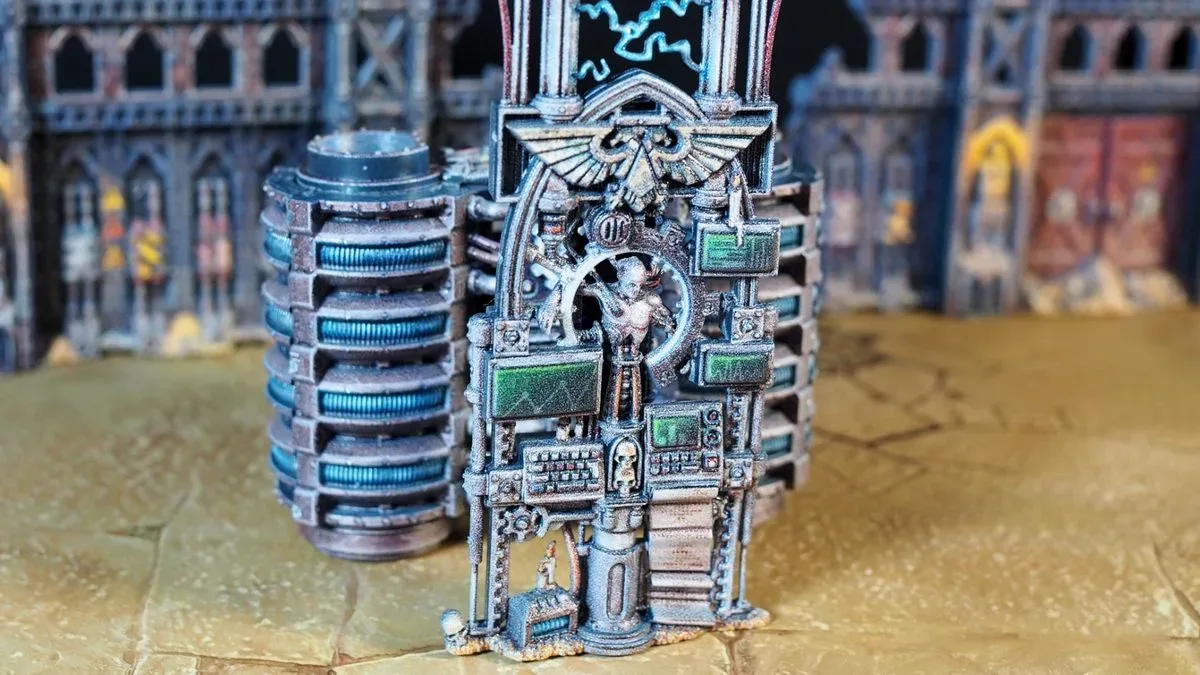
Yet Armageddon is an effective setting for that approach. The planet's war-torn industrial identity fits chipped-looking surfaces, muted tones, dust, grime, and damaged infrastructure. The finish has a roughness that complements Warhammer 40,000's famously bleak far-future aesthetic instead of obviously clashing with it.
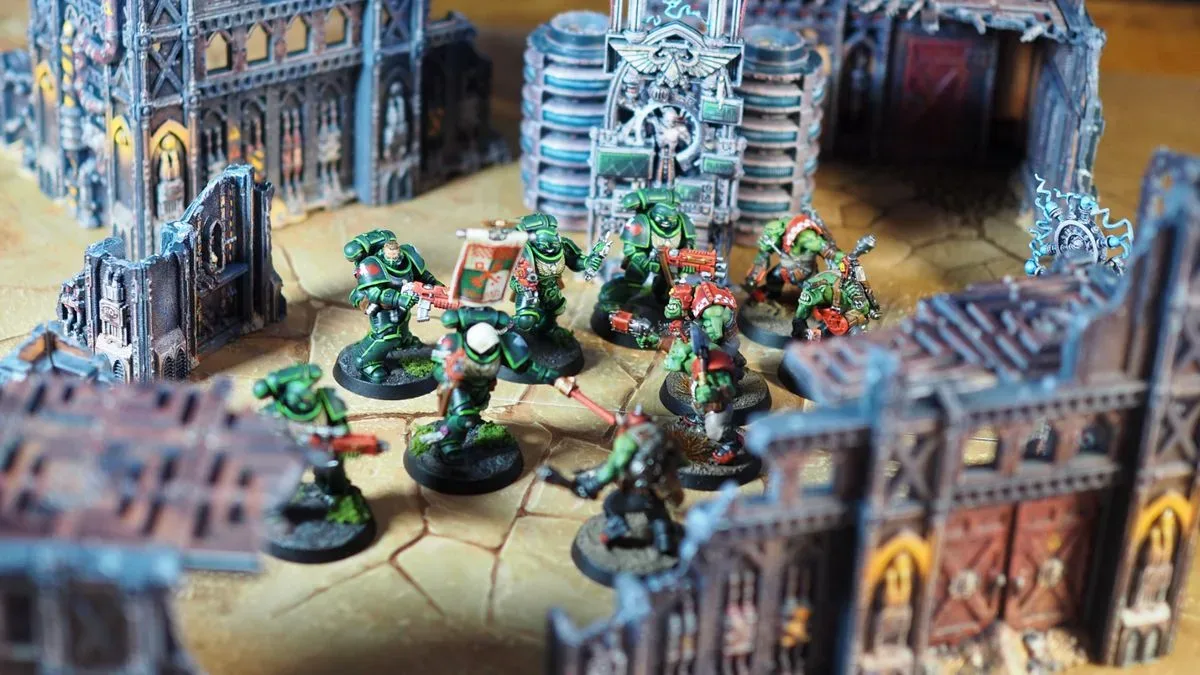
More importantly, the scenery appears restrained enough to serve its proper role: it frames the action rather than competing with the armies. Well-painted miniatures should still be the first thing players notice on the table. An over-detailed or overly colorful board can occasionally swallow the figures placed on it, especially when a faction already uses dark armor or complex camouflage. The Armageddon terrain's industrial styling gives models contrast while preserving the atmosphere of a devastated Imperial battlefield.
That balance matters beyond appearance. Terrain in a tabletop war game has to be readable. Players need to see where units can stand, which barriers provide cover, and how the footprint of a ruin affects movement. Scenery that looks impressive from a distance but becomes confusing during play can make games less enjoyable. A cleanly produced, consistent set has practical benefits alongside its visual ones.
Precision is one of the biggest advantages
Painting terrain by hand often involves compromises. Many hobbyists can produce excellent scenery, but broad surfaces, repeated components, pipes, broken masonry, exposed cables, and metallic details can turn into a laborious procession of small tasks. The temptation is to rush portions that will rarely receive close attention, particularly after finishing a large army.
The printed treatment in Battlefields: Armageddon provides a degree of neatness and consistency that would take considerable effort to reproduce manually across an entire table. Larger focal details are said to come through particularly well, even if certain less conspicuous elements are simplified by the process. For many players, that trade-off will be easy to accept. A uniformly finished board that is ready now can be more valuable than an aspirational masterpiece that remains half-painted in storage.
The set will not satisfy every hobbyist in exactly the same way. Some players enjoy terrain-making as much as painting armies, creating foam landscapes, scratch-built wreckage, and 3D-printed structures. Custom boards can also tell a specific story, whether that means an Ork scrapyard, a shrine world, a jungle death world, or an elaborate narrative battlefield built around a campaign.
But pre-painted scenery does not remove those options. It can instead serve as a dependable foundation: a complete board that works immediately and can later be expanded with personal details. Hobbyists may still add pigments, flock, posters, battle damage, extra debris, LEDs, or customized objectives if they want to make the board their own. Starting with a finished baseline is very different from having to create every structural piece before those enjoyable embellishments are even possible.
Sprue marks remain the main compromise
The most obvious limitation is an unavoidable one. Because the terrain is painted before it is removed from the sprue, clipping the pieces free leaves small areas of exposed gray plastic at their connection points. These nubs are a familiar issue for anyone who has assembled plastic miniatures, but they stand out more on pre-finished terrain because the rest of the object is already colored.
Fortunately, many of the connection points are positioned where they will be concealed during assembly. On rounded components and more exposed surfaces, however, the marks may remain visible on close inspection. The grimy, distressed look of the set helps disguise them at normal tabletop distance, and players seeking a cleaner finish could touch those areas up with a little paint.
That minor cleanup does not undermine the box's purpose. It simply establishes realistic expectations. Battlefields: Armageddon is about speed, cohesion, and convenience, not about delivering a flawless competition-level paint job with no intervention whatsoever. The crucial difference is that any optional touch-up work is exactly that: optional. The terrain is intended to look complete even if players choose not to do anything beyond assembly.
A premium shortcut, with a premium cost
Convenience at this scale comes at a substantial price. The set was estimated at roughly the cost of two Combat Patrol boxes, or around $350 / £220. It is available to pre-order directly from Warhammer ahead of its October 31 release. Independent miniature retailers may also offer discounts, depending on region and stock.
That cost will make Battlefields: Armageddon a careful purchase rather than an automatic one. Players willing to invest hobby time can certainly assemble a terrain collection for less money through homemade materials, 3D printing, second-hand finds, or unpainted kits. Existing hobbyists may also already own enough scenery to fill a board.
Still, time has value. For someone who has repeatedly postponed terrain painting, the price is not just paying for plastic. It is paying to avoid one of the hobby's largest remaining backlogs. The set offers the possibility of a visually coherent 40K battlefield without adding dozens of hours of painting to an already crowded project list.
A promising direction for pre-painted terrain
Battlefields: Armageddon may be more significant than a single scenery release. If the concept finds an audience, it points toward a future where pre-painted terrain becomes a regular option for different games and settings. Smaller Kill Team environments would be natural candidates, as would fantasy battlefields for Warhammer Age of Sigmar.
The appeal is easy to understand. Tabletop gaming thrives when people can spend less time struggling to reach a presentable starting point and more time playing memorable games. Traditional hobbyists will continue to make extraordinary boards by hand, and their work remains one of the great pleasures of the miniature scene. But not every player wants--or is able--to take on that level of commitment.
For those players, Warhammer 40,000 Battlefields: Armageddon looks poised to offer a compelling alternative: a board that captures 40K's battered industrial grandeur, gives armies a fitting stage, and gets there in hours rather than weeks. That may make it one of the more practical premium releases for anyone determined to finally stop fighting on an unfinished table.
Community
Discussion
Start the conversation.
No comments have been posted yet.