

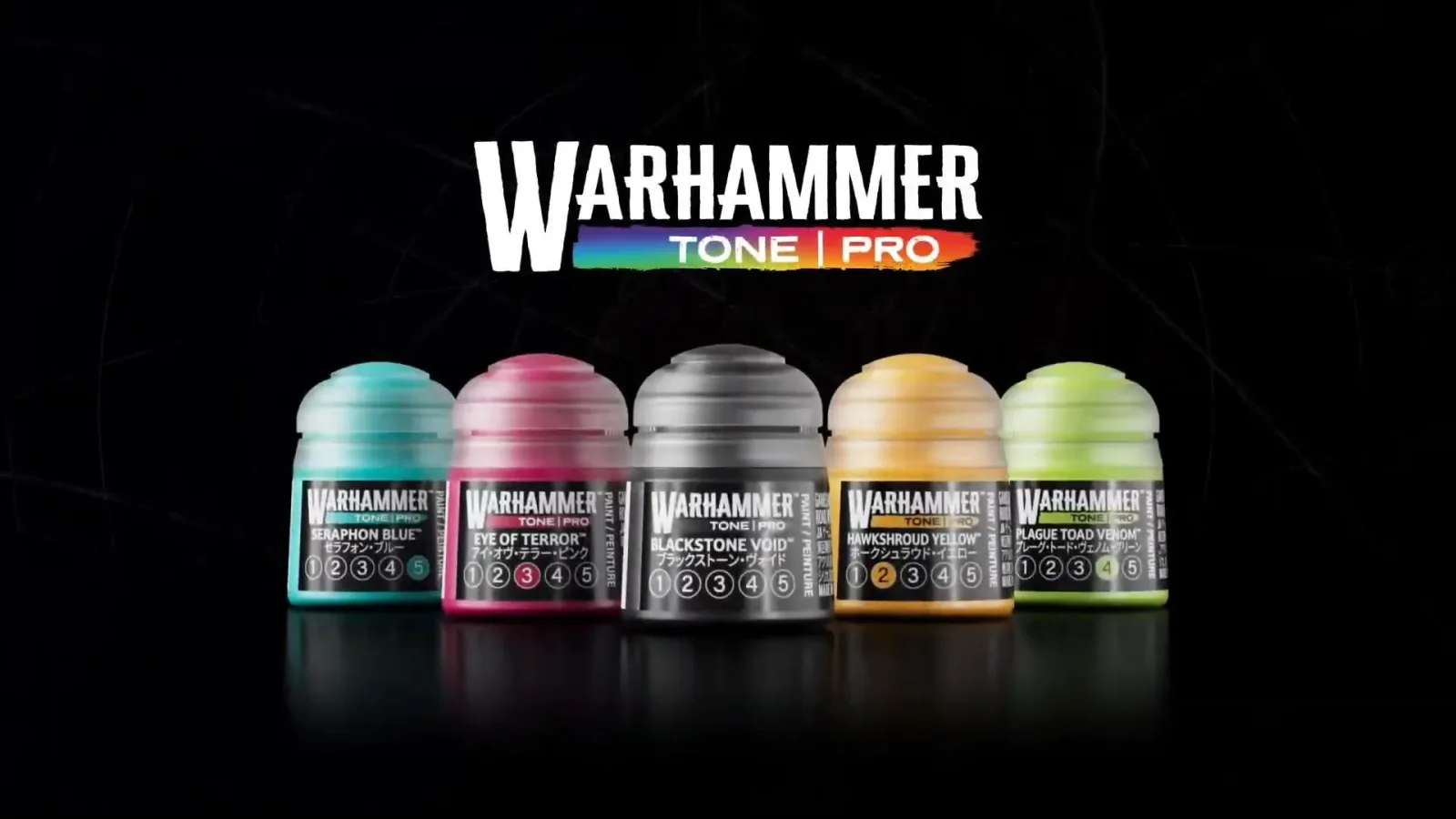
Warhammer miniature painting has long had one rule that veterans repeat to newcomers almost as often as they recommend priming a model: use two thin coats. It is sound advice, because building colour gradually has traditionally been the most reliable way to get a clean, opaque finish without filling fine sculpted details with paint. But early demonstrations of the newly announced Warhammer Tone Pro range are prompting fans to wonder whether that old wisdom could be about to change.
Revealed during the Big Autumn Warhammer Preview, Tone Pro is being presented as a new kind of paint line built around strong pigmentation, broad coverage and improved flow. Those are attractive promises on paper, especially for hobbyists who have spent years managing streaky first coats or correcting paint that settles too heavily in the wrong areas. What has generated the biggest response, however, is footage showing the paints apparently leveling themselves after they have been applied in unusually thick layers.
The result has led to a rare sight in miniature-painting circles: people enthusiastically watching paint dry.
Embedded Instagram post
A stress test that caught the community's attention
Professional miniature painter Louise Sugden, known online as Savage Ork Guy, has had hands-on time with the new range. In one particularly striking demonstration, Sugden deliberately applies a very heavy amount of Tone Pro paint to a miniature to test its self-leveling behaviour. This is precisely the sort of application that normally makes experienced painters nervous. Too much conventional acrylic paint can pool in recesses, form visible ridges, obscure edges and soften small details such as facial features, armour trim, chainmail or decorative icons.
For useful background on this topic, read Halo: Campaign Evolved Becomes a 25-Year Test of Friendship and Play.
In the early Tone Pro footage, the heavily applied paint appears to settle into a consistent base layer as it dries while leaving the miniature's sculpted detail readable. The visual effect has been compelling enough that a fan discussion titled "What sorcery is this" drew roughly 8,900 upvotes. Another response neatly framed why the clip has become so popular: "The age of two thin coats is over. The time of the one thick coat has come."
The joke borrows a familiar line from The Lord of the Rings, but it gets at a real point. A paint that can tolerate a less precise application while retaining a smooth, clean appearance could remove one of the most frustrating barriers for people beginning the miniature hobby. It could also save substantial time for established painters working through large squads, armies and board game collections.
Why "two thin coats" became hobby gospel
For decades, painting in thin layers has been one of the core techniques of the Warhammer hobby. Standard paints vary in opacity depending on the pigment, so a single coat can look patchy or leave the underlying primer visible. Adding paint too thickly may solve coverage issues initially, but it introduces bigger problems: brush marks, unwanted texture, pooling, and lost definition.
That is why the classic approach asks painters to thin their paint with water or a medium, apply a controlled coat, let it dry completely, then repeat. The process works, but it takes practice. Learning how much paint should be on the brush, how much thinning is appropriate, and how quickly it needs to be moved around a model can be intimidating. It also becomes slow when repeated across dozens of similarly equipped figures.
Tone Pro's apparent ability to smooth out after a generous application could potentially simplify that stage. It is important to stress that the footage seen so far is an early showcase rather than a substitute for broad, independent testing. Paint performance can change depending on the colour, the primer beneath it, local temperature and humidity, brush type, surface preparation and the shape of the miniature. A flat shoulder pad and a deeply detailed cloak may not behave in exactly the same way.
Still, the demonstration addresses an issue nearly every painter understands immediately. If the behaviour holds up across the range, Tone Pro may allow hobbyists to achieve dependable basecoats with a much wider margin for error than conventional miniature paints permit.
Not the same job as Contrast and Speedpaint
The hobby market already has products designed to make miniature painting faster. Citadel Contrast paints and comparable ranges such as Army Painter Speedpaint are intended to flow over a light undercoat, gathering in recesses while leaving raised areas lighter. That creates shadows and highlights in a single step, and it can produce attractive tabletop-ready results rapidly.
But speed-paint products are not effortless in every situation. They have their own techniques and limitations. Too much paint in one area can leave tide marks, and painters frequently need to work quickly and deliberately to avoid uneven drying. They are also used for a different visual purpose: rather than laying down a fully uniform, opaque basecoat, they are generally designed to create immediate variation in tone across a model.
Tone Pro appears aimed at a more fundamental part of the process. Its promise is not simply fast colour with built-in shading; it is a solid, even foundational coat with strong coverage and flow. That distinction may be important for painters who use traditional layering, edge highlighting, glazing and weathering techniques afterward. A reliable opaque basecoat is valuable whether the eventual project is a parade-ready character model, a competitive army, or a quickly painted set of gaming miniatures.
It may also make Tone Pro appealing to painters who never quite got comfortable with the particular handling required by Contrast-style products. One of the range's potential strengths is that its initial demonstrations look accessible: put paint on the miniature, and let the paint do more of the work of settling evenly.
Experienced painters are watching closely
The excitement is not limited to beginners hoping for a gentler entry point. Warhipster, a creator well known for painting with Contrast-style methods, was among the painters who were able to try Tone Pro before its public reveal. Their early reaction has been highly positive, adding weight to the community interest around the new formula.
That enthusiasm matters because experienced hobbyists tend to recognize how challenging it is to balance opacity, flow and detail preservation. High pigment density is useful, but paint that is too heavy can be difficult to manipulate. Strong flow can help paint settle smoothly, but uncontrolled flow can send it into recesses where it is not wanted. A formula that manages to provide coverage while remaining forgiving would be a meaningful technical achievement, not merely a convenience product.
There is also a practical army-painting angle. Large Warhammer forces often involve repeating colours across numerous miniatures: armour panels, cloth, weapons, skin tones, shoulder markings and vehicle sections. Even a modest reduction in the number of passes needed for each colour could add up over an entire collection. Painters who enjoy the creative parts of the process but find basic basecoating laborious may have particular reason to keep an eye on Tone Pro.
Excitement is warranted, but real-world testing will matter
For now, the strongest evidence comes from curated early demonstrations, so it is sensible to keep expectations measured until more people have used the paints across a wide range of projects. The most revealing tests will involve different colours, particularly traditionally troublesome pigments, alongside complex sculpts packed with texture and recesses. Painters will also want to see how Tone Pro behaves over black, white, grey and coloured primers, as well as whether it performs consistently when used for brushwork rather than in a deliberately dramatic stress test.
Questions remain about the range's practical characteristics too. Hobbyists will be interested in drying time, how easily colours mix, whether the finish responds well to washes and highlights, and how it holds up on larger surfaces. None of those questions undermine the promise of the self-leveling footage; they simply reflect how many variables go into deciding whether a paint becomes a permanent fixture on a painting desk.
Even so, the early response is understandable. Miniature painters are accustomed to techniques that reward patience, precision and repetition. Seeing a thick application apparently resolve into a crisp, opaque coat without swallowing the miniature beneath it feels counterintuitive because it runs against one of the hobby's oldest cautions.
If Warhammer Tone Pro consistently delivers the coverage, flow and self-leveling qualities shown in these first hands-on demonstrations, it could become useful to everyone from first-time painters to veteran collectors. The familiar instruction may not disappear entirely--thin layers will always have a place in detailed painting--but Tone Pro could make the path to a clean first coat considerably less demanding. For a community used to carefully controlling every drop of paint, that is enough to make watching it dry feel like an event.
Community
Discussion
Start the conversation.
No comments have been posted yet.