

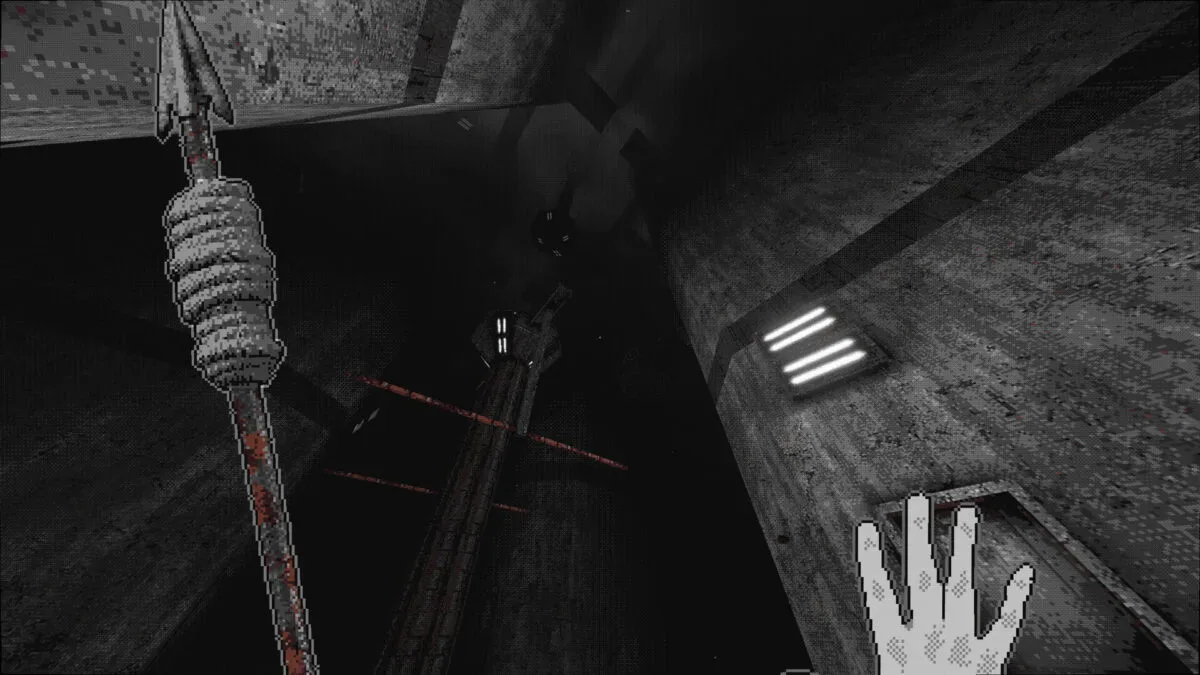
White Knuckle takes a simple premise--climb before the deadly material below reaches you--and turns it into an unusually physical brand of horror. It is not a game about effortlessly scaling a mountain or admiring a vista after a difficult route. It is about gripping a ledge with one increasingly exhausted hand, desperately searching a backpack for the right tool, and realizing that every second spent organizing supplies is another second closer to being swallowed by toxic sludge.
Currently available in Early Access on Steam, with a free demo also available, White Knuckle arrives at a moment when climbing games have become a surprisingly broad genre. There are quieter, contemplative climbs, more social ascents, and games where traversal is only one component in a much larger adventure. White Knuckle takes the opposite direction. It narrows the experience until climbing is nearly everything, then adds roguelike uncertainty, resource management, a relentless timer, and looming horror to make each upward movement feel dangerous.
A climb controlled one hand at a time
The defining idea behind White Knuckle is that the player is effectively embodied as a pair of hands. Progress comes from grabbing edges, ledges, and handholds individually. That sounds straightforward, but the game makes the act of holding on feel like an active problem rather than a background animation.
Hands visibly strain as they bear weight. Their color shifts from pale to pink and eventually red, providing an immediate warning that a grip is becoming unsustainable. Rest is necessary, but rest costs time. Beneath the player, a hazardous sludge continually rises through the structure. Fall into it and the run ends, with a new map waiting on the next attempt.
For useful background on this topic, read Halo Studios Cinematic Director Says He Was Promoted and Laid Off in the Same Week.
That loop gives the game a roguelike edge without making its tension feel abstract. A bad route choice, a missed grab, or a few moments lost handling inventory can have consequences far beyond a single stumble. The danger is always spatial and immediate: the player can see the climb above, feel their hands weakening, and know there is no safe ground waiting below.
White Knuckle is described as a speed-climbing game, though its speed does not seem to come from uncomplicated movement or reflex alone. Fast ascent requires judgment. Players need to decide when to pull themselves up carefully, when to swing, and when it is worth jumping for a more distant grip. Moving too cautiously leaves too much time for the sludge to close in. Moving recklessly can waste stamina or send the player tumbling.
Tools create options, but also difficult tradeoffs
The climb is not limited to natural handholds. White Knuckle provides equipment that can alter a route, but each item introduces another layer of pressure. A hammer carried in the pack can be used with found picks to create new handholds in walls. A metal rod can be thrown at a distant surface, potentially creating a point to grab, swing from, or stand upon.
Those are powerful possibilities in a game built around reaching places that may otherwise be inaccessible. Yet they are not free solutions. A pick used now cannot be used later. A thrown rod may solve one obstacle while leaving a player short on options for the next. Supplies occupy physical room in a backpack, too, so carrying useful gear means managing limited space.
That inventory is not simply a menu detached from the action. Items must be physically placed inside the bag, remembered, and found again when needed. Opening it in the middle of an ascent becomes its own stressful task. The player is not only deciding which tool to use; they are fumbling to retrieve it while their hands continue to fatigue and the rising threat keeps advancing.
This is where White Knuckle's particular anxiety becomes clear. Many survival games create pressure through hunger meters, ammunition counts, or distant threats. Here, the pressure is embedded in the mundane act of trying to hold on. A misplaced item or a slow search through the pack can become just as frightening as a monster encounter because the game has made every pause meaningful.
Routes are choices, not guarantees
Even early in a run, White Knuckle presents multiple ways upward. That does not necessarily make the climb safer. A route that appears inviting from below may demand equipment the player has not found, require a difficult sequence of jumps, or become an exhausting dead end. Choosing poorly can force a retreat, losing valuable height and time in a game where the environmental hazard never waits.
This structure should make repeated attempts important. Because maps change between runs, memorizing a single perfect route is not the entire answer. Players will need to read a new environment quickly, assess which handholds look viable, and decide how much of their inventory to commit to an immediate problem. It is a form of procedural uncertainty that supports the game's horror atmosphere: there may be a route upward, but confidence is never guaranteed.
The design also encourages the kind of improvement that makes demanding games compelling. Early failures can be messy and panicked, but each attempt has the potential to teach a small skill. Perhaps the player learns to hang from one hand while using the other to drive a pick into the wall. Perhaps they learn the best moments to consume a stamina-restoring item. Perhaps they simply become better at recognizing when a tempting route is not worth the risk.
White Knuckle's challenge, then, is not merely surviving a timer. It is learning how to stay calm when the game is deliberately built to make calm feel unnatural.
The horror is waiting higher up
The industrial, scientific, and possibly nuclear-feeling setting gives the ascent an immediately grim identity. It is a strange vertical structure rather than a scenic mountain, full of harsh surfaces, improvised traversal opportunities, and the implication that something has gone very wrong. There is little contextual certainty about where the player is or why they are trapped in this place, which leaves plenty of room for the environment to feel hostile on its own.
But the rising sludge is apparently not the only threat. Higher areas are said to become more frightening, with creatures emerging from the darkness to interfere with the climb. For a player still struggling to outpace the material below, the prospect of evading hostile beings while maintaining grips and sorting tools sounds especially intimidating.
Power-ups are also hidden farther into the climb and are expected to persist between runs. That could provide a meaningful longer-term progression system, giving repeated failures a sense of advancement even when the player has not reached a new high point. The specifics of those upgrades, as well as the full behavior of the creatures, remain part of the mystery for players pushing deeper into the game.
At the lower levels, the wildlife spotted so far includes brown and gold cockroaches that can be collected, though their purpose is unclear. That detail is small, but it fits the game's unpleasant texture. White Knuckle seems interested in making the setting feel grimy and unsettling even before its more overt horrors arrive.
White Knuckle makes panic part of the controls
What separates White Knuckle from a conventional climbing challenge is the way it turns emotional control into a practical skill. The immediate instinct, when sludge is rising and a grip is fading, is to flail upward. The game appears designed to punish that impulse. A rushed jump can miss. A hasty tool decision can leave a player unprepared. An unfocused inventory search can consume the time needed to escape.
At the same time, a perfectly slow and methodical approach is not viable either. White Knuckle forces its players to inhabit the uncomfortable space between planning and urgency. They need to move with purpose, make decisions under incomplete information, and accept that a run can collapse because of one mistake made several ledges earlier.
That combination gives the game a strong hook for players who enjoy difficult systems and the satisfaction of visible improvement. The best runs should feel earned not only through dexterity, but through composure. Getting higher means learning when to conserve strength, when to spend a rare item, and when to trust a jump that looks impossible.
White Knuckle is still in Early Access, so its larger progression, creature encounters, and upper reaches remain areas for players to discover as development continues. But the core is already distinctive: a climbing game where hands shake under strain, every tool matters, and the floor is steadily disappearing beneath you. For anyone curious enough to test their nerve, the Steam demo offers a chance to see whether they can keep climbing when every instinct says to panic.
Community
Discussion
Start the conversation.
No comments have been posted yet.