

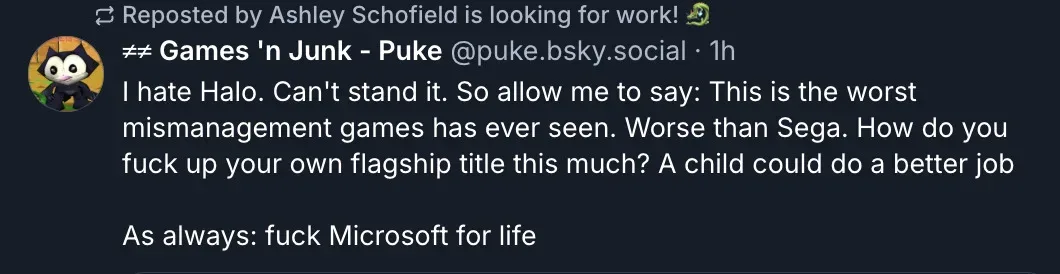
Xbox is facing another intense wave of criticism following further layoffs and a sweeping set of studio changes that have reportedly reshaped the responsibilities of several of its most recognizable teams. The reaction from players, developers, analysts, and longtime Xbox fans has been overwhelmingly bleak, with the anger extending beyond the immediate human cost of job losses to concerns over what these changes mean for Halo, Rare, Obsidian Entertainment, Turn 10, Playground Games, and the broader identity of Xbox Game Studios.
The latest developments arrive during an extended Xbox "reset" that is expected to eliminate roughly 3,200 jobs in total. While it was already known that the process was not complete, the newest cuts and restructurings have renewed the sense that Microsoft's gaming business is moving through a prolonged period of instability. For the people losing their roles, the impact is immediate and personal. For those who remain inside the affected teams, uncertainty now surrounds reporting structures, creative priorities, and the future of projects that may have been years in development.
Halo's reported move is the flashpoint
The most attention-grabbing element of the shake-up is the reported change surrounding Halo. Activision Blizzard is set to develop the next Halo title, moving the series away from 343 Industries, the studio that has been responsible for the franchise since Bungie departed from it. That news has become the focal point for a divided but deeply emotional community response.
Embedded X/Twitter post
Embedded X/Twitter post
Embedded X/Twitter post
For many fans, Halo is inseparable from Xbox's history. It was the defining series of the original Xbox era, helped establish Xbox Live, and remained one of the platform's most recognizable exclusives for decades. Seeing its development assigned elsewhere has therefore been treated by some as a dramatic admission that the existing stewardship was no longer trusted with the series' future.
For useful background on this topic, read Undead Labs Completes Xbox Separation, Remains at Work on State of Decay 3.
Others have argued that a drastic course correction could be necessary. Halo's recent history has included considerable scrutiny over the direction, content cadence, and commercial expectations around Halo Infinite. From that perspective, a new developer arrangement may offer a chance to rethink the franchise rather than continue with a structure that has struggled to satisfy every part of its audience.
Even among people open to change, however, there is anxiety over the implications of placing Halo under an Activision Blizzard development umbrella. Activision Blizzard is synonymous with the enormous operational machine behind Call of Duty, and some observers fear that Xbox's most valuable properties could increasingly be organized around a centralized, franchise-first model. Halo is a series with its own tone, history, multiplayer traditions, and community expectations, so the question is not simply whether another studio can make a Halo game. It is whether that game can retain a distinct identity while operating within a rapidly changing corporate structure.
Rare, Obsidian, and racing studios face new homes
The restructuring is not limited to Halo. Rare, the historic British studio behind games such as Banjo-Kazooie, GoldenEye 007, Perfect Dark, and the ongoing Sea of Thieves, is reportedly being folded into Activision Blizzard as well. The news has produced a particularly strong reaction because Rare carries decades of creative history, even as its modern reputation is closely tied to the continued success of Sea of Thieves.
Fans have voiced concern that Rare could be treated mainly as additional development capacity for Activision Blizzard's largest games. The cynical shorthand has been that storied studios are being sent into "Call of Duty mines," a phrase that reflects fears of consolidation rather than any confirmed single-project assignment. It is the symbolism that has proven especially upsetting: an independent-minded studio with a long list of beloved characters and original worlds now becoming part of a larger unit best known for managing blockbuster service games.
Obsidian Entertainment is also reportedly moving under Bethesda. The change has a notable historical resonance. Obsidian developed Fallout: New Vegas, the acclaimed 2010 entry in Bethesda's Fallout universe, and fans have spent years hoping the studio might return to the series. Its placement alongside Bethesda has consequently led to speculation about whether the two companies could become more closely connected around Fallout in the future. No new Fallout project or Obsidian assignment has been confirmed as part of this restructuring, but the organizational move has inevitably revived the conversation.
Meanwhile, Turn 10 Studios and Playground Games are reportedly being combined. Turn 10 is the longstanding developer of Forza Motorsport, while Playground is best known for Forza Horizon and is also working on Fable. The studios share the Forza name but have traditionally occupied different creative spaces: Motorsport focuses on track-based simulation racing, while Horizon has built an open-world festival format with a broader, more arcade-friendly appeal. Bringing them together could potentially create closer technical and production coordination, but it also raises questions about how each series' individual strengths will be protected.
Consolidation fuels a broader Xbox identity crisis
None of these changes exist in a vacuum. Over the last several years, Microsoft pursued a major acquisition strategy that brought Bethesda, Activision Blizzard, and many associated studios and teams under the Xbox umbrella. The acquisitions gave Xbox an immense catalogue of intellectual property, from Call of Duty and Warcraft to The Elder Scrolls, Fallout, Doom, Diablo, Crash Bandicoot, and many others.
Yet the current moment has made many people ask what ownership on that scale is supposed to accomplish if the result is job cuts, closures, absorbed teams, and less visible creative independence. Critics see a painful contradiction: Microsoft acquired a huge collection of studios in the name of expanding Xbox's output, only for parts of that collection to now be reorganized around fewer leadership groups and bigger franchise structures.
One interpretation of the new organization is that Xbox is doubling down on intellectual property. In that reading, multiple teams under one umbrella can support massive, durable brands in the same way Activision has scaled Call of Duty. This could include shared technology, larger support networks, coordinated content plans, and the ability to keep major franchises active across PC, Xbox, PlayStation, and other ecosystems where applicable.
The downside, critics argue, is that this approach risks reducing studios to support arms for a handful of established brands. Xbox has historically benefited from teams with sharply different identities: Rare's playful experimentation, Obsidian's role-playing depth, Playground's open-world driving expertise, and 343's custodianship of Halo. Corporate consolidation may improve efficiency on paper, but it can also make a portfolio feel narrower if each team is judged chiefly by its usefulness to a major intellectual property machine.
Physint announcement creates an uncomfortable contrast
The timing has added another layer of frustration. Just a week before this news, Xbox announced that it would be home to Hideo Kojima's Physint. The project had previously been associated with Sony before reportedly being cancelled amid budget and schedule concerns. The prospect of an Xbox-backed Kojima project was a high-profile signal of ambition, but it now sits awkwardly beside an ongoing reset marked by layoffs.
For observers, the contrast is difficult to ignore. New prestige partnerships and major intellectual-property initiatives can communicate investment in the future, while widespread reductions communicate the opposite to employees and fans watching from outside. Neither event necessarily explains the other, but their proximity has intensified questions about how Xbox is setting priorities and what the company wants its long-term creative footprint to be.
Why the response has been so severe
Layoffs are unfortunately common throughout the modern games industry, but the Xbox response has been so severe because this story combines several anxieties at once. There are the job losses themselves, which affect real people and their livelihoods. There is the apparent dismantling or reassignment of long-standing studio identities. There is Halo's uncertain future. And there is the larger feeling that Xbox's direction can change abruptly, even after years of acquisitions and reassurances about building a stronger first-party organization.
Some commentators have gone as far as questioning whether Microsoft has a coherent plan for Xbox at all. Others believe the strategy is clear enough: concentrate resources around the largest brands, release games wherever the business case supports it, and use the company's scale to operate games and services over a long period. The problem is that a strategy can be legible without inspiring confidence, especially when it is accompanied by workforce reductions and changes that appear to reduce the autonomy of individual studios.
For now, there are more questions than answers. What will Activision Blizzard's role in Halo actually look like? How will Rare operate inside its new structure? Will Obsidian retain its distinct creative voice under Bethesda? How will Turn 10 and Playground divide responsibilities while continuing work on their existing franchises? And, most importantly, how many more jobs will be lost before the reset is finished?
Xbox still possesses some of the industry's most valuable brands, experienced developers, and technical resources. But the latest layoffs and studio reshuffles have made clear that those assets alone do not guarantee trust. Rebuilding that trust will require more than a new organizational chart. It will require stability for developers, clarity for fans, and games that prove these historic studios still have room to create more than the next entry in a corporate franchise plan.

Community
Discussion
Start the conversation.
No comments have been posted yet.