

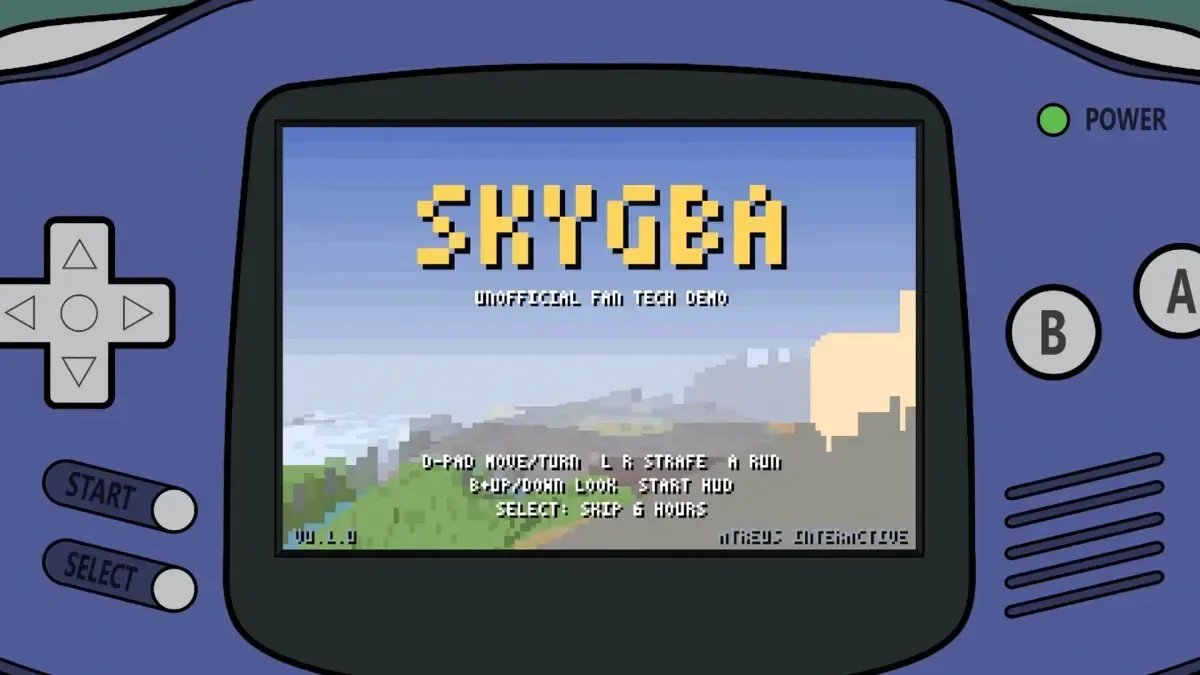
Skyrim has appeared on an extraordinary range of hardware over the years, from home consoles and PC storefronts to virtual reality headsets and portable systems. Yet one new fan project is attempting something far more unusual: bringing a version of Bethesda's enormous fantasy world to the Game Boy Advance.
The project is called SkyGBA, and it is being developed by YouTuber Atreus as an experimental attempt to recreate elements of Skyrim for Nintendo's 32-bit handheld. It is not a finished conversion of the full game, and the early build should be understood as a technical demo rather than a playable replacement for Skyrim. Still, it already allows movement through a simplified slice of Tamriel, including an interpretation of Whiterun, using the Game Boy Advance's limited controls and hardware.
That alone makes SkyGBA an eye-catching retro development project. The Game Boy Advance was built for colorful sprite-based games, side-scrollers, tactical RPGs, racing titles, and isometric adventures. It was never designed to run a vast first-person or free-roaming 3D role-playing game on the scale associated with Skyrim. Translating even the broad idea of that experience to the system requires major compromises, technical invention, and a willingness to rethink what "Skyrim on GBA" can realistically mean.
An Early Look at a Very Ambitious Experiment
The available SkyGBA footage and demonstration focus on exploration. Players can use the D-pad to move around a compressed, low-detail environment meant to evoke Skyrim's northern region of Tamriel. Whiterun is among the recognizable locations represented in the project, though the visual result is necessarily far removed from the detailed city players know from the original game.
For useful background on this topic, read Sonic's First Movie Helped Keep the Hedgehog Franchise Alive, Says Takashi Iizuka.
At this stage, the project's achievement is less about visual fidelity and more about proving that a navigable fantasy landscape can be presented on the Game Boy Advance at all. The system's display, processing limits, memory constraints, and small button layout create a very different design environment from modern platforms. A project based on Skyrim cannot simply be reduced in resolution and placed onto a cartridge. Its world, interface, controls, assets, systems, and performance expectations all need to be redesigned around the hardware.
SkyGBA currently looks like the beginning of that redesign. Its environments are highly simplified and the demo is still rough, but it establishes a foundation for further experimentation. Atreus has indicated that additional attention could lead to work on making the port more visually appealing, suggesting that the current presentation is not intended to be the final look.
Why the Game Boy Advance Is Such a Difficult Target
The Game Boy Advance launched in 2001 and remains one of Nintendo's most celebrated handhelds, but its strengths are very different from the requirements of a game such as Skyrim. Bethesda's 2011 RPG is built around a large explorable world, detailed environments, extensive quests, character progression, dialogue, combat, inventories, and numerous interconnected gameplay systems. Even in its original form, it demanded hardware vastly beyond what was available in the Game Boy Advance era.
That gap means a hypothetical completed SkyGBA would almost certainly need to be a new interpretation rather than a literal one-to-one port. A conventional "demake" may be the more useful comparison. The goal would be to capture selected places, themes, and feelings associated with Skyrim while making every feature fit within a much smaller technical budget.
World design would likely have to become compact and carefully segmented. Large open landscapes could be represented through smaller zones, abstracted maps, or separate areas loaded individually. Buildings and dungeons might become simplified interiors. Terrain would need to use lightweight visual tricks instead of the geometry and effects expected from a modern 3D release. Even seemingly simple additions, such as non-player characters, enemies, or a day-and-night cycle, could create substantial performance and memory considerations.
Controls present another major challenge. The Game Boy Advance offers a D-pad, A and B face buttons, L and R shoulder buttons, Start, and Select. That is a capable setup for many genres, but Skyrim's original control scheme assumes access to a large set of commands, menus, quick actions, camera controls, and contextual interactions. A GBA adaptation would need an efficient interface, perhaps with menu-driven actions, simplified combat inputs, or context-sensitive prompts.
A Demake Needs More Than Familiar Locations
Whiterun and the wider setting are useful starting points because they instantly communicate the project's inspiration. However, recreating recognizable geography is only one piece of the task. Skyrim is remembered not only for mountains, settlements, and dragons, but for the sense of freedom that comes from walking in any direction, discovering a cave, meeting an unexpected character, or deciding to pursue an unrelated quest.
Creating that feeling on older hardware is possible, but it calls for smart prioritization. Classic handheld RPGs regularly built convincing worlds with limited screen space and modest storage capacity. They succeeded through strong art direction, memorable music, readable maps, and carefully paced discovery rather than sheer scale. If SkyGBA develops beyond its initial exploration demo, its most compelling direction may be to apply those lessons instead of trying to imitate every system from the original game.
A smaller story set around Whiterun, for example, could potentially offer exploration, conversations, item collection, and a handful of combat encounters without attempting to reproduce all of Skyrim. Likewise, a top-down, isometric, or otherwise stylized perspective could make the project easier to read and perform well while giving it a distinct identity. The current demo already shows that the project is not afraid to radically reinterpret the source material for the handheld format.
The Appeal of Pushing Retro Hardware
Fan-made projects like SkyGBA are often interesting precisely because they seem impractical. They test the limits of beloved systems and invite players to imagine alternate versions of gaming history. What might a major 2010s open-world RPG have looked like if its ideas had been adapted for an early-2000s handheld? How much of its atmosphere could survive the shift to a smaller screen and 32-bit technology?
The answers do not necessarily require a complete recreation. In many cases, the process of solving individual problems is the point. Rendering a navigable 3D-like scene, fitting recognizable landmarks into a low-resolution view, and constructing workable controls can each be meaningful accomplishments for a homebrew developer. The result can be valuable as a technical demonstration even if it never turns into a feature-complete game.
That spirit has helped sustain retro homebrew communities for decades. Developers continue creating original games, tools, prototypes, and demakes for discontinued hardware because the constraints encourage unusual solutions. A Game Boy Advance project inspired by Skyrim sits at the extreme end of that tradition: a modern gaming giant being filtered through the specifications of a much older portable console.
What Comes Next for SkyGBA
For now, SkyGBA remains an early-stage project with a limited but intriguing demonstration. It is playable in the basic sense that players can move around its small representation of Skyrim's world, but it should not be mistaken for a completed Game Boy Advance version of Bethesda's RPG. There is no indication of a full release, a final feature list, or how closely any future build could resemble the original game's structure.
The next steps would be substantial. Visual improvements could make locations easier to recognize and the environment more coherent. Better movement, expanded maps, interaction systems, or combat would each move the prototype closer to a more traditional game. At the same time, every addition would need to be measured against the Game Boy Advance's severe technical limits.
That uncertainty is part of what makes the project worth watching. SkyGBA may remain a fascinating proof of concept, or it could gradually become a more complete retro-styled adventure inspired by Skyrim. Either outcome highlights the continuing enthusiasm for Nintendo's handheld and the creativity of developers who choose difficult hardware challenges for the sake of seeing what is possible.
For players who grew up with the Game Boy Advance, there is also a simple nostalgic appeal in seeing Tamriel reduced to a pocket-sized experiment. SkyGBA does not need to replace Skyrim to be memorable. Its current demo is a reminder that even a game associated with huge landscapes and modern platforms can inspire inventive new forms when placed in the hands of an ambitious retro developer.
Community
Discussion
Start the conversation.
No comments have been posted yet.