

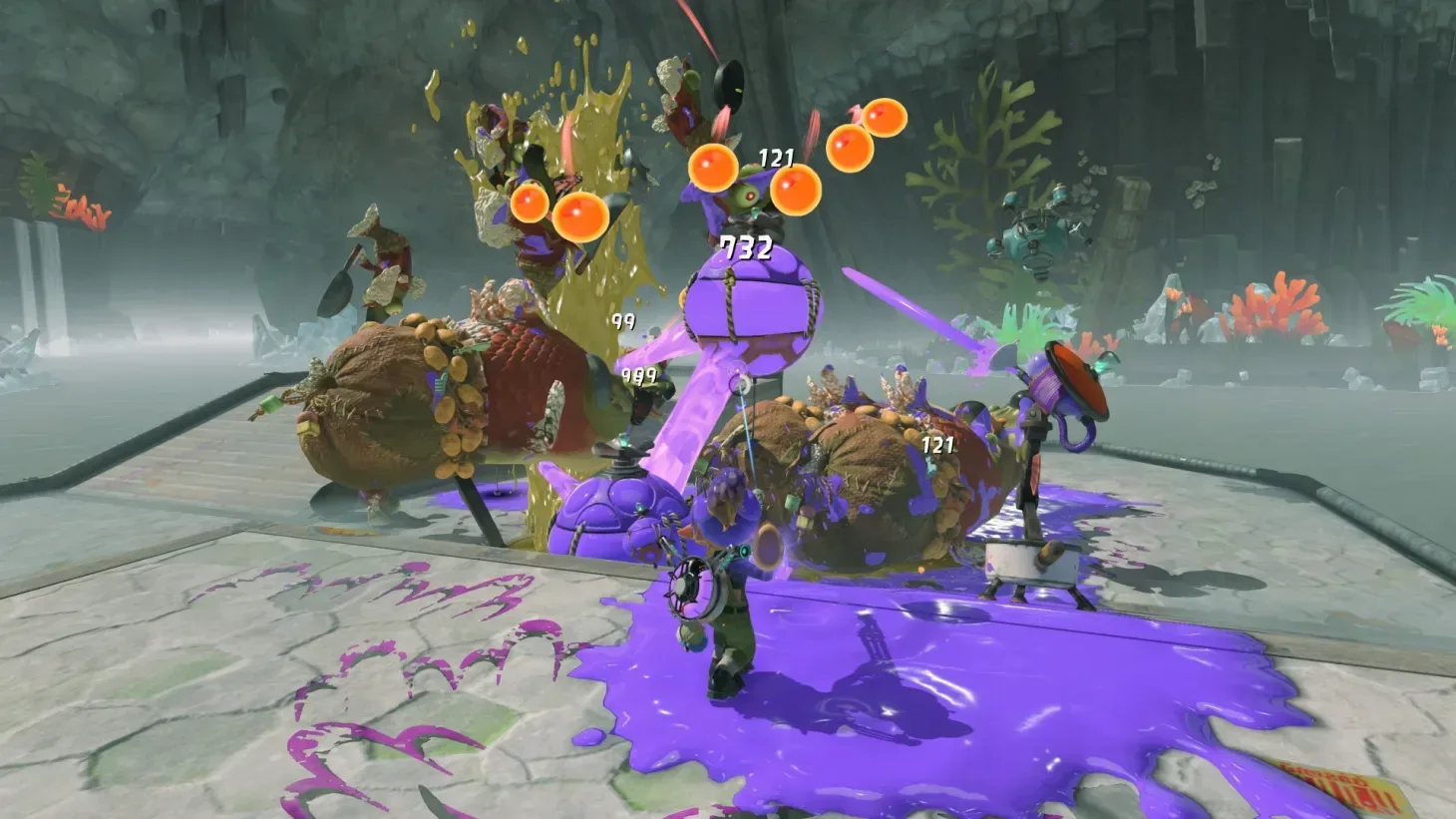
Splatoon Raiders succeeds by recognizing just how good Splatoon feels when it is allowed to become a full-fledged action game. Nintendo's colorful ink-slinging series is best known for competitive multiplayer, but its solo excursions have long carried their own appeal through inventive stages, clever mechanics, and imaginative boss encounters. Raiders narrows that formula into a PvE looter-shooter structure built around compact raids, escalating Salmonid fights, and near-constant loadout experimentation. The shift leaves behind competitive play entirely, yet it preserves the series' lively visual identity and remarkably fluid movement. The result is a focused adventure that makes a strong argument for Splatoon's combat-driven side.
On Switch 2, Splatoon Raiders earns an 8.8 out of 10. It is not a complete replacement for the experimental obstacle courses and puzzle-forward missions that have defined other single-player Splatoon offerings. Repetition eventually catches up with its raid objectives, its treasure-hunting story barely registers, and its music does not always provide the energy the action deserves. Even so, the sheer pleasure of moving through ink, adapting to crowded battlefields, and refining a personalized build gives Raiders exceptional momentum. The game understands the power of a mission that takes only a few minutes, a new upgrade waiting to be tested, and the persistent temptation to begin one more run.
A Familiar Feel, Reframed for Raids
The fundamentals remain the foundation. Swimming through ink is still fast, smooth, and intuitive, serving both as movement and as a natural way to reload. That rhythm of firing, diving, repositioning, and resurfacing remains one of the most satisfying ideas in modern action games. Raiders places that rhythm under more sustained pressure than many previous single-player campaigns. Instead of regularly stepping away from combat for platforming challenges or puzzles, it asks players to survive and dominate confrontations that can turn chaotic in seconds.
Raids arrive in several forms. Some are timed battles that demand quick decisions under mounting pressure. Others are linear stretches filled with enemies, while more open maps allow free-form traversal and encourage players to approach threats from different angles. These formats are not radically different from one another, and the campaign's back half can make their repeated structure more noticeable. Still, the variety in map layouts helps raids avoid feeling completely interchangeable, especially when enemy combinations force a change in tactics.
Combat is built around a constant stream of meaningful rewards. Power Eggs contribute to charging Ultimate abilities, while enemy parts are used for crafting. Spirhalite Shards function as currency, and missions can also yield new weapons and gadget components. Crucially, gathering these resources does not interfere with the smooth loop of shooting, reloading, and swimming. Loot is integrated into the flow rather than treated as an interruption, making progression feel like a natural consequence of fighting well and clearing objectives efficiently.
Build Crafting Is the Real Hook
Raiders' most persuasive feature is the amount of control it gives players over their combat style. Upgradeable tanks effectively function as character classes, and each one pushes a different approach. The Speed tank emphasizes mobility and ranged options, allowing players to stay agile and attack from safer positions. The Power tank is designed around direct aggression, supporting those who want to overpower threats at close range. The Tactical tank leans into battlefield control, with tools such as deployable turrets, ink vortexes, and trip-mines.
Each tank's gadgets can be upgraded and customized, and that is only one layer of the system. A large arsenal of weapons, numerous modifications, and three selectable Ultimate abilities create a broad set of possible builds. Not every weapon appears to reach the elegant utility balance familiar from competitive Splatoon, but Raiders compensates by making experimentation enjoyable and useful. A setup that feels merely adequate in one raid may become excellent against a particular enemy type, map shape, or boss mechanic. The game consistently gives players reasons to reconsider their equipment rather than settle permanently into a single preferred configuration.
That flexibility adds longevity well beyond the credits. Unlocking a new part or improving an ability produces an immediate question: how will this work in the next raid? The answer is rarely theoretical for long because missions are brief and easy to jump into. This compact structure turns build testing into a satisfying habit. Raiders is at its best when an upgraded gadget, a different weapon, and an adjusted Ultimate combine to create a noticeably stronger strategy than the one used only a few missions earlier.
Salmonids Bring the Pressure
The combat encounters have enough variety to offset some of the sameness in mission objectives. Smallfry and Chum minions fill arenas and create urgency, but the broader Salmonid lineup is what gives fights their tactical texture. More than 10 unique Salmonid types appear, including powered-up variants with individual weaknesses and distinct dangers. Their presence means that even when a raid's formal objective looks familiar, the actual flow of combat can demand different positioning, target priorities, and equipment choices.
This is where Raiders most clearly distinguishes itself from a simple sequence of horde encounters. Salmonids can flood the map and quickly turn a controlled situation into a scramble for space. Players need to reassess their approach on the fly, particularly when stronger variants enter the arena. The mounting threat makes the action tense without undermining Splatoon's playful personality. Bright ink and cartoonish creatures remain central to the presentation, but the encounters can inspire the kind of concentration usually reserved for a difficult co-op shooter.
Boss battles are another major strength. Recent Splatoon PvE bosses have not always reached the series' most imaginative standards, but Raiders delivers a more impressive set of set-piece confrontations. These larger encounters restore some of the novelty that the core raid formula occasionally lacks. They also provide welcome opportunities for the game's weapons, tank abilities, and Ultimates to work together in more dramatic ways.
What Raiders Gains--and What It Leaves Behind
The focus on fighting makes Splatoon Raiders more cohesive as a combat game, but it comes with a trade-off. Earlier PvE material in the series often delighted in puzzle solving, unusual movement challenges, and platforming detours. Those ideas are mostly confined here to side-mission tutorials built around particular gadgets. Players hoping for a broad mixture of action and experimental stage design may miss that older variety.
The campaign's narrative does little to fill that gap. The treasure-hunting premise is suitably silly and moves the party from raid to raid, but it is not memorable enough to become a meaningful reason to continue. Raiders is driven by its mechanics instead: better gear, tougher battles, interesting enemy pairings, and the prospect of improving a favorite build. The soundtrack is similarly disappointing, with repetition that becomes more apparent as the campaign progresses.
Those flaws matter, especially over a longer play session. Yet they do not undermine the game's most important strength: its ability to make almost every cleared raid feel like productive progress. A post-game campaign extends that pull, ensuring that the upgrade chase does not abruptly end once the main credits roll.
Co-Op Supports the Solo Experience
Splatoon Raiders supports both single-player and cooperative play without making either feel like an afterthought. Levels are appropriately designed and scaled for a solo run, so playing alone does not feel like a compromised version of the experience. When more help is needed, friends can join the fight, and a beacon system can invite a random player into a session for a single mission. Completing these assisted runs awards special loot, giving the feature a practical role beyond simple rescue.
Multiplayer functionality was smooth in pre-release testing, with partying up and tackling missions together working cleanly. The co-op structure also fits the game's rapid pacing. Since raids are compact, joining up does not require scheduling a marathon session; it is easy to complete a handful of missions, compare new equipment, and make a few upgrades before moving on.
Who Should Play Splatoon Raiders?
Splatoon Raiders is an easy recommendation for fans who love the movement and weapon feel of Splatoon but want a more dedicated PvE game. It is particularly well suited to players who enjoy build crafting, co-op horde combat, short repeatable missions, and post-game progression. Existing fans of Salmon Run-style intensity will find a larger adventure built around that escalating pressure, while solo players can still expect a properly tuned experience.
Players looking primarily for a rich story, a varied platforming campaign, or endlessly diverse objectives should approach with more measured expectations. Raiders is tightly focused, and its repetition is real. But that focus also allows its strongest systems to shine.
Final Takeaway
Splatoon Raiders turns the series' phenomenal movement and weapon handling into a lively, loot-driven PvE adventure. Its campaign can become repetitive, its story is disposable, and it does not fully replace the clever puzzle-platforming variety of past solo content. Nevertheless, the tank classes, gadget upgrades, weapon combinations, escalating Salmonid battles, and strong boss encounters provide a rewarding reason to keep returning. With a worthwhile post-game campaign and flexible co-op support, Splatoon Raiders gives Switch 2 owners a colorful and compelling new way to get inked.
Community
Discussion
Start the conversation.
No comments have been posted yet.