

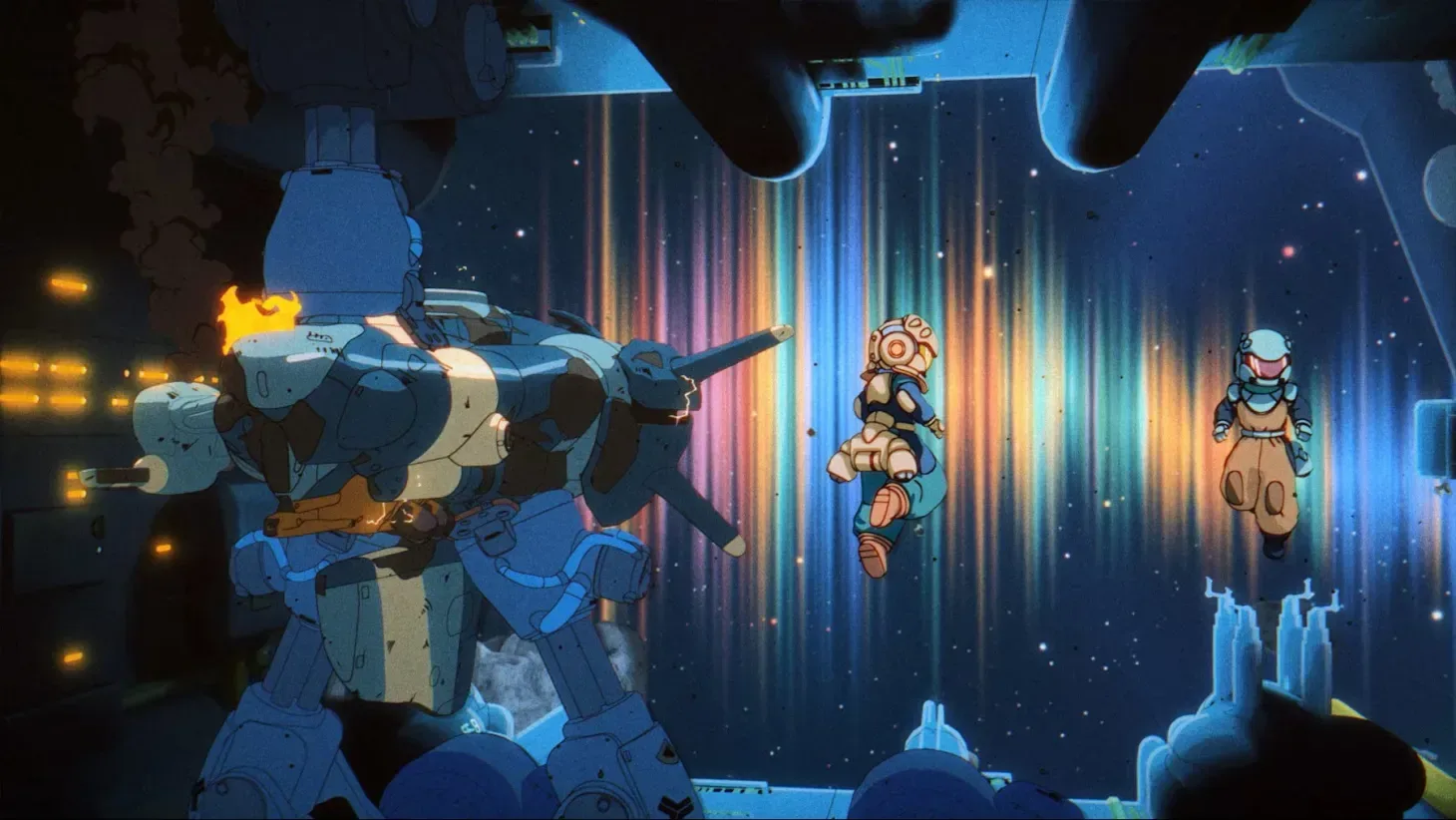
Orbitals is a charming, visually spectacular co-op adventure whose personality shines brighter than some of its underlying systems. Set among decaying space stations, eccentric alien life, and cassette-futurist machinery, Shapefarm's Switch 2 game succeeds at creating a world that is immediately inviting to look at and pleasant to inhabit. Its biggest issue is not a lack of imagination. Rather, Orbitals has so many appealing ingredients that its uneven storytelling, occasionally shallow puzzle design, and awkward combat stand out more sharply than they might in a less memorable package.
At its best, Orbitals feels like an animated sci-fi series brought to life for two players. It is colorful, playful, and sincere, with an infectious sense of whimsy running through its environments and character interactions. At its weakest, it asks its audience to invest emotionally in stakes that have not received enough on-screen development, then hurries through a finale that needs more room to breathe. The result is a good adventure with an unmistakably lovable identity, even when it falls short of the stronger emotional and mechanical impact it seems capable of delivering.
A Space Station Worth Exploring
The central setup follows Maki and Omura, two young adults living aboard an isolated space station threatened by a deadly storm. Protecting their community requires collecting three reactor cassettes, sending the pair aboard their ship to investigate abandoned and deteriorating stations scattered through space. It is a functional premise for a level-based co-op journey, providing a reason to travel, solve environmental problems, and meet strange creatures along the way.
Orbitals is strongest when it lets that framework serve discovery rather than when it leans too hard on the mission's larger narrative importance. The abandoned stations feel like playful mechanical playgrounds, packed with environmental details that suggest a tactile, optimistic vision of future technology. Cassette-inspired design motifs turn ordinary devices and industrial spaces into something unusually warm. The game is not simply futuristic; it is deliberately nostalgic about a future that never was, using chunky technology, bright colors, and inventive environmental shapes to create a distinct visual language.
Animal-like aliens add another layer of charm to each stop on the journey. Their presence helps the levels feel inhabited even amid all the ruin, while the light banter between the leads keeps the expedition from becoming too solemn. The tone is cozy more often than tense, and that quality carries Orbitals through moments where the actual task at hand is fairly straightforward.
Maki and Omura Make the Trip
The clearest emotional success in Orbitals is the relationship between its two playable characters. Maki and Omura have an easy, likable rapport. They speak in sync, trade puns, sing silly songs, and generally sound happy to be traveling together. Their dynamic resembles a sibling-like partnership, although the game does not firmly define it. That lack of formal explanation matters less than the warmth conveyed through their behavior.
It is refreshing to follow co-op protagonists who are not constantly snapping at each other or being forced through a familiar cycle of conflict and reconciliation. Maki and Omura already function as a team, and the game's playful tone benefits from their mutual affection. Their connection also reinforces the cooperative design: the people sharing a screen are controlling characters who genuinely seem to enjoy sharing an adventure.
Unfortunately, the same clarity is not extended to the community they are trying to save. Orbitals repeatedly establishes that Maki and Omura care deeply for the people waiting back home, but it more often tells players about those bonds than lets them experience them. The objective is therefore understandable without becoming especially urgent. It is easy to see why the leads want to retrieve the reactor cassettes; it is harder to feel personally invested in most of the people depending on them.
Asymmetrical Co-Op With Constant New Ideas
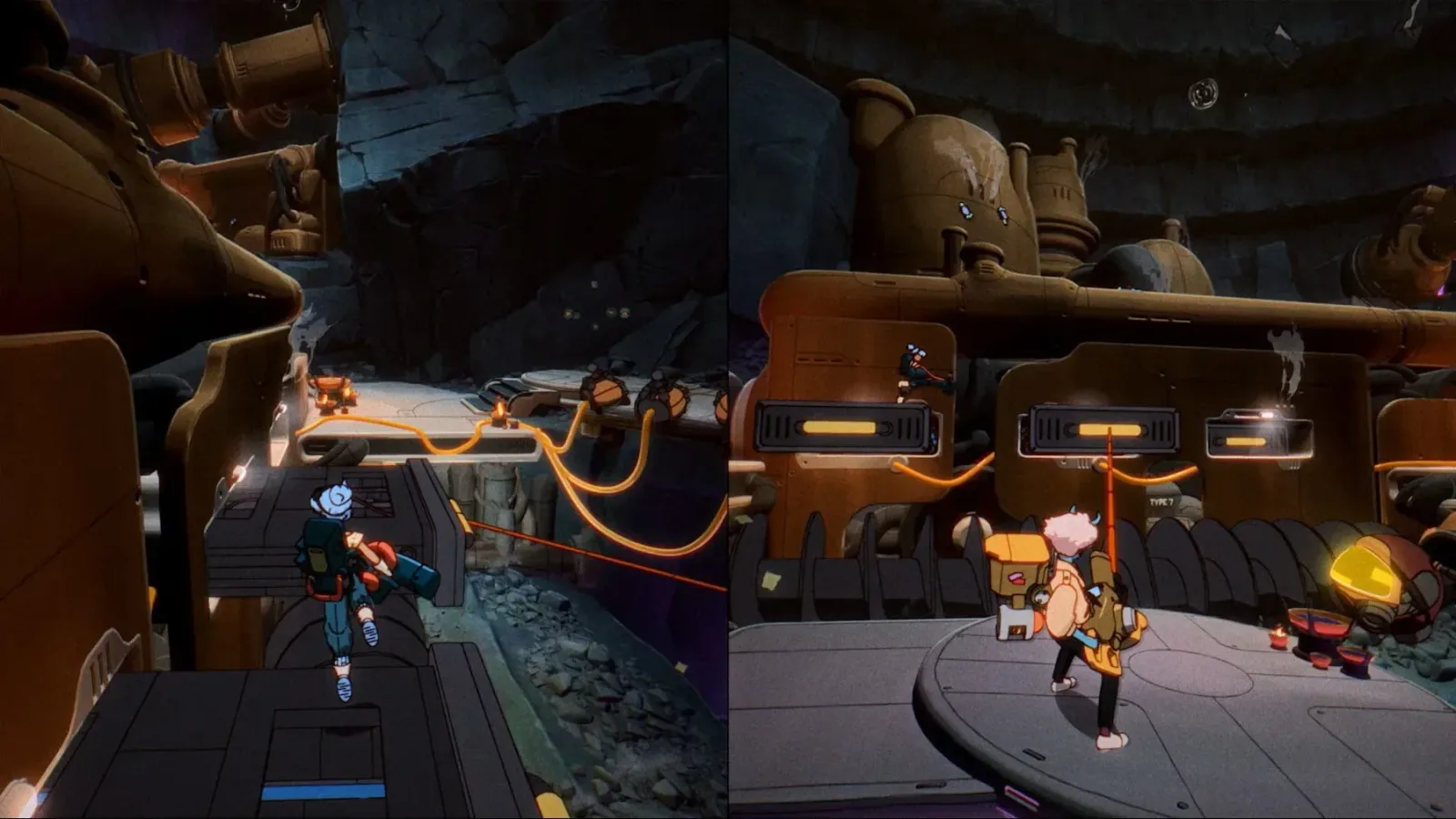
Orbitals is built entirely around co-op play, and its core puzzle structure is almost always asymmetrical. Maki and Omura regularly carry different tools, typically drawing from a laser, grappling hook, and water cannon. The pair must combine those abilities to alter environments, create routes, activate mechanisms, and work through obstacle-filled spaces. There are occasional minigames and brief situations in which neither character has specialized equipment, but the distinct-tool approach defines the experience.
The game deserves real credit for variety. It keeps finding different ways to frame familiar tools, introducing new environmental applications rather than relying on one repeated trick. A grappling hook, for example, becomes part of a broader conversation between positioning, timing, and the other player's equipment. That regular turnover helps Orbitals avoid feeling stale across its journey, even when individual puzzle sequences are not especially demanding.
Some of the simpler encounters expose the limits of the design. Certain solutions amount to a rigid chain of actions: one player uses a tool, then the other player uses theirs, repeating the process until a path opens. These moments can feel more like following a prescribed routine than collaborating to solve a problem. There is not always much need for creative thought, meaningful communication, or the delighted chaos that great co-op puzzles can inspire.
Still, Orbitals has a talent for making modest mechanics feel more appealing through presentation. Blasting platforms into a wall is not inherently exciting, but it becomes more memorable when those platforms bloom into vibrant flower petals against a soil-covered surface. This is a game where visual context does substantial work. The most whimsical applications of its tools can make even middling mechanical challenges feel worth seeing through.
The Ship Is a Clever Hub, but Combat Is a Rough Patch
Travel between stations takes place aboard a home-base spaceship that grows over the course of the game. New critters and minigames gradually give the craft more character, making it feel like an evolving communal space rather than a purely functional menu between levels. This is one of Orbitals' better structural touches, complementing the game's cozy sensibility and making progress feel visible.
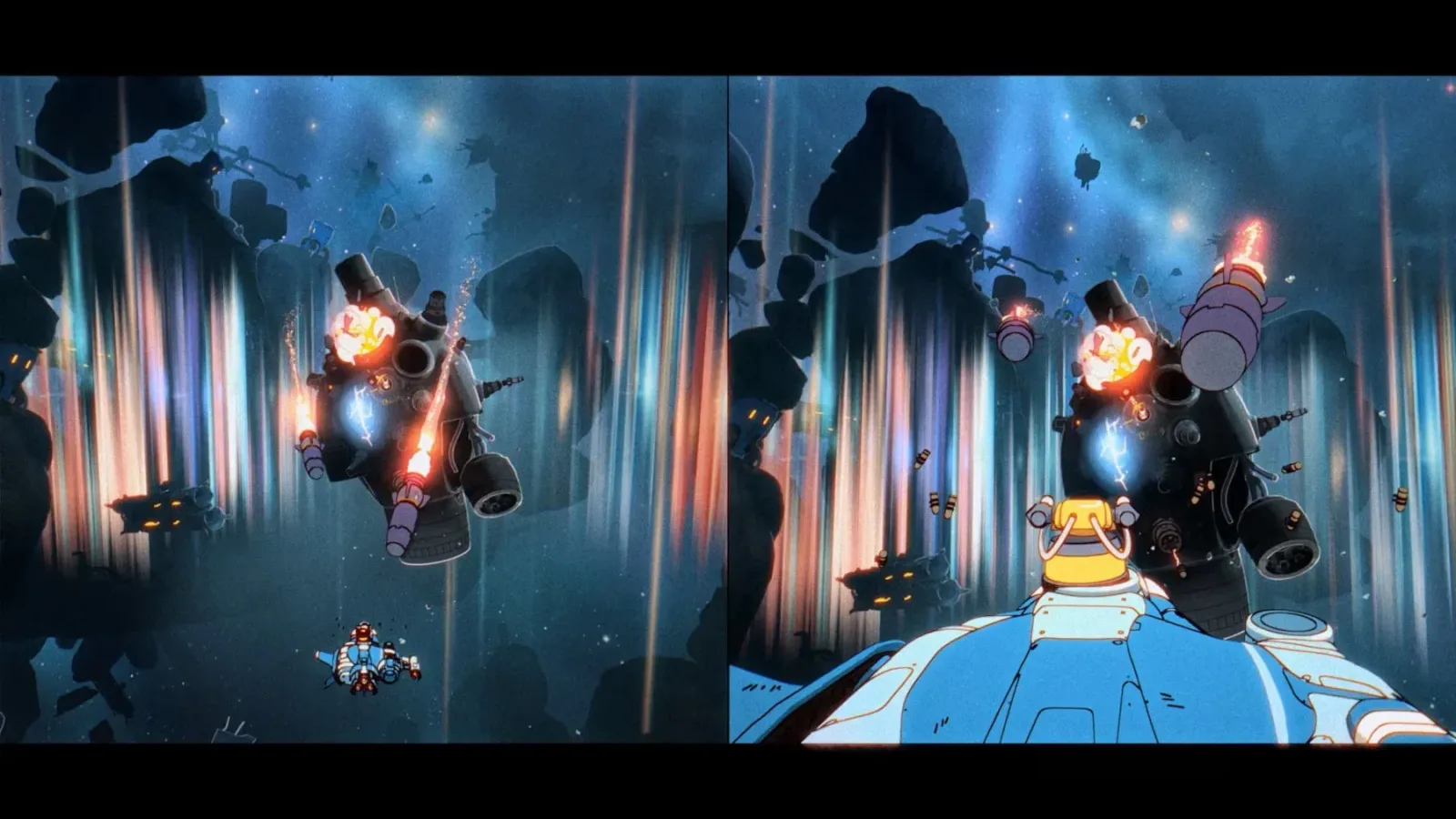
Flying the ship also continues the co-op emphasis. One player operates the pilot's chair while the other handles the guns. The division of responsibilities can produce engaging teamwork, particularly when one player is manipulating obstacles or switches while the other navigates the vessel through the resulting opening. It is an appealing concept that fits the game's asymmetrical philosophy.
However, the space-combat portions are considerably less graceful. Fast homing missiles are consistently uncomfortable to evade, and the pressure of managing movement under attack can undermine the otherwise relaxed atmosphere. A late-game combat sequence becomes especially overwhelming. Orbitals does not collapse under these frustrations, but these sections lack the smooth, playful feel of its best environmental puzzles and make the journey feel bumpier than it needs to be.
A Gorgeous Presentation in Search of a Stronger Ending
Presentation is Orbitals' defining strength. Its cutscenes use a gorgeous retro-anime style, while gameplay translates that sensibility into attractive 3D-rendered environments. The two approaches feel cohesive rather than separate, united by expressive designs, bright coloration, and a broadly optimistic sci-fi imagination. The soundtrack is equally important to the game's appeal. Its title theme in particular has the energy of an electrifying throwback, immediately setting the tone for the strange and welcoming universe ahead.
That carefully cultivated mood makes the final stretch more disappointing. For most of its runtime, Orbitals keeps its narrative in the background and gives its attention to the journey, the puzzles, and Maki and Omura's companionship. In roughly the last half hour, it suddenly delivers a large amount of story material. The pace accelerates too quickly, major emotional beats do not have enough preparation, and the conclusion feels less satisfying than the game's gentle build-up suggests it should be.
A more focused story about the leads' ties to their home community could have made the ending much stronger. Orbitals has the foundations for heartfelt stakes, but it does not spend enough time building those relationships before asking them to carry its climax. The result is an ending that is easy to follow conceptually but difficult to feel at the intensity it wants.
Who Should Play Orbitals?
Orbitals is best suited to pairs seeking a visually rich, approachable cooperative adventure rather than a punishing puzzle game. Players who value atmosphere, character chemistry, and unusual art direction will find plenty to appreciate. It is also a natural fit for anyone drawn to retro anime aesthetics, cassette-futurist science fiction, and worlds that balance abandoned-space-station melancholy with cheerful absurdity.
Those seeking intricate, high-pressure coordination challenges may find parts of the puzzle design too guided, while players sensitive to difficult evasive combat may be frustrated by the ship's missile-heavy encounters. Its story is also unlikely to satisfy players looking for a deeply developed ensemble drama. The strongest reason to play is not the urgency of its central mission, but the pleasure of spending time in its universe with another person.
Final Takeaway
Orbitals earns its positive impression through craft, warmth, and style. Its story does not land as firmly as it should, and several gameplay segments feel less polished than the game's impeccable presentation. Yet Maki and Omura's friendly dynamic, the ever-changing co-op toolset, the delightful spaceship hub, and the sheer appeal of the game's audiovisual identity keep the adventure buoyant.
It is a spacefaring game with room to improve, but also one with enough heart and personality to make its flaws easier to forgive. On Switch 2, Orbitals stands as a good co-op excursion for players willing to prioritize charm and creativity over narrative depth and mechanical consistency.


Community
Discussion
Start the conversation.
No comments have been posted yet.