

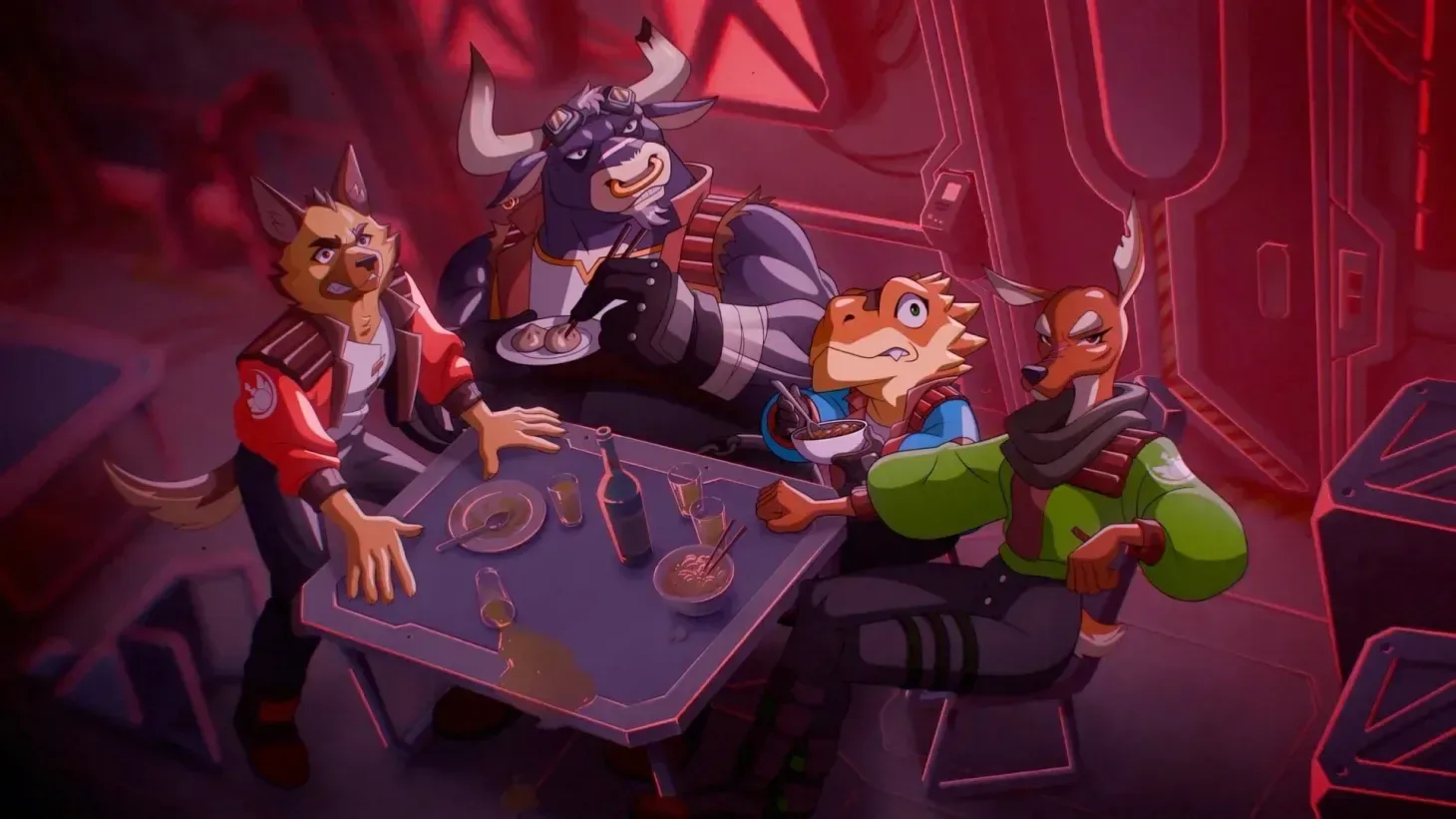
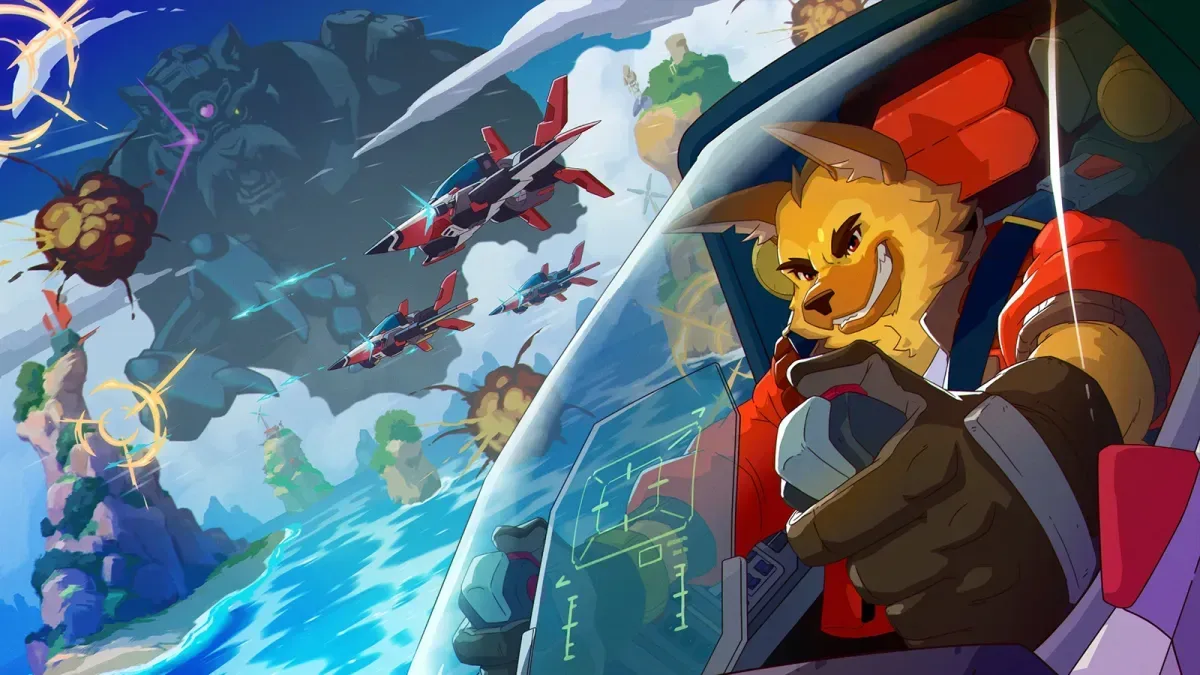
Wild Blue Skies is a sincere attempt to bring a familiar kind of arcade space combat back into view, but sincerity alone is not enough to make the journey soar. On PlayStation 5, the game puts players in the cockpit of Bowie, an anthropomorphic dog piloting a combat ship alongside a squad of animal allies. Their mission is to stop Grimclaw, an anthropomorphic tiger whose enormous cyborg head makes him an appropriately cartoonish-looking threat. The setup immediately establishes what sort of adventure this is: colorful, character-driven, fast-moving, and deeply indebted to the rail-shooter template popularized by Star Fox 64.
There is nothing subtle about that inspiration. Most stages move Bowie's ship along predetermined routes, sending enemy formations, environmental hazards, and oversized bosses into the player's path. A smaller number of missions open into compact free-roaming spaces. There are branching routes, incentives to replay the campaign, and an emphasis on communicating squadmates. Wild Blue Skies understands the appealing surface features of its lineage. Unfortunately, it too often reproduces older ideas without showing why they still work best today, or how they might be improved for a modern audience.
Verdict: A Familiar Flight With Too Much Turbulence
At its best, Wild Blue Skies provides flashes of energetic arcade spectacle. Bright skies, unusual enemy craft, lively voice work, and a steady stream of incoming targets can create the kind of breezy momentum that makes a rail shooter immediately satisfying. The campaign is also approachable enough to reach its credits, while its alternate paths and optional challenges give completion-minded players a reason to return.
Yet the core act of flying and shooting rarely feels as clean or reliable as it needs to. Controls are serviceable rather than disastrous, but several design choices repeatedly turn action into a slog. A limited view of the battlefield, awkward targeting rules, environmental collisions, scarce healing, and punishing restarts combine to make losses feel imposed by the game instead of earned through player mistakes. That distinction matters enormously in a score-chasing action game, where failure should encourage another attempt rather than inspire irritation.
Wild Blue Skies can impersonate a classic effectively, but it does not consistently match the precision, personality, or enduring design strengths that made that formula memorable in the first place.
Combat Gets in Its Own Way
The basic controls make sense on paper. Bowie has standard lasers, a lock-on system, and powerful homing attacks for enemies caught in the targeting reticle. In practice, using these systems can be needlessly limiting. Standard laser fire and locking on are assigned to separate buttons, forcing a choice between two actions that feel like they should work together. Rather than smoothly tracking enemies while maintaining a steady assault, combat often asks the player to prioritize one function over the other.
The lock-on tool is also hampered by its short effective range. By the time an enemy is close enough to target for a stronger homing shot, it may already be moving out of view or disappearing from the screen entirely. That makes the mechanic feel less like a rewarding tactical option and more like an opportunity that closes before it can be meaningfully used. Fast arcade action benefits from clear rules and responsive feedback; here, the targeting system introduces uncertainty at precisely the moments when decisiveness is needed.
Visibility is another persistent problem. The reticle-focused perspective can make it difficult to understand exactly what Bowie is firing at, and there is no first-person view option to provide a clearer aiming alternative. The issue becomes more pronounced when enemies, projectiles, and scenery overlap in a crowded encounter. The game wants players to react quickly, but its camera and aiming presentation can obscure the information required for those reactions.
Collisions add another unwelcome complication. Striking a wall can send the ship ricocheting around like a pinball, producing a loss of control that feels disproportionate to the mistake. This is especially troublesome in the freer open-area missions, where navigation has a larger role than in the more tightly directed rail stages. Those sections should offer a welcome change of pace, but their extra movement demands expose the limitations of the handling and collision behavior.
Hazards and Bosses Test Patience More Than Skill
Wild Blue Skies does not avoid challenge, and challenge itself is not the problem. The issue is that the game frequently frames failure around situations that do not feel fully readable or avoidable. Health pickups are uncommon, while stray enemies, wall impacts, and screen-filling attacks can rapidly burn through a ship's durability. It is possible to be overwhelmed by danger without feeling properly equipped to escape it.
That creates a frustrating loop. A death after an honest misjudgment can be motivating, especially in a short arcade campaign designed for repeated runs. A death caused by being bounced into the environment, clipped by an unexpected enemy, or engulfed by effects that overwhelm the screen feels much less instructive. When lives run out, the resulting return to the beginning of the campaign raises the stakes of every unfair-feeling encounter. The game's replay structure is meant to encourage route experimentation, but harsh setbacks can instead discourage further exploration.
Boss fights compound the problem. Their imposing designs and energetic performances give them a theatrical presence, but many battles last longer than they need to. Extended boss health bars are not inherently bad, yet these encounters do not always add enough evolving mechanics or fresh ideas to justify their duration. The result can be exhausting rather than climactic, particularly after stages already filled with visibility issues and environmental pressure.
Colorful Presentation, Generic Personality
The visual presentation is one of Wild Blue Skies' more reliable strengths. Its use of bright colors makes the game easy to recognize at a glance, and the ships have a cool, toy-like charm. Bowie's crew is visually appealing, while bosses and secondary figures arrive with enough flair to make their scenes feel animated and lively. The voice cast also brings real energy to the material. Dialogue is delivered with conviction, whether teammates are responding to the action or enemies are loudly projecting their confidence.
But the performance work cannot fully compensate for the writing. The cast members remain broadly defined and interchangeable, without enough individual perspective or development to distinguish them. Their dialogue could often be traded among characters with little impact. Bosses largely boast and shout with confidence that the story has not earned, while squadmate complaints after accidental friendly fire can make the player feel bad without deepening their relationships or personalities.
The levels have a similar issue. A journey from desert terrain to icy landscapes offers surface-level variety, and the prospect of flying through hurricanes, tornadoes, hail, or lava flows certainly sounds exciting. Yet these places seldom develop a vivid identity beyond their biome. Several on-rails missions begin with characters explaining that a storm or snowfall has reduced visibility. While weather-based danger can be a compelling narrative and mechanical idea, its repeated use here can resemble an explanation for weak draw distance rather than a deliberate atmospheric choice.
There are individual attractive sights across the campaign, but Wild Blue Skies struggles to turn them into memorable places. The world is colorful without becoming distinctive, much like its cast is energetic without becoming especially memorable.
Replay Value Exists, but the Friction Remains
The game does make a credible effort to support repeat play. Branching campaign paths and additional challenges are well suited to this style of action game, inviting players to revisit stages and search for different outcomes. Completing the main route is achievable, and the campaign's structure reflects the appealing arcade notion that a successful first run is only the beginning.
However, replayability depends on a strong foundation of trust between game and player. Players need to believe that better awareness, sharper aiming, and improved route knowledge will reliably create better results. Wild Blue Skies too often disrupts that trust with its short lock-on distance, problematic collisions, limited health recovery, and cluttered threats. The desire to see alternate paths can remain, but the desire to repeat difficult sections weakens when the game's rough edges are as likely to determine success as improved play.
Performance and Platform Context
On PlayStation 5, Wild Blue Skies presents its colorful art direction and ship designs clearly enough to support its arcade ambitions. The larger concern is not a lack of visual appeal but how the game uses sightlines during combat. Weather effects, limited visibility, and reticle-centered aiming can make enemy tracking harder than it should be. A first-person camera option might have offered a valuable alternative, but none is available.
Its release also arrives in a period when this style of rail shooter faces an especially obvious point of comparison: a strong remake of Star Fox 64 released this year on Switch 2. Wild Blue Skies should still be judged on its own ideas, but that context makes its lack of evolution harder to ignore. It is difficult to find places where its design meaningfully advances lessons learned since 1997, and it does not consistently reach the level of clarity and craft that older genre standouts already established.
Who Should Play Wild Blue Skies?
Players with a deep affection for colorful, character-filled rail shooters may find enough nostalgic appeal to justify some interest. The alternate routes, cheerful presentation, vocal performances, and occasional satisfying combat bursts show an understanding of why this genre remains loved. Anyone specifically looking for another game in that mold will recognize the appeal immediately.
But those players should approach with tempered expectations. Wild Blue Skies is better suited to genre devotees who can tolerate awkward systems and uneven difficulty in exchange for a familiar structure. Players seeking a polished action game, precise targeting, distinctive worldbuilding, or a modernized take on the formula are likely to find its shortcomings difficult to overlook.
Final Takeaway
Wild Blue Skies has the right silhouette: a heroic animal pilot, a colorful squad, branching flights, oversized villains, and a campaign built around fast-moving space battles. It also has a few moments where that silhouette comes alive, particularly when the action flows smoothly and its vibrant presentation takes center stage.
But homage becomes imitation when a game cannot establish its own voice or refine the elements it borrows. Wild Blue Skies offers attractive art, capable performances, and a welcome affection for arcade flight combat, yet its mechanical frustrations and generic design repeatedly undercut those virtues. Bowie and the crew get airborne, but this adventure never quite finds the open sky it is reaching for.
Community
Discussion
Start the conversation.
No comments have been posted yet.