

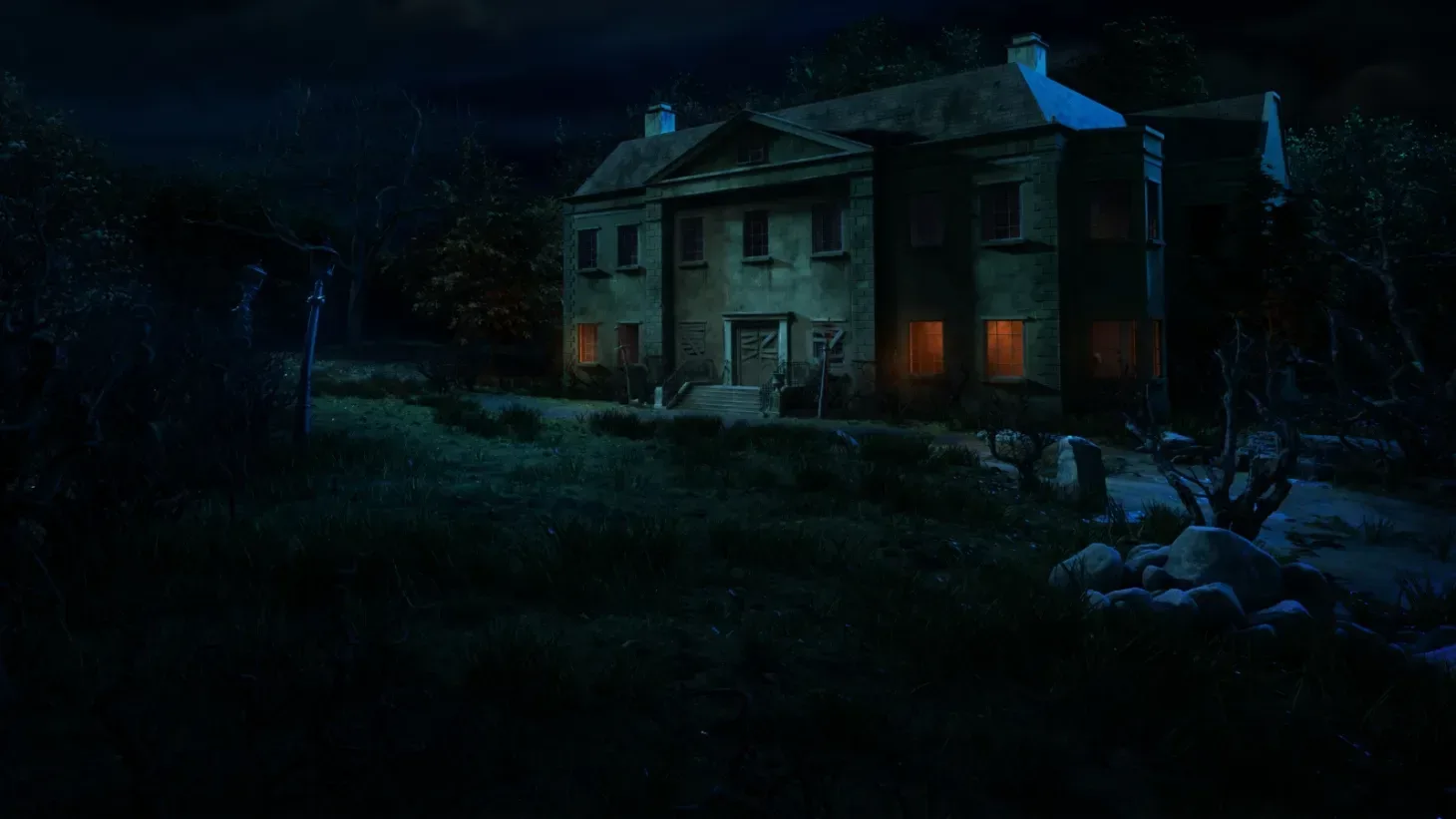
The Incident at Galley House begins with an irresistible premise: a condemned mansion, a gathering of strangers, a stormy night in 1936, and a collection of deaths that were never properly explained. From a present-day vantage point, players step into the role of a researcher able to reconstruct fragments of that fatal evening. The objective is not simply to watch the past unfold, but to rebuild it piece by piece--identifying the guests, locating them within the house, tracking their conversations, and eventually understanding how their fates became intertwined.
It is a mystery game built around the pleasure of making connections. A stray remark gains new meaning after another scene is unlocked. A character's alibi collapses because a later conversation places them somewhere else. A room that initially seems irrelevant becomes crucial once its layout is understood. The Incident at Galley House repeatedly turns small observations into major discoveries, and it does so with enough confidence that following the trail feels less like checking off objectives and more like genuinely conducting an investigation.
A Mansion Full of Questions
The central scenario is immediately compelling. One visitor arrives at Galley House after being invited by a person named Rupert Galley, yet none of the mansion's many occupants recognize that name as their host. That seemingly simple contradiction opens a widening series of questions. Who is Rupert Galley? Why has this particular group assembled at the estate? What do the guests know about one another? And why will none of them survive the night?
The game's modern framing device supplies the means to answer those questions. A machine can reconstruct scenes from the past, allowing events from 1936 to play out in the present. However, those scenes are not handed over in clean chronological order. Information must be earned through deduction. Each recovered sequence becomes another piece in a larger 26-segment timeline involving roughly a dozen characters, all of whom are initially known only by numerical identifiers until their names are discovered.
That structure makes the early stages wonderfully uncertain. A conversation may reveal a clue about someone's destination without clarifying their identity. A physical detail in the background may matter more than the dialogue taking place in front of it. A scene discovered late in the night can provide the key to unlocking something much earlier. The mystery does not merely ask players to remember facts; it asks them to reconsider those facts as their understanding changes.
Deduction Through Codes, Context, and Curiosity
Accessing scenes relies on an inventive code-entry system. Numerical inputs correspond to the relevant people, locations, and times, with correct combinations revealing reconstructed moments that match those criteria. It sounds technical on paper, but the process becomes a satisfying loop of hypothesis and confirmation. Learn that two guests may have been in the living room at a particular hour, enter the appropriate information, and see whether the game validates that deduction with a new scene.
The effect is reminiscent of a classic drawing-room murder mystery, where every testimony, timetable, and room layout matters. The difference is that Galley House gives players more freedom than a strictly linear whodunit. It is possible to pursue one person's entire evening, push forward across several character threads to reach the end of the night, or carefully fill in events in chronological order before advancing. Missing gaps can be revisited later, and the design accommodates several routes through the same web of revelations.
That flexibility is one of the game's greatest strengths. It encourages different investigative instincts rather than insisting on a single correct rhythm. Some players will want to chase the biggest immediate lead, while others will methodically organize every known movement before proceeding. Both approaches can work. The important thing is attention: paying close notice not only to what characters say, but to what they avoid saying, what they imply, and what the environment quietly communicates.
Tools That Respect the Player's Time
With so many people, scenes, motives, and pieces of dialogue to manage, The Incident at Galley House could easily become overwhelming. Instead, it provides a generous suite of in-game organizational tools. The returning notepad allows players to record their own observations and save quotations directly from dialogue transcripts. Scenes can be paused, making it possible to reread and highlight important exchanges without rushing to keep up. A keyword search function helps surface relevant conversations, while timeline markers can be placed to flag major events such as a death or an important discovery.
These features do not solve the mystery for the player, nor should they. Their value is in reducing needless friction. Rather than relying on external notes or memorizing every line, players can focus on interpreting evidence. The game also indicates how many discoverable cinematics remain locked within each scene, which is an especially welcome quality-of-life touch. It offers a sense of progress and helps prevent aimless searching without exposing the exact solution.
Not every available tool will be essential for every player, but their inclusion supports the game's open-ended structure. Those who prefer a lighter touch can make only occasional notes. Those who want to turn the experience into a full-scale evidence board have the tools to do so. The result is a mystery that feels demanding without becoming unnecessarily hostile.
Character, Atmosphere, and Unease
Galley House is more than an abstract logic puzzle. Its guests gradually emerge as a colorful, complicated group, and the game gives enough time with their interactions for certain personalities to become genuinely sympathetic. That creates a growing sense of dread. Players know from the outset that these people are doomed, yet learning more about them makes their inevitable deaths carry greater weight.
The presentation reinforces that discomfort. The mansion's eerie mood and the grim historical premise create a steady undercurrent of unease, while several moments effectively lean into more overtly hair-raising territory. The atmosphere never needs to overwhelm the deductive work; instead, it gives the investigation emotional texture. Searching a transcript is more tense when a newly understood line hints at betrayal, danger, or a person unknowingly walking toward their death.
The voice performances are generally strong and help sell the period setting and shifting relationships between the guests. There is one notable weakness: reactions when characters learn about another person's death can occasionally sound strangely subdued. Given the circumstances, those muted responses can break the mood for a moment. It is a relatively small blemish in an otherwise effective dramatic presentation, but it stands out precisely because the surrounding writing does such a good job of building tension.
An Ending That Invites Debate
The Incident at Galley House excels at making players revise their theories. Major twists encourage renewed searches through old scenes, and clues that seemed decorative or incidental can suddenly become essential. The game rewards persistence, especially for anyone inclined to uncover every available cinematic rather than stopping once a solution is technically possible.
Its conclusion, however, is likely to divide its audience. The story intentionally withholds the largest explanation at the heart of the mystery. Plenty of meaningful ancillary answers are provided, and the revelations that do arrive are significant enough to keep the ending from feeling empty. Still, the biggest question remains more ambiguous than some players will want after spending so much time constructing theories and tracing every thread.
That choice has clear artistic purpose, and players who enjoy lingering uncertainty may find it fitting. For those who come to detective fiction primarily for a final, concrete accounting of every event, it may feel like the game holds back one answer too many. The ending does not erase the quality of the journey, but it does keep Galley House from delivering completely unqualified closure.
Who Should Investigate Galley House?
This is an excellent fit for puzzle and adventure fans who enjoy reading closely, organizing evidence, and making leaps of logic from incomplete information. It is especially well suited to players who loved mysteries where the act of understanding matters as much as the final reveal. Patience is required: the volume of dialogue and the large cast can be intimidating at first, and the experience rewards deliberate attention rather than speed.
Players looking for action-heavy horror or a straightforward linear narrative may find the reconstruction system too methodical. Likewise, anyone who needs every major supernatural or narrative question resolved beyond doubt should approach the final act with measured expectations. But for players eager to inhabit a richly layered historical puzzle, those caveats are far outweighed by the game's cleverness.
Final Takeaway
The Incident at Galley House turns a familiar stormy-mansion setup into an intricate and memorable exercise in deduction. Its coded scene discovery, flexible timeline, and excellent investigative tools make uncovering the truth feel active and personal. Every breakthrough comes from observing, questioning, and returning to details that once appeared insignificant.
While the intentionally ambiguous conclusion may leave some unanswered questions lingering after the credits, the route to that ending is consistently engrossing. Galley House is a carefully assembled mystery whose strongest achievement is making players feel smart for noticing what was there all along.
Community
Discussion
Start the conversation.
No comments have been posted yet.