

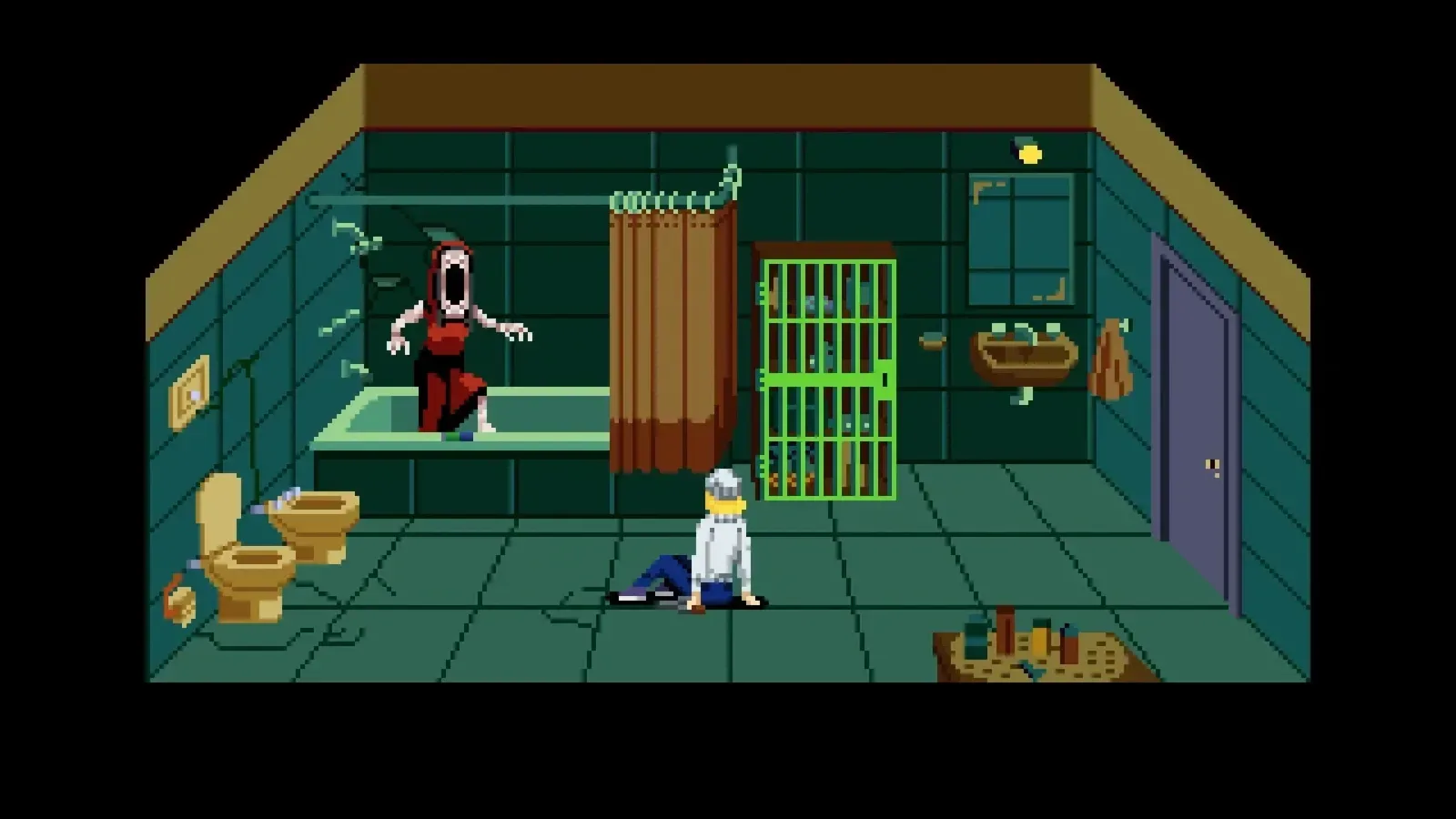
Tenebris Somnia takes several genres that can easily feel trapped in the past--point-and-click adventure games, survival horror, and full-motion-video storytelling--and makes a strong case for their continued potential. On PC, this compact supernatural nightmare turns the familiar routines of searching rooms, combining items, conserving ammunition, and decoding clues into an eight-hour experience with an unusually confident identity. Its pixel-art presentation may look modest at a glance, but the game repeatedly finds inventive ways to use its constraints. More importantly, its live-action sequences are not a novelty pasted onto a retro adventure framework. They are a central part of the horror, the narrative, and occasionally the puzzle design.
The result is a creepy, entertaining adventure that understands why older horror games were so effective without merely copying their rougher edges. Tenebris Somnia wants players to feel cautious, curious, and occasionally cornered, but it does not confuse frustration with fear. Its puzzles ask for lateral thinking rather than arbitrary leaps, its combat has weight without becoming cumbersome, and its limited resources apply pressure without making every encounter feel like a punishment. The game is not flawless, particularly when it spells out aspects of its lore that might have been more powerful left to implication, but its best ideas land with real force.
A nightmare begins at an apartment door
The story follows Julia, who has been plagued by recurring dreams in which her filmmaker ex-boyfriend, Ivan, is slaughtered by monsters. Concerned that these nightmares may be more than dreams, Julia visits Ivan's apartment to check on him. That simple, emotionally loaded premise quickly becomes the entrance to something far stranger: a demonic dream world shaped by memory, creativity, obsession, and a relationship that has clearly left scars on both people involved.
Tenebris Somnia tells its dialogue-free story through environmental details, disturbing encounters, and live-action segments. The absence of spoken exposition gives Julia's journey a broadly readable emotional clarity, while the game's imagery steadily makes the situation more unsettling. The story is interested in obsession both as a romantic wound and as an artistic impulse. Ivan's horror filmmaking is not just background flavor; it is woven directly into the game's structure and themes. The line between a horror film, its creation, and the nightmare Julia is enduring grows increasingly unstable.
For useful background on this topic, read Saber Says Hellraiser: Revival Is Performing 'Extremely Well' on PC and Consoles.
That premise gives the live-action material a purpose beyond simple nostalgia for FMV games. At points, Tenebris Somnia feels like a horror game built around a movie that is itself embedded in the story. This layering supports the game's tone and makes its more cinematic moments feel thematically appropriate rather than distracting.
Live-action horror with real impact
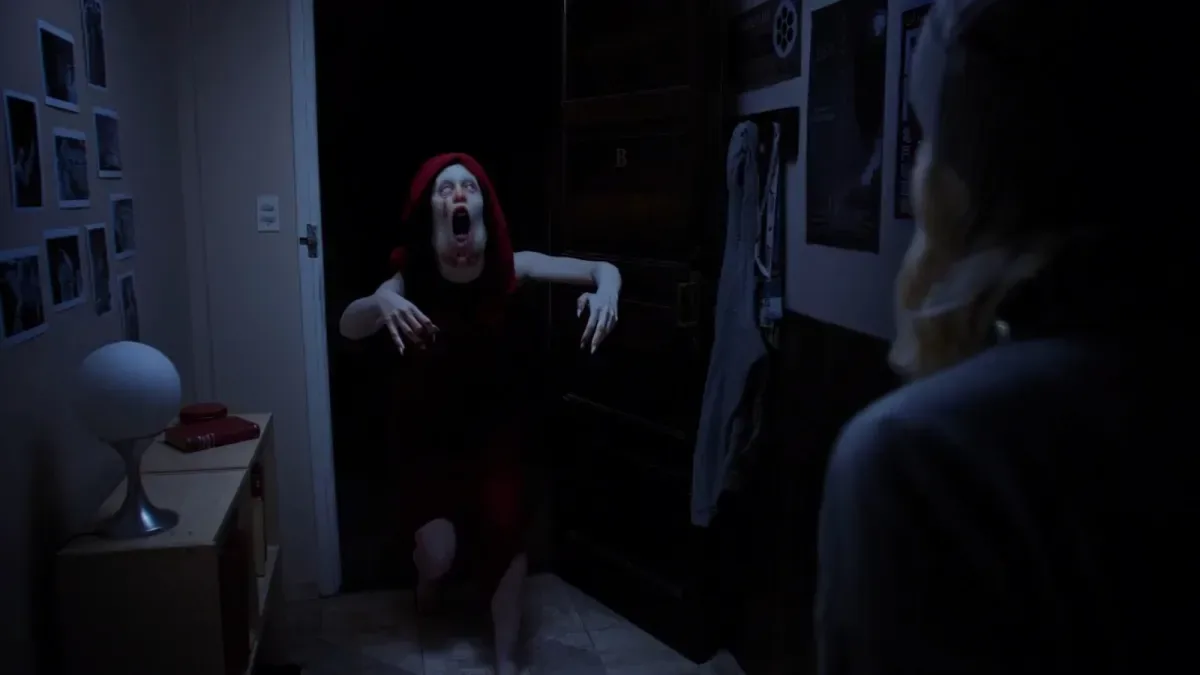
The live-action scenes are among Tenebris Somnia's strongest features. They are well shot, feature impressively grotesque practical effects, and are placed with a clear understanding of pacing. Rather than taking over the experience for extended stretches, these sequences arrive at moments where they can sharpen a scare, reveal a new detail, or emphasize Julia's reactions. A seemingly small action, such as opening a door, can trigger an effective live-action jolt.
These scenes also do meaningful work that pixel sprites alone could not accomplish as easily. Julia's fear, concern, and determination register vividly through an actor's expressions, making her more immediately human than an intentionally simplified in-game model could be. The monsters benefit as well. Grotesque creatures are unnerving in pixel form, but seeing their physical textures and movements in live action gives them an extra layer of unpleasant reality.
Crucially, the filmmaking is not separate from play. Some scenes contain visual clues, encouraging close attention rather than passive viewing. That integration makes the FMV component additive to the adventure-game format. It supports the mystery, enriches the setting, and contributes to the sensation that every strange image might matter later.
A small building full of smart puzzles
Most of Tenebris Somnia takes place in a dreamlike four-story apartment building. The contained setting is a strength. It gives the adventure a focused, claustrophobic shape while allowing rooms and floors to transform in increasingly bizarre ways. Players explore these spaces, locate objects, combine tools, interpret environmental clues, and unlock routes deeper into the nightmare.
The puzzle design is consistently creative, especially considering the game's deliberately limited visual style. Reflections in mirrors and screens become important in clever scenarios, with the game finding ways to make perspective and presentation part of the problem-solving process. The puzzles are strange enough to feel appropriate for a supernatural dream world, but they remain readable. They require observation and occasional outside-the-box thinking, not blind experimentation or endless item use.
One particularly devious sequence even turns the game's limited save points into an unexpected resource. It changes how progress and planning are considered without abandoning the internal logic of the adventure. That is the kind of idea Tenebris Somnia handles well: it recognizes conventions from older games, then finds a thoughtful way to recontextualize them.
The game does sometimes provide more explicit explanation than its otherwise evocative design needs. Its supernatural threats have intriguing lore, but portions of that lore are delivered in a more direct "tell, don't show" fashion. This does not make the story confusing--if anything, the overall chain of revelations remains easy to follow--but a little more restraint could have made certain mysteries feel even more ominous.
Survival horror tension without needless misery
Although puzzle solving is at the center of the experience, Tenebris Somnia also delivers satisfying survival-horror action. Julia can defend herself with melee weapons and firearms, and the attacks have deliberate animations that recall classic adventure-horror games. Swinging a pipe or firing a shotgun is more responsive and impactful than the retro presentation might suggest. The controls and combat avoid the mechanical stiffness that can make deliberate movement feel like an accidental limitation rather than a source of tension.
Encounters are paced intelligently. The game allows enemies to become threatening, but generally ends its most intense confrontations before they become exhausting. Regular monsters can often be evaded, which makes caution and resource preservation worthwhile. Players who learn when not to fight will have more ammunition and healing available when violence is unavoidable.
Ammo and health are limited, but not so scarce that the game becomes oppressive. Tenebris Somnia understands the value of letting a player feel vulnerable for a while. Running low on bullets or reaching the edge of death creates genuine pressure, yet the game is willing to provide a box of ammunition or a health vial at a moment when survival seems most uncertain. This balancing act preserves dread without locking the experience into prolonged desperation.
Boss fights add variety
The boss battles are a welcome surprise in a game so strongly rooted in adventure-game problem solving. They are not interchangeable damage races. One encounter focuses on surviving waves of small, gremlin-like enemies, while another asks Julia to defend a fragile effigy of herself from demented servants. Elsewhere, the game offers a confrontation involving mirrored versions of a tentacled flesh monster that would fit comfortably beside some of survival horror's most famously grotesque creations.
These battles give the adventure bigger spikes of intensity and help prevent the four-story setting from feeling too mechanically uniform. They also demonstrate that Tenebris Somnia's horror is not limited to atmosphere. When it needs to turn its concepts into active threats, it is capable of doing so with imagination.
Who should play Tenebris Somnia?
Tenebris Somnia is an easy recommendation for PC players who miss the pacing and exploratory satisfaction of older adventure and survival-horror games, but do not necessarily want the clunkier aspects of those eras. It is especially well suited to fans of haunted apartments, dream logic, practical-effects creature horror, and stories where filmmaking itself becomes part of the horror.
Players looking for a lengthy open-world game or a combat-heavy action experience should adjust expectations. This is a focused eight-hour adventure built around a single escalating location and a deliberately old-school format. Its visual style may also be an immediate hurdle for anyone who judges its production values solely by sprite detail. But the game repeatedly proves that its modest pixel presentation is a creative foundation, not a limitation it cannot overcome.
Final takeaway
Tenebris Somnia succeeds because it treats its retro influences as tools rather than rules. It borrows the room-by-room curiosity of classic adventures, the ammunition anxiety and grotesque encounters of survival horror, and the immediacy of FMV filmmaking. Then it blends them into a cohesive supernatural story that is more than the sum of those parts.
Its lore occasionally explains too much, and its old-school look will not appeal to every audience. Yet the strengths are substantial: smart puzzles, effective combat, varied boss encounters, carefully managed resources, and live-action sequences that actively strengthen both the storytelling and the gameplay. Tenebris Somnia is a hair-raising, well-executed horror romp that shows how much atmosphere can be built with a small space, a handful of pixels, and a very disturbing nightmare.
Community
Discussion
Start the conversation.
No comments have been posted yet.