

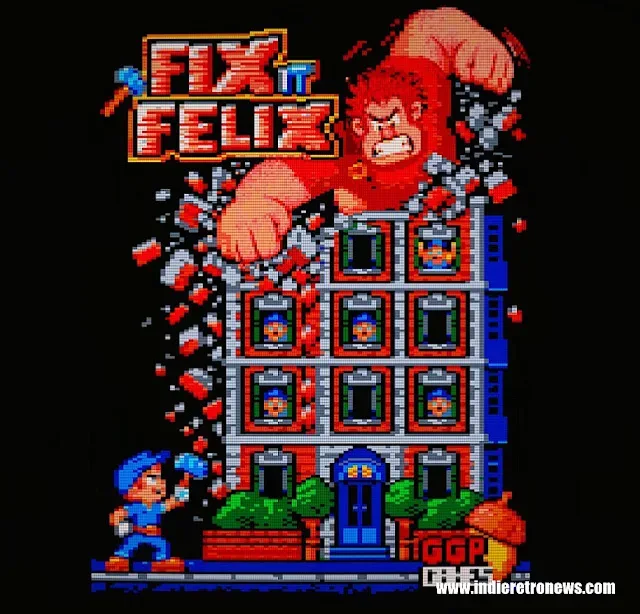
The Amstrad CPC Plus and GX4000 libraries have received an unexpected new arcade-style addition in Fix It Felix Jr., a fan project from Amstrad GGP. Inspired by the fictional coin-op game seen in the 2012 animated film series, the release reimagines that deliberately old-school screen game as a real production for Amstrad hardware.
It is an especially fitting match of idea and platform. The original fictional cabinet was designed to evoke the straightforward challenge, bright visuals and instantly readable objectives of early-1980s arcade games. This new version takes those principles seriously, putting players in control of repairman Felix Fixe Junior as he climbs a damaged building, restores broken windows and attempts to stay ahead of the chaos caused by the giant Ralph.
The result is not positioned as a new official entry in the film property, but as a dedicated fan-made game built around a concept that has long felt tailor-made for a genuine retro system. For CPC Plus and GX4000 owners, it offers a chance to play a version of the arcade fantasy rather than merely seeing it represented on screen.
A fictional arcade machine made tangible
Fix It Felix Jr. has an unusual history compared with most retro conversions. Its foundation is a game that was invented for a movie: a fictional arcade cabinet intended to establish the world and personality of its characters. That imagined game drew upon the visual language of classic single-screen climbers, with a towering building, a destructive antagonist at the top and a hero working upward to undo the damage.
For useful background on this topic, read Pinball Illusions' Lost Vikings Table Is Taking Shape on Amiga AGA.
Amstrad GGP's project brings that premise to the CPC Plus and GX4000 in a form that can be played on the hardware itself. The central objective is immediately clear: Ralph smashes windows, Felix has to repair them, and danger accumulates as the player moves between floors. It is an uncomplicated setup, but one with room for the escalating pressure that defines the best arcade experiences.
Players scale the building floor by floor, using Felix's magical golden hammer to mend shattered windows. The action is not just about speed, since the route through the building must be managed while avoiding hazards. Falling bricks can interrupt a climb, while birds add another moving obstacle to track. As the screen fills with repairs to complete and threats to avoid, the simple task of fixing windows becomes a test of timing and positioning.
That focus on a single, understandable activity is important. Arcade games of this style work best when a newcomer can understand the goal in seconds but needs repeated attempts to master the rhythms of movement, hazard avoidance and score-building. The building itself becomes the arena, with each level presenting another layer of windows and another opportunity for the situation to get out of control.
Repairs, collectibles and survival
While Felix's hammer is the key tool, the game also includes collectible elements that encourage players to look beyond the nearest broken window. Medals can be collected during a run, while pies left on windowsills by tenants provide another familiar arcade-style reward. These touches help give the building a sense of character: it is not merely a grid of objectives, but a place populated by grateful residents responding to Felix's work.
The combination of medals, pies, falling debris and birds suggests a play loop built around short-term decisions. A player can take the most direct path toward a damaged window, or detour to pick up an item while trying not to expose Felix to danger. That tension is central to score-driven games. The best route is not always the safest one, and the safest route may not be enough when the building needs urgent attention.
Ralph remains the cause of the upheaval overhead, punctuating the premise with the destructive personality expected from the character. Yet the game's viewpoint belongs firmly to Felix. Rather than trying to defeat the giant through combat, players restore order one window at a time. It is a refreshing arcade goal, built around repair and persistence instead of direct confrontation.
That also makes the game naturally suited to repeated sessions. The player's task is easy to explain to someone watching, and the hazards are visible enough that successes and mistakes should be immediately understandable. Whether played for a high score, completion or simply the novelty of seeing this fictional arcade concept on Amstrad equipment, the format has the directness associated with the era it celebrates.
Designed for the Amstrad Plus family
The release is specifically aimed at the Amstrad CPC Plus and GX4000, two closely related parts of the Amstrad family. The CPC Plus line built on the legacy of the original CPC home computers, while the GX4000 was Amstrad's cartridge-based console. A game supporting this side of the ecosystem is therefore notable both as a computer release and as a contribution to a console library that remains comparatively small.
Homebrew development has continued to give older machines new reasons to be played, and projects such as Fix It Felix Jr. show how modern fan communities can approach those systems with material that would have been unthinkable during their original commercial lifetimes. The inspiration may come from a much later film, but its arcade design is intentionally rooted in an earlier period, making the transition to 8-bit-era Amstrad hardware feel unusually natural.
The project's presentation is described as aiming for the spirit of the 1980s arcade boom: rapid action, an easy-to-grasp premise and a clear visual relationship between objective, enemy and obstacle. It is a style that suits the Amstrad Plus machines well, particularly when a game is designed around readable screens and focused action rather than sprawling worlds or dense menus.
There is also a pleasing circularity to the concept. A contemporary animated film created an affectionate imitation of an old arcade game; years later, a fan team has used real vintage hardware to make that imitation playable in a format much closer to the kind of machine it was originally referencing. The gap between fictional cabinet and physical retro release has effectively been closed.
Credits behind the fan project
Fix It Felix Jr. is credited as an original concept by Tobikomi, with the 2026 Amstrad GGP Games release identified as a fan project. Development credits name MaitrejoeGGP for code and graphics, and Echo for music and sound. Testing is credited to Gomez Addams GGP.
Those credits underline the collaborative nature of the release. On retro hardware, a successful arcade game depends on several disciplines working together: programming has to keep movement and hazards responsive, graphics need to make the playfield legible at a glance, and sound must reinforce the pace without overwhelming the action. A simple arcade premise can demand considerable care when it is being translated into an engaging game on period-inspired hardware.
The emphasis on original code, graphics, audio and testing also distinguishes this kind of fan work from a mere themed mock-up. The appeal lies in the fact that the concept has been adapted into a functioning game structure for its target machines, complete with the practical elements needed for a satisfying arcade loop.
A welcome addition for retro arcade fans
For players interested in the continuing life of the CPC Plus and GX4000, Fix It Felix Jr. is a particularly charming release because its source concept already speaks the language of vintage games. The climbing, repair work, collectibles and hazards are not modern mechanics awkwardly forced onto old hardware. They are the building blocks of a classic arcade experience, applied to a recognizable fictional setting.
Its arrival also highlights the creative range still found in the retro scene. New software for discontinued platforms does not have to be limited to nostalgia for games that actually existed decades ago. It can also make room for playful alternate histories: in this case, an arcade cabinet that never existed outside a movie can now be experienced as though it had found its way into an Amstrad collection.
With Felix repairing shattered windows, Ralph continuing his destructive rampage, and players dodging bricks and birds on the climb, the game embraces the simple, urgent pleasures of arcade design. For the Amstrad Plus community, it is another new reason to switch on hardware that is still receiving imaginative support many years after its original era.
Community
Discussion
Start the conversation.
No comments have been posted yet.