

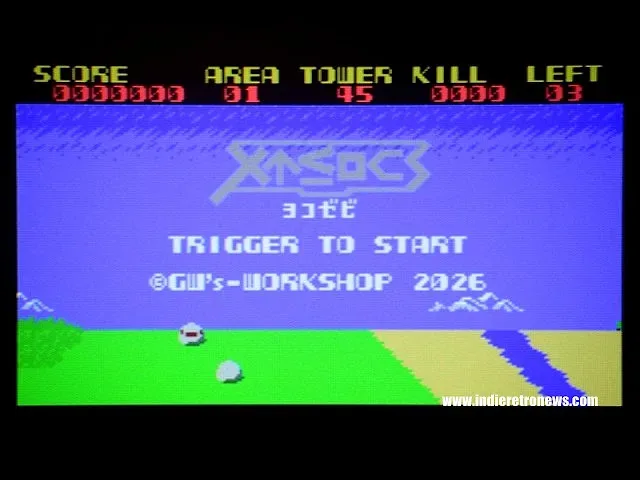
The MSXdev26 competition is underway, and its opening entry comes from a developer with a strong history in the event's shooter scene. GW's-Workshop has submitted YokoXevi, a new game for the original MSX1 hardware that takes a classic horizontal shoot 'em up format and builds it around a deliberate blend of arcade-era inspiration and technical ambition.
YokoXevi arrives with a clear design goal: create a side-scrolling shooter with roots in Xevious, the influential arcade game known for separating threats in the air from targets on the ground. The title itself points to that direction, with "yoko" meaning sideways in Japanese. Rather than simply recreating an old formula, however, YokoXevi adapts those ideas for a horizontally scrolling MSX1 experience.
That makes the game a fitting way to start a competition devoted to new software for the MSX platform. MSXdev has long given developers an annual reason to explore a family of machines whose limitations remain part of their appeal. The challenge is not only to make a playable game, but also to find personality and visual impact within the constraints of vintage hardware. YokoXevi appears designed to meet that challenge head-on.
A familiar shooter structure with a focused twist
At its core, YokoXevi is a side-scrolling shooter in which players guide a spacecraft through hostile territory. Enemy formations approach through the air, while separate dangers and objectives occupy the ground below. Keeping the ship alive means reading both layers of the action instead of concentrating only on whatever is directly ahead.
For useful background on this topic, read Flashback Is Finally Making Its Way to Atari ST in a New Work-in-Progress Port.
The game's attack system is central to that balancing act. A standard forward shot is used to confront aerial enemies, while downward-firing missiles are intended for ground targets. This means players must decide where their attention belongs at any given moment. An oncoming airborne wave may demand immediate forward fire, but ignoring the surface below can leave dangerous targets intact.
That division is a defining feature of the game's stated inspiration, and it can give shooters a different rhythm from games where every enemy sits on one shared plane. The player is not merely steering around obstacles and holding down a fire button. They are managing two directions of attack, assessing threats at different elevations, and trying to maintain control as the screen continues to scroll.
YokoXevi also builds toward a larger confrontation. Players who survive the regular enemy forces will eventually face a massive enemy mothership at the end of the journey. A final encounter of that scale is a natural payoff for a compact arcade-style shooter, especially one framed around the journey of a lone craft through increasingly hazardous territory.
Built for the MSX1
The MSX1 is an especially interesting target for a scrolling action game. Developers working on the system must account for strict display and sprite capabilities while still making movement readable, responsive, and exciting. In that context, YokoXevi's listed visual features stand out.
GW's-Workshop has incorporated multiple parallax scrolling backgrounds, giving different parts of the scenery a sense of moving at different speeds. Parallax is a familiar technique for adding depth to 2D game worlds: closer layers appear to move faster than distant ones, creating the impression that the player is flying through a space rather than across a flat backdrop. It is an effect strongly associated with later arcade and console games, so seeing it applied to an MSX1 shooter is a notable technical choice.
The game also uses multiplexed sprites. Put simply, sprite multiplexing is a method used to make more on-screen objects possible by reusing available sprite resources at different vertical positions as the display is drawn. For a shooter, that matters because enemy activity is part of the spectacle. A sparse screen can be easier to manage, but a fuller battlefield can better communicate the pressure and pace expected from the genre.
These features are not merely visual bullet points. In a shoot 'em up, presentation supports gameplay. Background motion must make forward progress feel convincing without obscuring enemy fire. Sprites need to be visible enough for players to quickly distinguish threats from scenery. And when several elements appear at once, the game needs to preserve a sense of order even as it increases intensity.
YokoXevi's technical approach suggests an effort to make the most of the MSX1 rather than treating the platform's age as a reason to avoid ambitious presentation. The competition environment encourages exactly that kind of experimentation: projects that are recognizably designed for older hardware but still try to surprise players familiar with its usual boundaries.
PSG audio completes the arcade mood
Sound is another important part of YokoXevi's pitch. The game includes rich PSG audio samples, making use of the programmable sound generator technology associated with the MSX experience. Audio design in retro shooters carries much of the work of selling impact: shots need to feel immediate, enemy destruction should provide feedback, and the soundtrack or accompanying effects have to keep momentum moving forward.
The phrase "rich PSG audio samples" points to an attempt to give YokoXevi a more textured soundscape while remaining within the character of the hardware. That matters because a shooter's atmosphere is created by the combined effect of scrolling scenery, enemy patterns, weapon sounds, and music or ambient audio. The visual techniques may catch attention first, but the audio layer is what can make repeated runs feel energetic rather than mechanical.
For fans of MSX games, this combination of technical display work and platform-appropriate sound is likely to be a major part of the appeal. Modern retro development is often at its best when it respects the identity of a machine while refusing to assume that its most familiar tricks are the only ones worth pursuing.
Keyboard and joystick support
YokoXevi supports control through a standard keyboard setup as well as a traditional joystick or gamepad configuration. That flexibility is valuable for an MSX release, where players may approach the game through original hardware, compatible controllers, or other setups built around the platform.
The control requirement is straightforward in theory but demanding in practice. Players need to navigate incoming aerial attacks while also aiming missiles toward ground targets. A responsive control scheme is especially important in a game where a small movement can determine whether a ship avoids danger, lines up a forward shot, or gets into position to deal with a target below.
Support for both keyboard and joystick-style input also keeps the game aligned with the broad traditions of home-computer action games. Some players prefer the direct familiarity of keys, while others will want the tactile movement and button layout associated with a dedicated controller. Either way, the game's dual-attack structure should give players more to think about than simple directional movement and constant firing.
GW's-Workshop returns to a proven genre
GW's-Workshop is no stranger to placing highly in previous editions of the MSXdev competition, particularly with MSX1 shooters. That background gives YokoXevi an added point of interest. The developer is returning to a genre they know well, but doing so with a new setting, a horizontal layout, and an explicitly stated connection to one of arcade gaming's foundational shooters.
There is value in that continuity. Competition entries can be experiments, but they can also reflect years of accumulated lessons. A developer that has repeatedly worked with the MSX1 and the shooter format is positioned to understand where players expect responsiveness, how much visual clutter the screen can sustain, and which techniques can make a game feel larger than its hardware specifications might suggest.
YokoXevi therefore enters MSXdev26 as more than an early submission. It is also a statement of intent for the competition's new cycle: a fresh game for vintage hardware that embraces recognizable genre traditions while trying to push presentation through parallax backgrounds, multiplexed sprites, and detailed PSG sound.
What YokoXevi represents for MSXdev26
Annual development contests are often most exciting at the beginning because the first entries establish a tone. YokoXevi sets that tone with an unabashedly arcade-minded project. It is rooted in the challenge and clarity of the shoot 'em up, built for a machine with a devoted retro community, and shaped around features that invite players to see what remains possible on MSX1 hardware.
Its appeal will likely rest on the fundamentals: whether enemy encounters remain readable, whether the two-direction attack system creates satisfying decisions, and whether the final mothership battle provides a memorable conclusion. Yet the presentation is an important part of the package, too. Multiple moving background layers and a busy sprite display can turn a familiar format into something that feels especially lively on the platform.
With YokoXevi now among the first games in the MSXdev26 lineup, retro shooter fans have a new MSX1 mission to watch. The game promises air-and-ground combat, keyboard and joystick options, and an ambitious attempt to pair classic design ideas with hardware-conscious flair. For a competition built around keeping the MSX creatively active, that is a strong opening move.
Community
Discussion
Start the conversation.
No comments have been posted yet.