

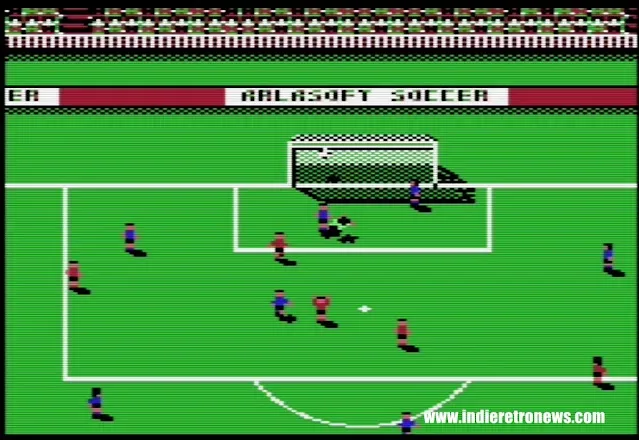
Arlasoft Soccer has arrived for the Commodore 64, bringing a remarkably ambitious Sensible Soccer-style football experience to one of gaming's most beloved 8-bit systems. The project has been in planning and development for around five years, and its goal was not simply to reproduce the appearance of the famous top-down football game. Its creators set out to capture the responsive player control, recognizable ball behavior, and quick-flowing match action that made Sensible Soccer so enduring.
That is a particularly daunting objective on Commodore's 1982 home computer. The C64 has a 1MHz 6502-family processor and 64KB of RAM, a dramatic reduction in available computing resources compared with the 16-bit systems associated with Sensible Soccer. Yet Arlasoft Soccer aims to retain the essential "Sensi" character while tailoring the overall package to the realities of the hardware.
The result is a release built for players who still enjoy original Commodore hardware as much as for retro fans using modern alternatives. It includes one-player and CPU-controlled matches, a 16-team cup competition, penalty shoot-outs, multiple tactical options, selectable difficulty levels, and pitches whose surfaces meaningfully affect how the ball behaves. It is an extensive football game by C64 standards, even with some larger-scale features necessarily left on the cutting-room floor.
Recreating Feel Rather Than Just Looks
Top-down football games can appear deceptively simple. Small player sprites, a scrolling pitch, and a ball moving between them may look easier to replicate than a contemporary 3D sports simulation, but the difference between an enjoyable approximation and a convincing recreation often lies in systems players cannot immediately see.
For useful background on this topic, read Family Time Copycat Sparks Plagiarism Debate as Wolf Colony Sim Climbs Steam Wishlist Charts.
Arlasoft Soccer's visual direction was reportedly the more manageable side of the work. The real challenge involved the underlying movement model: how footballers accelerate, turn, and respond to commands; how the ball travels across the pitch; how possession feels; and how the game maintains its brisk tempo amid the chaos around the penalty area. Those qualities are central to why Sensible Soccer remains a landmark football game, and they required more than simply designing sprites that resembled the original style.
A major breakthrough came through technical material shared by the team behind SWOS2020. This included reverse-engineered C++ source code and detailed documentation of the relevant systems. That material offered an important blueprint for understanding and recreating the gameplay logic more faithfully. It allowed the Arlasoft Soccer team to concentrate on translating that behavior to an 8-bit environment rather than attempting to infer every small rule of the original movement and physics from observation alone.
Even with that foundation, the conversion demanded extensive redesign. Code made for a 16-bit processor running at roughly 7MHz cannot simply be dropped onto a 1MHz 8-bit CPU. Every calculation, memory allocation, timing decision, and animation update had to be considered through the C64's severe constraints. The project's achievement is therefore as much about engineering compromise as it is about nostalgia.
Smart Technical Shortcuts Keep the Match Moving
Football is a demanding genre for old hardware because many things need to happen at once. Numerous players move independently, the ball follows its own rules, input must remain responsive, the field scrolls, and sprites need to be displayed without overwhelming the machine. Arlasoft Soccer uses several careful methods to keep that workload under control.
One key measure is the use of mathematical lookup tables. Multiplication and division are relatively expensive operations on the C64's processor, especially when they need to occur repeatedly during active play. By storing pre-calculated results for frequently needed operations, the game can access those values quickly instead of spending precious CPU time calculating them anew.
The game also limits player and ball movement updates to alternating frames. In practical terms, this halves the processing burden from those systems while preserving an overall impression of continuous play. Other calculations are handled in tile space rather than at pixel-level precision, another decision that reduces the computational demands of keeping a crowded football match in motion.
These are not glamorous solutions, but they are exactly the kinds of decisions that make sophisticated software possible on classic hardware. They also underline why a faithful-feeling C64 adaptation is more difficult than merely shrinking graphics or reducing the number of teams. The machine has to remain responsive when a pass is threaded through midfield or when several players converge in front of goal.
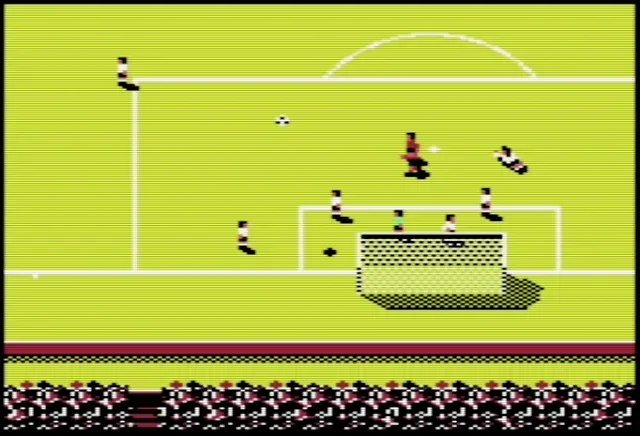
There can still be small performance dips during especially busy goalmouth situations. That is presented as a familiar trait rather than a complete surprise: the original Amiga 500 version could also slow down under intense on-screen activity. In a way, that similarity reinforces Arlasoft Soccer's focus on preserving the game's spirit instead of pursuing an unrealistic claim of technical perfection on far more limited hardware.
Commodore 128 Gets an Extra Advantage
Players using a Commodore 128 have a notable performance option. The machine can use a border raster speed boost, which gives Arlasoft Soccer additional processing time and can deliver virtually flawless performance. This is an appealing bonus for C128 owners, especially in a game where timing, scrolling, and sprite handling are so central to the experience.
The core game remains intended for Commodore 64 compatibility, rather than turning the C128 into a separate enhanced edition with fundamentally different content. Still, the extra headroom demonstrates how closely the project has been optimized around the limits of Commodore's 8-bit family. It also gives dedicated hardware users a reason to test the game on different configurations.
A Focused Feature Set Within 64KB
No amount of programming ingenuity can erase the C64's 64KB memory ceiling. Arlasoft Soccer consequently makes clear choices about what matters most. Expansive career modes, player substitutions, and licensed player names are absent, all sacrificed to preserve the immediate match experience and fit the game into its available memory.
That does not mean the release is bare-bones. Players can choose between human and CPU opposition, making it suitable for both local sessions and solo play. A 16-team cup mode provides a structured tournament framework, while penalty shoot-outs offer a compact alternative for decisive matches. There are also eight difficulty settings, allowing players to tailor the challenge across a wide range rather than settling for a single CPU behavior.
Tactics receive meaningful attention as well. Six formations are available, giving managers the opportunity to shape how their side occupies the pitch. A football game at this scale cannot represent every tactical instruction found in modern simulations, but formation selection still helps players approach matches differently, whether they favor a more defensive setup, balance across the field, or a stronger attacking presence.
Arlasoft Soccer also includes seven pitch types. These are more than visual variations, as the different surfaces alter the ball physics. That feature should give matches a greater sense of variety and encourages players to adapt to conditions rather than treating every field as identical. On a game focused so strongly on movement and ball control, changing the surface can have a noticeable effect on how passes, runs, and loose balls develop.
Broad Support for Retro Setups
The game supports both PAL and NTSC formats, an important consideration for the international Commodore community. It is designed to run on original hardware, while also supporting popular ways of playing C64 software today, including VICE, MiSTer, and modern clone consoles.
That compatibility gives Arlasoft Soccer a wide potential audience. Some players will likely experience it on a vintage computer connected to a CRT display, while others may load it into an emulator or FPGA-based setup. Making room for both PAL and NTSC users also helps ensure that the game is not restricted to one regional timing standard.
There is one known caveat for owners of the C64 Ultimate using turbo modes. A minor glitch has been identified in that configuration, and a patch is awaited. The issue does not change the broader compatibility target, but it is worth keeping in mind for players who rely on accelerated modes rather than standard-speed operation.
An 8-Bit Celebration of Fast Football
Arlasoft Soccer stands out because it takes on a type of project that is easy to underestimate. Recreating a classic football game's broad look is one task; recreating its momentum, control response, and personality on a much weaker computer is another altogether. The game's five-year journey reflects the amount of work required to turn that ambition into a playable C64 release.
Its missing career features and player licensing are understandable consequences of the platform's strict memory budget. What remains is centered on the part that matters most to fans of this particular football tradition: quick, approachable matches driven by distinct movement, direct control, tactical choices, and the unpredictable consequences of a ball in play.
For Commodore 64 enthusiasts, Arlasoft Soccer is a striking demonstration of what can still be achieved on the system. For fans of classic top-down football, it offers an unofficial new way to experience the essential Sensible-style formula on hardware that originally seemed far too constrained for the task.
Community
Discussion
Start the conversation.
No comments have been posted yet.