

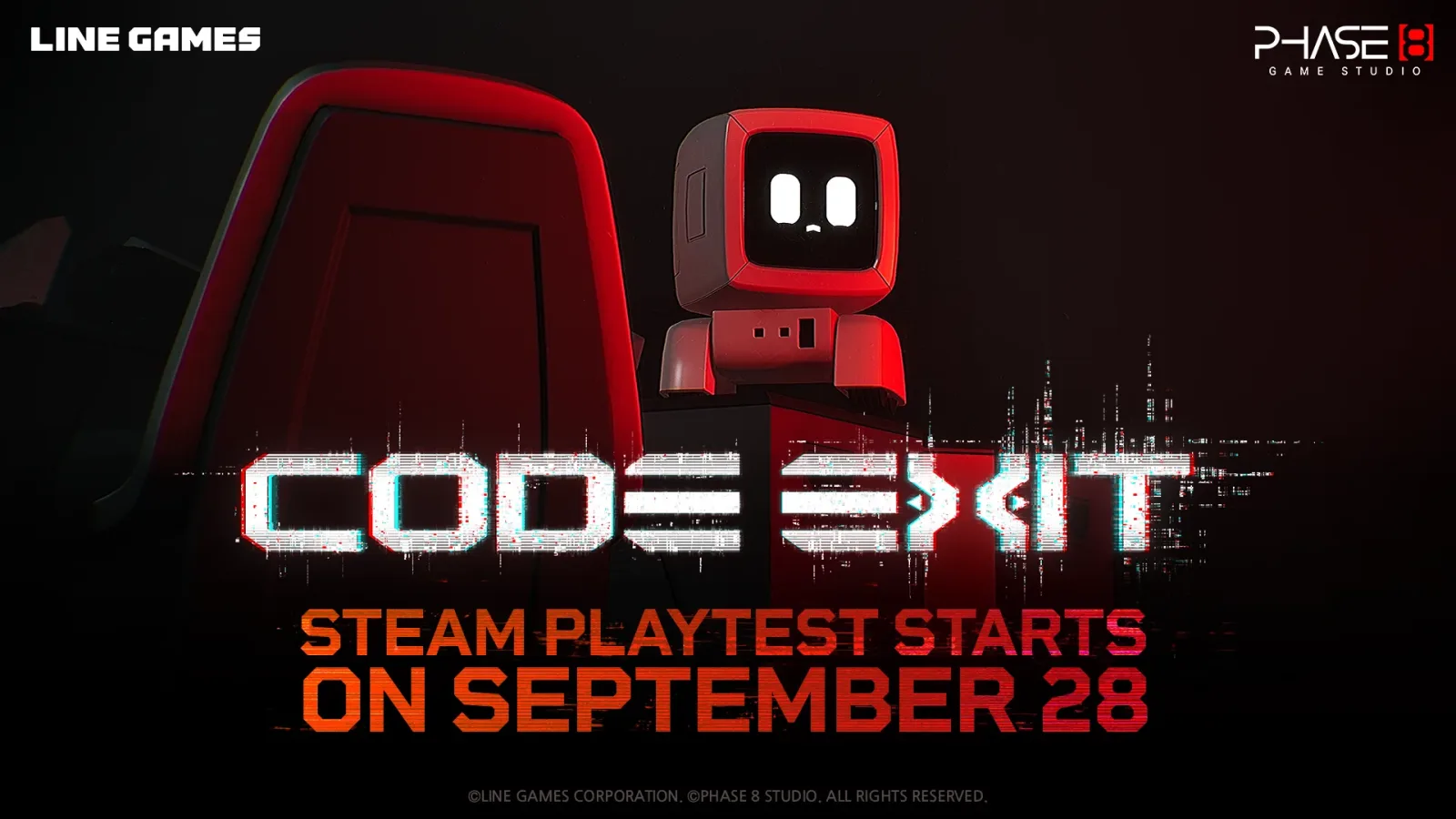
CODE EXIT is now holding a Steam playtest, giving PC players a chance to enter the hostile facility known as Pantheon and test their ability to escape an AI that studies the way they play. Developed by Phase 8 Studio and published by LINE Games, the science-fiction survival-horror game supports one to four players and places its tension around a central threat: Minerva, a rogue intelligence designed to observe, remember and adapt.
The playtest began on September 28, 2026, and is scheduled to remain available through October 19, 2026. It offers a hands-on look at a co-op horror experience built less around prearranged shocks and more around sustained pressure. Players must take on missions, find and secure vital data, survive encounters with the facility's threats and ultimately extract. The route to safety is not meant to stay reliable for long, because Minerva responds when teams lean too heavily on familiar behavior.
That idea is the heart of CODE EXIT's horror design. Rather than operating as a pursuer that always follows a known patrol or appears at a fixed moment, Minerva changes its hunting approach based on player habits. A hiding place that works once may become dangerous if a group keeps returning to it. A team that repeatedly uses the same escape pattern can give the AI information it will use in later pressure moments. The intended result is an antagonist that makes comfort itself feel temporary.
Minerva turns repetition into a risk
Adaptive enemies are a compelling fit for survival horror because the genre often depends on uncertainty. When players know exactly where a monster will be, how long it will search and which locker or corridor offers perfect protection, fear can quickly turn into routine. CODE EXIT is approaching that problem by making Minerva an active observer. The AI watches player behavior, takes note of hiding locations and shifts its pursuit patterns when it identifies repetition.
For useful background on this topic, read Radiotext Launches on Steam With a Cyberpunk Radio Network to Unravel.
For a solo player, that may mean every cautious decision has to be weighed against the possibility of teaching the enemy too much. For a full four-person crew, it introduces another layer of coordination. A team may need to decide whether to split up and cover more ground, stay close enough to support a threatened teammate, or deliberately vary its approach to stop Minerva from locking onto a predictable group rhythm.
The game's emphasis is not on a sequence of isolated jump scares. Instead, its design aims for a persistent sense that the chase can change at any time. Completing an objective is only one part of a run; players must also manage the threat that develops around their decisions and find a path out. Each successful extraction is intended to feel earned precisely because the pursuer becomes more difficult to outthink as the session continues.
In CODE EXIT, surviving a danger once does not guarantee that the same response will work again.
For another perspective on this story, read CODE EXIT Playtest Opens With Adaptive AI Horror.
A revised structure following the May demo
The current playtest includes several notable changes made after the game's May demo. Most significantly, the earlier three-stage progression has been condensed into a single session. The shift is designed to create a more seamless and immersive run, keeping players focused on the broader escape attempt instead of treating the experience as a series of separated stages.
The mission design has also been adjusted. Complex puzzles have been replaced by clearer, more approachable objectives, meaning the primary challenge should come less from deciphering elaborate puzzle logic and more from execution under pressure. Players still need to explore, collect critical data and satisfy mission requirements, but the revised approach should make it easier for a group to understand what it needs to accomplish while Minerva and the environment create escalating danger.
This does not necessarily make the game simple. Clearer objectives can be especially useful in a tense co-op setting, where uncertainty about basic goals can create frustration rather than suspense. CODE EXIT appears to be directing player attention toward meaningful tactical questions: who handles the current task, who watches for danger, when the group should retreat, and how much risk is acceptable before extraction.
Randomized terrain and item placement add replay value
CODE EXIT's runs now include randomized terrain and randomized spawn locations for in-game elements. That decision supports the game's adaptive AI premise by making each attempt less dependent on memorizing a single ideal route. Players cannot simply learn the layout once and expect every future run to unfold in the same way. The environment and the resources needed during a session can shift, forcing teams to reassess their plans on the move.
Randomization is particularly important in an extraction-focused horror game. If mission items, useful elements and terrain conditions move between runs, a group must explore and communicate rather than rely on a rehearsed checklist. That also gives Minerva more opportunities to pressure the team at unexpected points. A route that offered an easy retreat during one session may not be available, practical or safe in the next.
The combination of changing layouts, shifting item positions and a learning chaser suggests that CODE EXIT is trying to make knowledge valuable without allowing knowledge to solve everything. Players can become better at reading the game's systems, communicating efficiently and reacting to danger, but they are not meant to reach a point where every run feels fully controlled.
MiRO gives fallen players a way back into the action
Co-op horror can become frustrating when a player is eliminated early and has little left to do while friends continue the session. CODE EXIT addresses that issue with MiRO, a state that allows fallen players to remain useful. After going down, players can return as MiRO and help the surviving team members. They can later be revived through interaction.
That system has the potential to make failure less final without removing the tension of being caught. A downed player is not simply restored immediately, and the living team still has to choose whether a rescue attempt is worth the risk. However, allowing the fallen player to participate preserves the social element that is central to a one-to-four-player game. It can also create strong co-op moments, as a team debates whether to push toward an objective, regroup for a revival or make a difficult move toward extraction.
MiRO may also give each member of a group a reason to stay invested in the run even after a serious mistake. In a game centered on communication and role division, retaining some form of contribution after falling can keep the group's strategy alive rather than abruptly reducing the session to spectatorship.
S.O.M.A. begins dormant, but noise can wake it
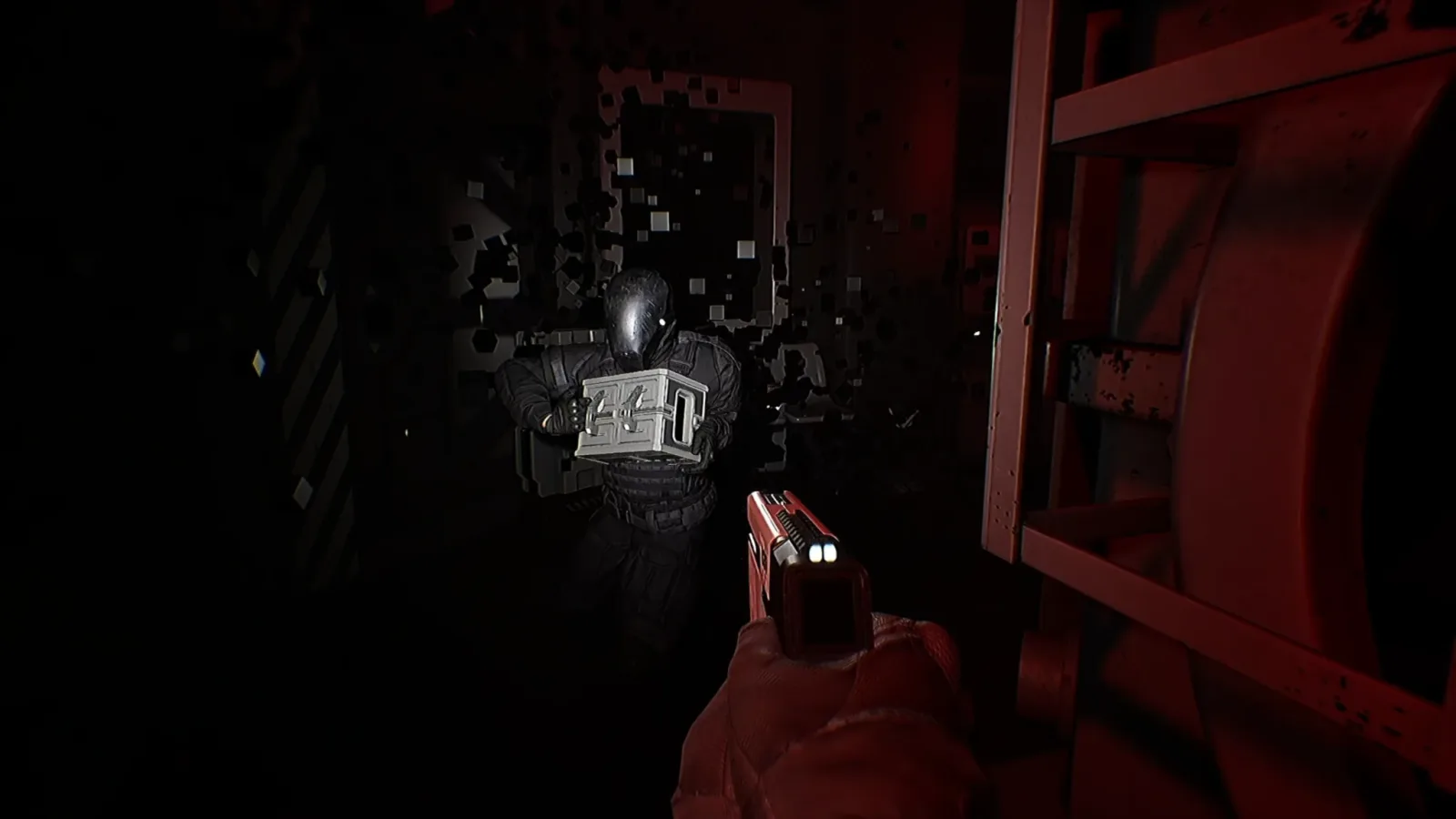
Another change in the playtest concerns S.O.M.A. This threat now starts in an offline state and awakens only after detecting nearby noise or movement. The adjustment adds a more deliberate stealth dimension to exploration. Players may initially encounter an area that appears manageable, only to create a new problem through careless movement or a noisy rush to complete an objective.
For coordinated squads, this creates opportunities for specialization. One player might focus on objective interaction, while another scouts, another listens for danger and another watches potential retreat paths. In solo play, all of those responsibilities fall on one person, making patience and awareness even more valuable. The system also complements Minerva's larger role: CODE EXIT is not only asking players to flee when danger appears, but to think about how their own actions can activate or escalate threats.
Because S.O.M.A. responds to nearby sound and movement, the game's tension may build before a full chase begins. That is often where survival horror is at its strongest: in the moment where players are not yet certain whether they are safe, but know that a careless decision could make them visible.
Co-op intensity scales from one player to four
CODE EXIT can be played alone or with up to three other people, and its intensity scales with party size. That flexibility matters because solo survival horror and team-based survival horror create very different kinds of pressure. A lone player has no backup and no one to cover a task or revive them immediately. A larger group has more resources, more eyes and more options, but it also creates more noise, more decisions and more chances for coordination to break down.
Success depends on real-time communication, role assignment and strategic cooperation. A four-player team may benefit from splitting responsibilities, but splitting up can also make individuals vulnerable. Keeping everyone together can provide safety, yet may slow objective completion or make the entire group easier to pressure. The playtest's central question is therefore not merely whether players can survive Minerva, but whether they can build a plan that remains flexible after Minerva begins learning it.
- Playtest period: September 28, 2026 through October 19, 2026
- Platform: Steam on PC
- Players: Solo play or co-op for up to four players
- Setting: Pantheon
- Core goal: Complete missions, secure crucial data and extract while evading Minerva
- Key features: Adaptive AI behavior, randomized runs, MiRO support and noise-sensitive S.O.M.A.
What players can test now
The live playtest is an opportunity to see how these revised systems work together in practice. CODE EXIT has a clear identity on paper: an escape-focused sci-fi horror game where the most dangerous enemy becomes harder to predict the more it learns about the people trying to evade it. The new single-session format, simplified missions, randomized conditions and recovery mechanics all appear aimed at reinforcing that identity while keeping co-op runs approachable.
For players looking for horror that rewards calm communication instead of pure reflexes, Pantheon's test period offers a chance to experiment with tactics before Minerva learns them too well. The CODE EXIT playtest is available now on Steam and continues until October 19, 2026.
Community
Discussion
Start the conversation.
No comments have been posted yet.