

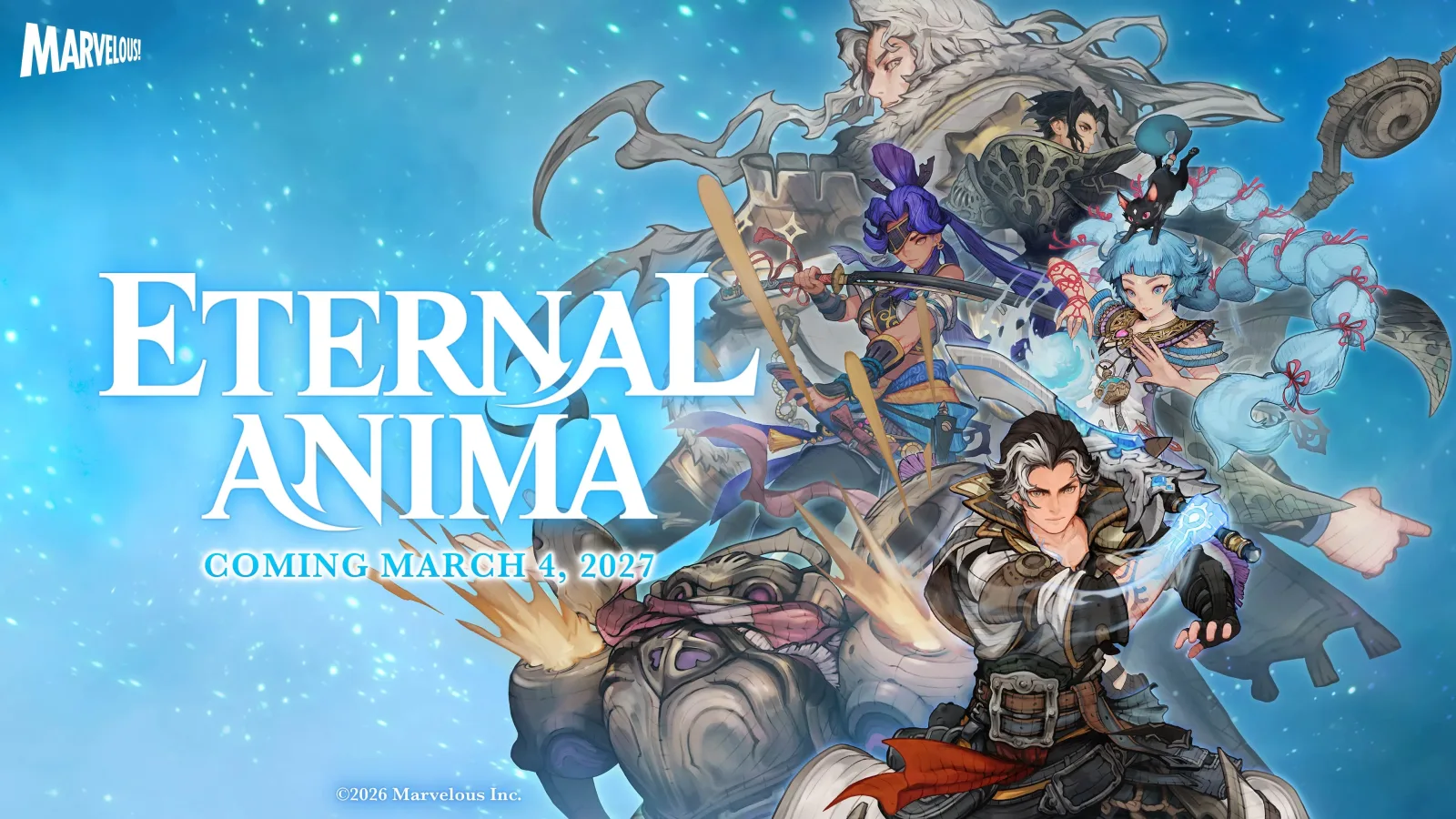
Eternal Anima is putting its creative influences and design philosophy in the spotlight through a newly localized video series featuring several prominent Japanese role-playing game veterans. The upcoming Marvelous-developed JRPG is scheduled to launch worldwide on March 4, 2027 for Nintendo Switch 2, PlayStation 5, Xbox Series X|S and Windows PC via Steam.
Called Special Discussion, the English-subtitled series pairs members of the Eternal Anima team with notable guests to examine the ideas behind the project, their respective histories in the genre, and the practical challenges involved in building a time-spanning adventure. Its first two episodes feature conversations involving director Katsuhisa Higuchi, Mistwalker's Hironobu Sakaguchi, Basiscape music producer Hitoshi Sakimoto, and composer Nobuo Uematsu.
Rather than simply serving as promotional interviews, the discussions outline several of the systems that define Eternal Anima. The game centers on a concept of legacy, with its heroes traveling between eras, encountering ancestors and descendants, and drawing power from the memories of people who came before them. That premise informs both the story and the player's mechanical progression.
A JRPG built around the idea of legacy
Eternal Anima's adventure spans generations. Players will travel across continents while connecting with characters linked across time, including ancestors and descendants. It is a familiar foundation for a dramatic fantasy RPG, but the stated emphasis on inherited memories, abilities and relationships gives the game's time-travel component a more direct role in gameplay.
For useful background on this topic, read Marked For Mayhem Dev Vlog Details Co-op Chaos, PvP Disruptors and November Playtest.
Protagonist Wade has access to an ability called Psychometry. Through it, he can decipher memories held inside artifacts. Those discoveries are not presented as story-only collectibles: Psychometry also lets Wade inherit abilities and classes from heroes of the past. The system appears designed to turn artifacts into a bridge between narrative discovery and party development, allowing earlier generations to actively shape the tools available in the present.
That approach suits a game interested in legacy as more than a thematic word. In many RPGs, old weapons, ruins and historical figures primarily establish atmosphere or lore. Eternal Anima instead positions memories as usable resources. Learning about past heroes can change how the current party functions, while the prospect of new classes and skills gives players a concrete reason to investigate the world's relics.
The first Special Discussion installment places Higuchi in conversation with Sakaguchi, whose career makes him a particularly apt guest for a discussion about long-running JRPG traditions. Their exchange addresses the meaning of legacy in Eternal Anima, broader perspectives on RPG design, and the importance of details that can seem small in isolation. The contents of treasure chests are among the specific elements discussed, underscoring how rewards and exploration contribute to an adventure's rhythm.
Treasure design may not sound as dramatic as time travel or a combat system, but it can strongly influence how players read a world. A chest can provide recovery items that encourage continued exploration, equipment that changes tactical options, or a carefully chosen piece of narrative context. For an RPG that asks players to search through remnants of the past, the contents and placement of discoveries can reinforce the feeling that every detour has value.
Time travel without losing the thread
Time-travel stories face an immediate structural challenge: every trip to another era raises questions about cause, effect and contradiction. Higuchi and Sakaguchi's discussion covers the team's effort to construct a narrative involving time travel without collapsing into paradoxes.
The exact shape of Eternal Anima's chronology remains to be seen, but the developers' attention to that issue is notable. A story centered on ancestors and descendants needs its timeline to feel understandable enough that the emotional connections between generations retain their weight. If the player is inheriting a past hero's class or encountering people who are connected across eras, those relationships need rules that the audience can follow.
There is also an opportunity here for the game's systems and storytelling to reinforce each other. Psychometry already frames the past as something that can be interpreted from objects in the present. Traveling across time adds another perspective: players may not just hear about history, but see its people, conflicts and choices in their original context. The contrast between a remembered event and the lived moment behind it could become one of Eternal Anima's most effective storytelling tools.
That structure could also make the title's legacy theme more personal. A descendant may carry the consequences of choices made generations ago, while an ancestor's reputation might look different once the player meets them directly. Whether the game leans toward tragedy, reconciliation or grand adventure, the setup gives it ample room to explore how history is preserved, misunderstood and passed on.
Future Sight Battles aim for tactical control
Eternal Anima's combat system is called Future Sight Battles. It is built around predicting enemy actions and responding with effective counters, giving players greater control over the flow of battle. The name aligns neatly with the game's larger interest in time: successful combat is not just about reacting to the current turn, but reading what is likely to happen next.
Prediction-based mechanics can make turn-based encounters feel more dynamic because they ask players to plan around intention rather than only damage values. If an enemy is telegraphing a major attack, players may have a chance to defend, disrupt it, exploit a weakness or arrange their own actions to capitalize on the opening. A system like this rewards observation while retaining the strategic decision-making associated with classic party RPGs.
Its connection to Psychometry is also important. Wade's ability to access memories and claim the capabilities of past heroes suggests that party customization may feed directly into the choices players make when they see an enemy's future move. Different inherited classes and skills could provide different answers to the same threat, making progression a matter of developing options rather than merely increasing numbers.
Marvelous has described Future Sight Battles as a way to predict and counter actions, but further details on party structure, class limits and the full battle flow have not yet been announced. Even so, the available outline points toward a system that seeks to make foresight a practical, moment-to-moment part of combat instead of only a narrative concept.
Sakimoto and Uematsu discuss the role of music
The second Special Discussion episode turns from systems and scenario design to music. Sakimoto, the music producer at Basiscape, speaks with Uematsu about expression in JRPG music, the difficulties composers face within the genre, and their individual creative processes. The conversation also addresses how those ideas informed Eternal Anima's score.
Music carries an unusually prominent role in role-playing games, where players may spend dozens of hours revisiting locations, fighting through long dungeons and watching dramatic character scenes. A town theme must remain inviting after repeated visits. Battle music must energize without becoming exhausting. Major story tracks need to support a scene while leaving room for the player's own reaction. For a game that crosses eras and follows a chain of generations, the score may also have opportunities to distinguish periods while tying them together through recurring ideas.
The involvement of Sakimoto and Uematsu in the discussion gives the video series a useful wider perspective on the craft. It invites viewers to consider the work behind a JRPG soundtrack not as decoration added after the main game is built, but as a core part of setting tone, shaping memory and helping key moments endure after the credits.
That focus is especially fitting for Eternal Anima's premise. If the game is about what survives across time, music can be among the strongest ways to create that feeling. A melody associated with a past hero, a location or a family line can gain new meaning when it returns in another era. Whether the finished score takes that specific route remains unconfirmed, but the theme gives its music a compelling narrative space to occupy.
Platforms, editions and release plans
Eternal Anima is in development for Nintendo Switch 2, PlayStation 5, Xbox Series X|S and PC via Steam. Marvelous is developing the game, with Marvelous USA handling publishing in the Americas and Marvelous Europe publishing it in Europe and Australia. The game has received an ESRB rating of T for Teen.
Physical pre-orders are available through participating retailers and the Marvelous USA online store for PlayStation 5 and Nintendo Switch 2. The standard physical edition is listed at $49.99 for PlayStation 5 and $59.99 for Nintendo Switch 2.
A physical Limited Edition is also planned for both of those platforms. It includes the game, a two-disc soundtrack, nine character art cards with a display stand, and an art book. It is listed at $79.99 on PlayStation 5 and $89.99 on Nintendo Switch 2.
Details regarding digital editions have not yet been announced. With launch still set for March 2027, there is time for Marvelous to reveal more about Eternal Anima's cast, progression systems, world design and the practical rules behind its movement through history.
For now, the Special Discussion series offers a clearer sense of the project's ambitions. Eternal Anima is looking to combine familiar JRPG pillars--party growth, tactical battles, exploration and an emotionally charged score--with a framework in which the past is not simply background. It is a living source of identity, power and consequence for the people moving through the story's present.
Community
Discussion
Start the conversation.
No comments have been posted yet.