

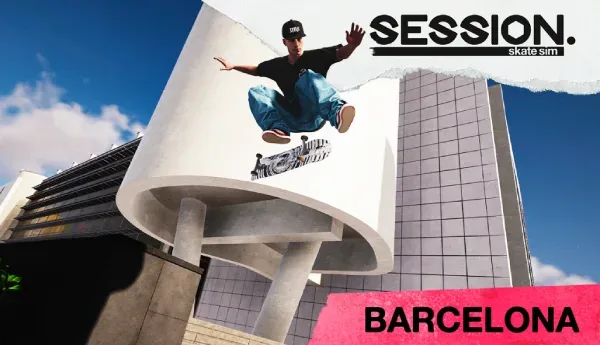
Session: Skate Sim has added a new destination for players who prefer carefully measured lines, technical tricks and self-made skate videos over arcade-style spectacle. The Barcelona DLC is available now, taking the skateboarding simulation to the Spanish city known for its distinctive architecture, open plazas and enduring place in real-world skate culture.
Developed by crea-ture Studios and published by NACON, the expansion is built around Barcelona-inspired environments that emphasize the kinds of surfaces and features skaters seek out in video parts: broad marble spaces, extended ledges and bright outdoor spots designed for linking together lines. It also includes seven new items for the game's Object Dropper, giving players further tools to alter a location and shape their own setups.
The Barcelona DLC arrives as Session: Skate Sim enters its fourth year. The game has now reached more than four million players worldwide, while its post-launch catalogue has grown to include eight additional content packs alongside numerous updates. That continuing support is notable for a game whose appeal rests less on quick accessibility than on asking players to repeatedly practice the fundamentals.
Barcelona's skate identity comes to Session
Barcelona has long been a recognizable setting in skateboarding footage. Its combination of smooth stone, public architecture and dense urban spaces has made the city a frequent destination for travelling skaters and a familiar visual reference for viewers of skate videos. The new DLC draws on that character rather than presenting Barcelona simply as a scenic backdrop.
For useful background on this topic, read Eternal Anima Video Series Explores JRPG Legacy With Sakaguchi and Uematsu.
Players can expect spaces oriented around street skating, where the line matters as much as the individual trick. Marble plazas provide room to build momentum and approach an obstacle from several angles, while long ledges encourage grinds, slides and attempts to carry a trick farther than before. Sunlit spots also give the environment an appropriately video-ready atmosphere, particularly for players using Session's built-in capture tools.
That focus suits the game's wider approach. Session: Skate Sim is not structured around an exaggerated skating fantasy where a few button presses produce a full sequence of flips and spins. Instead, it aims to make positioning, balance, timing and commitment central to each attempt. New terrain therefore has value beyond its appearance: a fresh ledge or plaza can become a new problem to solve, a new line to refine or a new setting for a filmed clip.
Seven additions for the Object Dropper
Alongside the Barcelona environment, the DLC introduces seven new items for the Object Dropper. This feature lets players place objects in the world, extending the possibilities of a given spot beyond its default layout. The announcement does not detail the individual items, but their inclusion means the expansion offers more than a fixed collection of locations.
For another perspective on this story, read Session: Skate Sim Barcelona DLC Is Available Now.
For a simulation built around experimentation, placeable objects can change how a familiar section is approached. A player may want to create a more direct route into a feature, add another obstacle to a line, or construct a setup specifically for a particular trick. The Object Dropper also supports the game's clip-making side, allowing skaters to shape scenes with a more personal visual identity before opening the editor.
That customization is especially useful in a title where successful runs often take time. Once players find a spot that feels right, being able to modify it can keep the process of practicing and recording from becoming static. The new items expand those options without changing the game's defining control philosophy.
A simulation designed around separate feet
Session: Skate Sim distinguishes itself through its ultra-realistic physics and its True Stance Stick control system. Rather than assigning board control to a more conventional set of trick inputs, the system uses the two sticks to independently manage each foot. The intention is to make players think about the physical actions behind a skateboarding trick rather than simply selecting a pre-defined move.
That design gives the game a steep, practice-focused learning curve. Landing a clean trick may require an understanding of stance, foot movement, board position and the approach to an obstacle. The reward is that a successful attempt can feel specifically earned. In this style of skate game, a simple ollie over a small object or a clean grind along a ledge can carry more weight because it was not guaranteed by an easy input sequence.
Barcelona's plazas and ledges appear well suited to that formula. Large open areas can give players the room needed to establish their approach, while longer obstacles create opportunities to work on consistency. Players who enjoy repeated attempts at a single trick will have new places to revisit, and those interested in flowing lines can use the wider spaces to connect features into a complete run.
Capturing clips remains part of the experience
Session: Skate Sim also includes an integrated editing tool for recording player footage. That feature is an important part of the game's identity, reflecting the role that filming has played in skateboarding culture. A session does not necessarily end after landing a trick; players can adjust their presentation and turn a successful line into a shareable skate-style clip.
The Barcelona DLC's visual cues--marble, sunlit public spaces and recognizable street-skating architecture--should give editors another backdrop for this process. The game's camera and editing options can be used to document a trick from an angle that highlights the approach, the length of a grind or the landing. For players who treat Session as both a skate simulation and a virtual filming tool, new locations are as much about atmosphere as they are about geometry.
With the Object Dropper additions included in the pack, players can also build a spot around the shot they want to create. The ability to arrange objects before filming gives the editing workflow an additional layer, whether the goal is a realistic-looking street clip or a more customized technical challenge.
Price and game availability
The Barcelona DLC is available now for $7.99 / £6.69 / EUR7.99. A new trailer has also been released alongside the expansion.
Session: Skate Sim itself is available on Xbox Series X|S, Xbox One, PlayStation 5, PlayStation 4, Nintendo Switch, and PC through Steam and the Epic Games Store. It is also listed through nacongaming.com. The announcement confirms the DLC's release but does not separately break down its availability by platform.
Four years into its lifespan, Session: Skate Sim continues to build on a deliberately specialized version of virtual skateboarding. Its core is not about instant high scores or forgiving combo systems; it is about learning how to control a board, accepting missed attempts and gradually assembling a line worth saving. The Barcelona DLC adds a fitting new stage for that process, with open marble spaces, long ledges and more objects for players determined to make each spot their own.
Community
Discussion
Start the conversation.
No comments have been posted yet.