

Few role-playing game series have cast a longer shadow than Final Fantasy, but longtime producer Yoshinori Kitase has offered a useful reminder that even landmark creative works begin with influences of their own. Speaking during the Lucca Comics & Games Festival 2026, Kitase discussed the importance of inspiration moving between artists, games, films, and generations. For him, one of the biggest formative touchstones was Star Wars.
The conversation began with Clair Obscur: Expedition 33, the successful RPG whose creators have spoken about their admiration for Final Fantasy. Rather than treating that connection as a problem or a simple case of imitation, Kitase said he was pleased to see developers take inspiration from the Square RPG series and build something new from it. He framed that relationship as part of a wider creative cycle: artists absorb the works that excite them, transform those ideas through their own perspective, and in turn become an influence on someone else.
Kitase's own career provides a prominent example. He said that movies, especially Star Wars, helped shape the ideas he brought into his games when he was younger. At the same time, he emphasized that he tried to avoid reproducing things too directly. The goal was not to make a Star Wars copy inside a Final Fantasy setting, but to take a compelling concept and reinterpret it in a different form.
Inspiration, not duplication
That distinction is central to Kitase's comments. Creative influence can be easy to spot when a character name, visual design, mechanic, or story beat recalls an earlier work. Yet the more interesting part of influence is often what happens after that initial spark. A creator may borrow the broad idea of a futuristic race, for example, but place it within an entirely different world, combine it with a new set of rules, and make it serve a different emotional or mechanical purpose.
For useful background on this topic, read Ghost Haunting demo Arrives on Steam Ahead of 2027 Launch.
Kitase described himself as cautious about making his Star Wars inspirations overly obvious. That concern makes sense for a franchise with such a distinct identity of its own. Final Fantasy is known for mixing fantasy with science fiction, melodrama with comedy, and traditional role-playing systems with experiments that change dramatically from one numbered installment to the next. Directly transplanting a famous film concept would risk pulling players out of that identity. Translating the spirit of an idea, however, can enrich a new setting without overwhelming it.
His comments also arrive at a moment when conversations around influence are especially active in the RPG space. Clair Obscur: Expedition 33 has drawn attention for its relationship to the traditions of Japanese role-playing games, including Final Fantasy. Kitase's response is notably generous: he sees inspiration as something worth celebrating when it helps creators make a new work rather than merely replicate an old one.
For Kitase, the exchange of ideas between creators is not a weakness in the creative process. It is part of how new games emerge and how a genre continues to evolve.
Biggs and Wedge are Final Fantasy VII's clearest nod
The most immediately recognizable Star Wars connection Kitase identified is found in Final Fantasy VII. Biggs and Wedge, members of the Avalanche group in the game's opening Midgar section, share their names with characters associated with the Rebel Alliance in Star Wars. The reference is overt enough that many fans have likely recognized it for years, and Kitase acknowledged it as one of the clearest examples of his affection for the sci-fi saga surfacing in Final Fantasy.
The names fit naturally within Final Fantasy VII's early story. Avalanche is a resistance movement operating against Shinra, a gigantic corporate power whose reach extends across Midgar and far beyond. Although Final Fantasy VII has its own politics, mythology, and character dynamics, the presence of a small group fighting a much larger authority gives the Biggs and Wedge names an extra layer of resonance.
They are also a good illustration of the line Kitase described. Naming supporting characters after Star Wars figures is a playful homage, but it does not turn Final Fantasy VII into Star Wars. Biggs and Wedge remain part of Avalanche, Midgar, and the environmental and political conflicts unique to Final Fantasy VII. The allusion gives knowing fans something to recognize while leaving the game's world intact.
That balance has long been one of Final Fantasy's strengths. The series frequently nods to fantasy, science fiction, mythology, and earlier games in its own history, while each main entry works to establish a separate setting and cast. Recurring names, creatures, jobs, and motifs create a sense of tradition, but their role changes from game to game. Kitase's Star Wars examples reveal one thread within that broader approach.
Blitzball and the idea behind Podracing
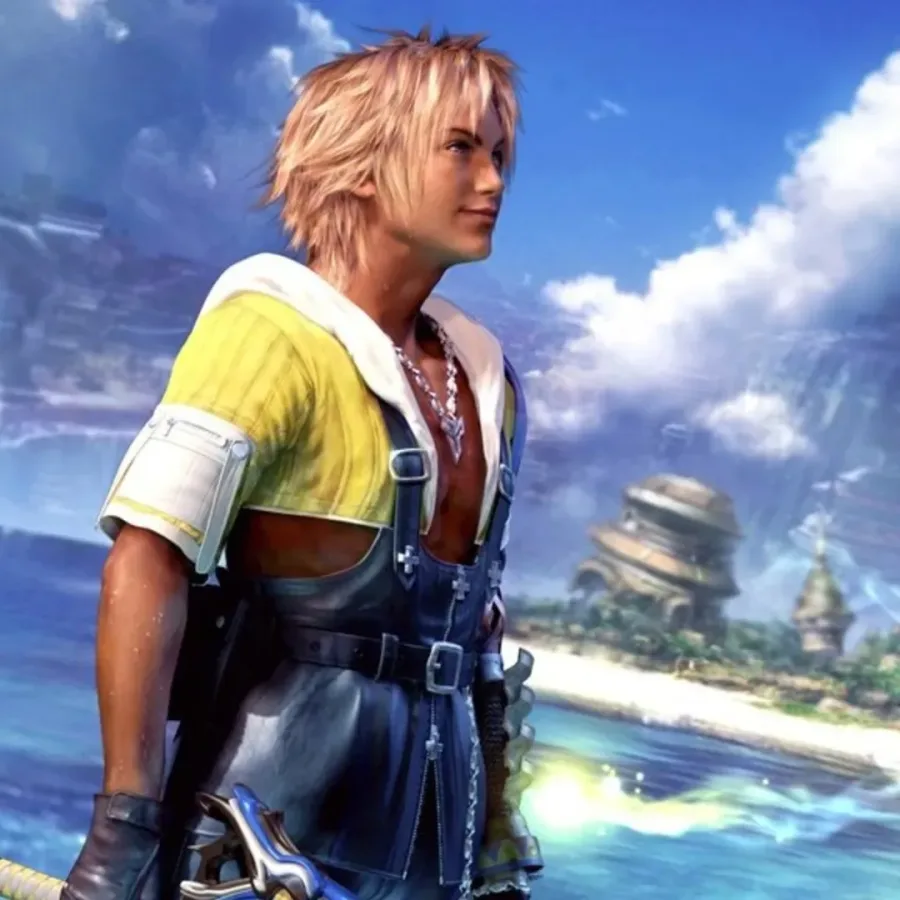
Kitase also identified a less obvious connection in Final Fantasy X. Its underwater sports game, Blitzball, was inspired by an idea he took from the Podracing sequence in Star Wars: Episode I - The Phantom Menace: presenting sport as part of a fantastical fictional setting.
Blitzball is not simply Podracing moved underwater. Final Fantasy X's sport is a team competition played in a sphere of water, with passing, positioning, scoring, management, and tournament progression forming a substantial optional activity. It is connected directly to protagonist Tidus as well, since he begins the story as a celebrated Blitzball player. The game's role in Spira extends past a minigame, helping establish cultural traditions, public entertainment, and Tidus's life before the events that send him into an unfamiliar world.
Still, the underlying creative leap is easy to understand. Podracing offered a memorable example of a spectator sport designed for a space-fantasy universe. It has rules, danger, famous competitors, excited crowds, and a place in the social fabric of its setting. Kitase saw value in that sort of worldbuilding and adapted the larger concept for Final Fantasy X.
In doing so, Blitzball became something distinctly suited to Spira. Water is one of Final Fantasy X's defining visual and thematic elements, from the coastal locations and aquatic enemies to the game's imagery of memory, loss, and ritual. Building the sport around a floating water sphere made it feel inseparable from that world. Rather than functioning as an imported sci-fi idea, it became a feature that players strongly associate with Final Fantasy X itself.
Why fictional sports matter
Fictional sports can do a surprising amount of narrative work. They make an invented setting feel inhabited by people whose lives include hobbies, rivalries, celebrities, and routines outside the main conflict. They can also provide an immediate way to communicate a protagonist's skills and history. In Tidus's case, Blitzball establishes his confidence, fame, and public identity before the story dismantles nearly every certainty he has.
Kitase's explanation suggests that the key lesson he took from Podracing was not a specific vehicle design or race structure. It was the utility of making entertainment part of the setting. Final Fantasy X then developed that idea through its own visual language and gameplay systems.
- Star Wars Podracing: a high-speed contest that helps make a galaxy far, far away feel populated and culturally textured.
- Final Fantasy X Blitzball: a competitive sport that deepens Spira, informs Tidus's character, and gives players a recurring side activity.
- The shared principle: fictional competition can be more than spectacle; it can make a fantasy world feel lived in.
A positive view of Clair Obscur: Expedition 33's Final Fantasy roots
Kitase's reaction to Clair Obscur: Expedition 33 carries additional weight because Final Fantasy itself has influenced so many RPG developers. A series with decades of history can easily be discussed only in terms of what it contributed to the medium. His remarks instead place it within a chain of influence that includes films such as Star Wars and extends to newer game creators.
That is a healthy perspective for a genre built on iteration. Turn-based battles, party systems, elaborate worlds, cinematic storytelling, minigames, and character-driven drama have all been reinterpreted countless times. What matters is how a developer combines those elements and whether the result has a voice of its own. Kitase appears to see the success of a Final Fantasy-inspired game as evidence that the ideas associated with the franchise still have room to generate new experiences.
It also underlines that influence should not be confused with a lack of originality. Every major creative medium is full of dialogue between works. Films inspire games; games inspire games; books, mythology, art, music, and real-world cultures inform all of them. The meaningful challenge is not avoiding inspiration, but using it thoughtfully.
Looking toward Final Fantasy VII Revelation
Kitase's reflections come as anticipation continues to build around the conclusion of the Final Fantasy VII remake trilogy. Final Fantasy VII Revelation is scheduled to launch on April 8, 2027. The project will bring the trilogy's reimagining of Final Fantasy VII to its final chapter, following a journey that has already expanded on familiar characters, locations, and story material.
For players revisiting the remake series, the Star Wars discussion offers another lens through which to view its world. Biggs and Wedge may be an obvious reference, but they also show how small homages can become part of a property's own history. In Final Fantasy, inspiration has never prevented the series from developing an identity. If anything, Kitase's comments suggest that openness to outside ideas has helped make that identity possible.
From the Rebel-inspired names in Midgar to the conceptual spark behind Blitzball in Spira, Star Wars left traces in some of Final Fantasy's most memorable settings. Kitase's larger point is perhaps the most important one: creative work does not stand still. It is passed forward, changed by new hands, and returned to the world in forms no one could have predicted at the beginning.
Community
Discussion
Start the conversation.
No comments have been posted yet.