

Fire Emblem: Fortune's Weave may have compelling protagonists, a colorful new cast, and the strategic battles fans expect from Nintendo's long-running series, but one issue is already testing players' patience: it spends an enormous amount of time talking about what is happening rather than letting players get on with it.
After roughly 10 hours with the game, the balance between story, tutorials, and actual tactical action can feel badly skewed. The concern is not that Fire Emblem has suddenly become a story-heavy series; narrative melodrama, elaborate political conflicts, relationship-building, and lengthy conversations have long been central to its identity. The problem is more specific. Fortune's Weave can seem unwilling to trust that its audience has understood anything the first time it explains it.
That means key story information is frequently restated, character conversations can linger after their point is already clear, and tutorials arrive to define concepts that appear self-evident. The result is a game that can feel padded even when its central cast and underlying premise are working.
A Strong Cast Can't Fully Offset Repetitive Conversations
There is plenty to like in Fire Emblem: Fortune's Weave. Its protagonists have made a strong early impression, and many of the supporting characters have proven easier to warm to than expected. Even players frustrated by the writing's pacing may still find themselves invested in the people at the center of this adventure.
For useful background on this topic, read Free GTA 6 Tokyo Game Show Shirts Are Already Being Listed for Hundreds Online.
That is part of what makes the issue frustrating. The game is not suffering because it has nothing to say. Rather, it often says the same thing too many times, in too many words, and at moments when players are eager to make progress.
A scene may establish a character's concern, explain the immediate stakes, and make the intended emotional takeaway clear within its opening exchange. Instead of moving on, the dialogue can continue circling that same conclusion. The next conversation may then reiterate it once more, sometimes with only minor changes in wording. This approach may ensure that no player misses the intended plot beat, but it also risks making attentive players feel as if the game assumes they were not listening.
In a genre where campaigns are already built around long battles, menu management, between-mission activities, and support scenes, every unnecessary explanation has a cumulative effect. A few slow exchanges are not a crisis. Dozens of them can change the rhythm of an entire campaign.
When Auto-Advance Becomes the Temptation
One telling sign of dialogue fatigue is the urge to turn on auto-advance and mentally disengage. Players may still read enough to follow the broad plot, but the confidence that an individual conversation will deliver something new begins to erode. Once that happens, even a genuinely important scene has to fight against expectations created by the game's more repetitive writing.
This is especially damaging in Fire Emblem. The series relies on players caring about its units, not simply optimizing their stats. A memorable support conversation, a meaningful dispute between allies, or a sharp revelation about a protagonist can make a difficult map more emotionally resonant. If routine scenes train players to skim, the game risks weakening the impact of the material that deserves attention.
There is a difference between making a dense fantasy narrative accessible and overexplaining it. Fire Emblem stories frequently involve unfamiliar nations, noble houses, ancient forces, military factions, and other proper-noun-heavy elements. Some degree of repetition can be useful when a game is asking players to follow a complicated conflict over many hours.
But accessibility does not require restating basic information at every turn. Better pacing can come from presenting an idea clearly once, reinforcing it naturally through gameplay or character decisions, and trusting the audience to connect the dots. A strong editor can often preserve every major narrative beat while cutting a surprising amount of repetition.
Tutorials Should Teach, Not Interrupt
The same lack of confidence appears in Fortune's Weave tutorials. Tutorials are essential in a strategy game, particularly one that may introduce fresh systems, map mechanics, combat interactions, social activities, or progression options. Fire Emblem can be intimidating for newcomers, and clear instruction is always preferable to obscuring fundamental rules.
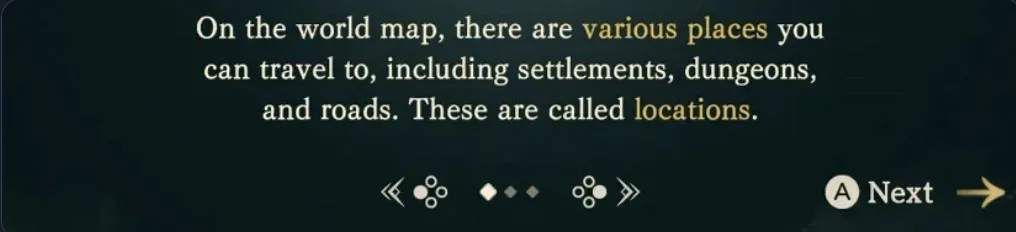
However, clarity is not the same as narrating the obvious. A tutorial that pauses the game to explain a genuinely complex mechanic may save players frustration later. A panel that explains that markers on the world map are called "locations" is another matter entirely. When a game stops to define the most immediately understandable elements of its interface, it can feel less helpful than patronizing.
Frequent tutorial interruptions also break momentum. Players may have just finished an important scene, prepared their team, or arrived at a new destination ready to see what happens next. Then the game pauses for another informational prompt. One interruption may be harmless, but repeated pauses make the player more aware of the game's structure than of its world.
A better approach would be to distinguish between mandatory essentials and optional detail. Critical combat instructions should remain front and center. Less urgent reminders could be placed in a help menu, shown as unobtrusive tooltips, or made available through an optional tutorial review. Returning players, meanwhile, benefit enormously from an option to reduce or disable basic explanations.
Strategy Games Need Room for Discovery
Part of the pleasure of a tactical RPG is learning. Players want to discover which units complement each other, how terrain changes a matchup, when to take an aggressive risk, and which systems deserve their attention. Even when a mechanic is introduced directly, there should be room to experiment with it.
Overly detailed instruction can unintentionally flatten that sense of discovery. If every function is explained before the player has a chance to interact with it, the game starts to feel like it is reading a manual aloud. The best tutorials provide enough knowledge to prevent confusion, then step back and allow the player to make decisions.
That is doubly important for Fire Emblem, where the emotional tension of a battle often comes from ownership. A victory feels satisfying because the player formed the plan, made the tradeoffs, and recovered from mistakes. The game should guide players toward that experience, not constantly stand between them and it.
The Pacing Problem Extends Beyond the Script
The complaint about too much dialogue is ultimately a complaint about pacing. Players do not necessarily want fewer characters, less world-building, or a thinner story. They want the game to recognize when it has made its point.
Jeff Grubb highlighted a spoilery example of this broader problem after spending around 50 hours with the game, describing the accumulation of dense fantasy terminology and extended exposition as the point where the approach finally wore him down. That reaction suggests the issue may not merely be an early-game onboarding hurdle. For some players, it could remain a persistent feature of the campaign.
Not everyone will be bothered by this. Some Fire Emblem fans enjoy luxuriating in every conversation and welcome a story that takes its time explaining alliances, motives, and lore. A player who wants a deliberately verbose fantasy drama may find more to enjoy than someone eager to move quickly from preparation to battlefield.
Still, the presence of a skippable dialogue function does not entirely solve the design problem. Skipping is a blunt instrument: it can remove the filler, but it can also cause players to miss humor, relationship growth, or information that matters later. Stronger editing would let players experience the good material without asking them to sift through excessive restatement.
Fire Emblem Has the Ingredients for a Better Balance
Fortune's Weave does not need to abandon its storytelling ambitions. It needs more discipline in how it delivers them. The game's appealing protagonists and enjoyable cast prove that the foundation is there. What is missing is restraint: fewer scenes that repeat established points, fewer tutorial pop-ups for intuitive actions, and more faith in the player's ability to retain information.
That change would improve more than just the time spent reading text boxes. It would make dramatic reveals sharper, comedy more effective, character moments more memorable, and battles feel like a more regular part of the campaign rather than a reward players must wait to reach.
For a series built around both tactical decisions and emotional attachment, that balance matters. Fire Emblem is at its best when its writing gives players a reason to care about the people they command, then gets out of the way long enough for them to lead. Fortune's Weave appears to have many of those reasons already. It simply needs to stop explaining them quite so often.

Community
Discussion
Start the conversation.
No comments have been posted yet.