

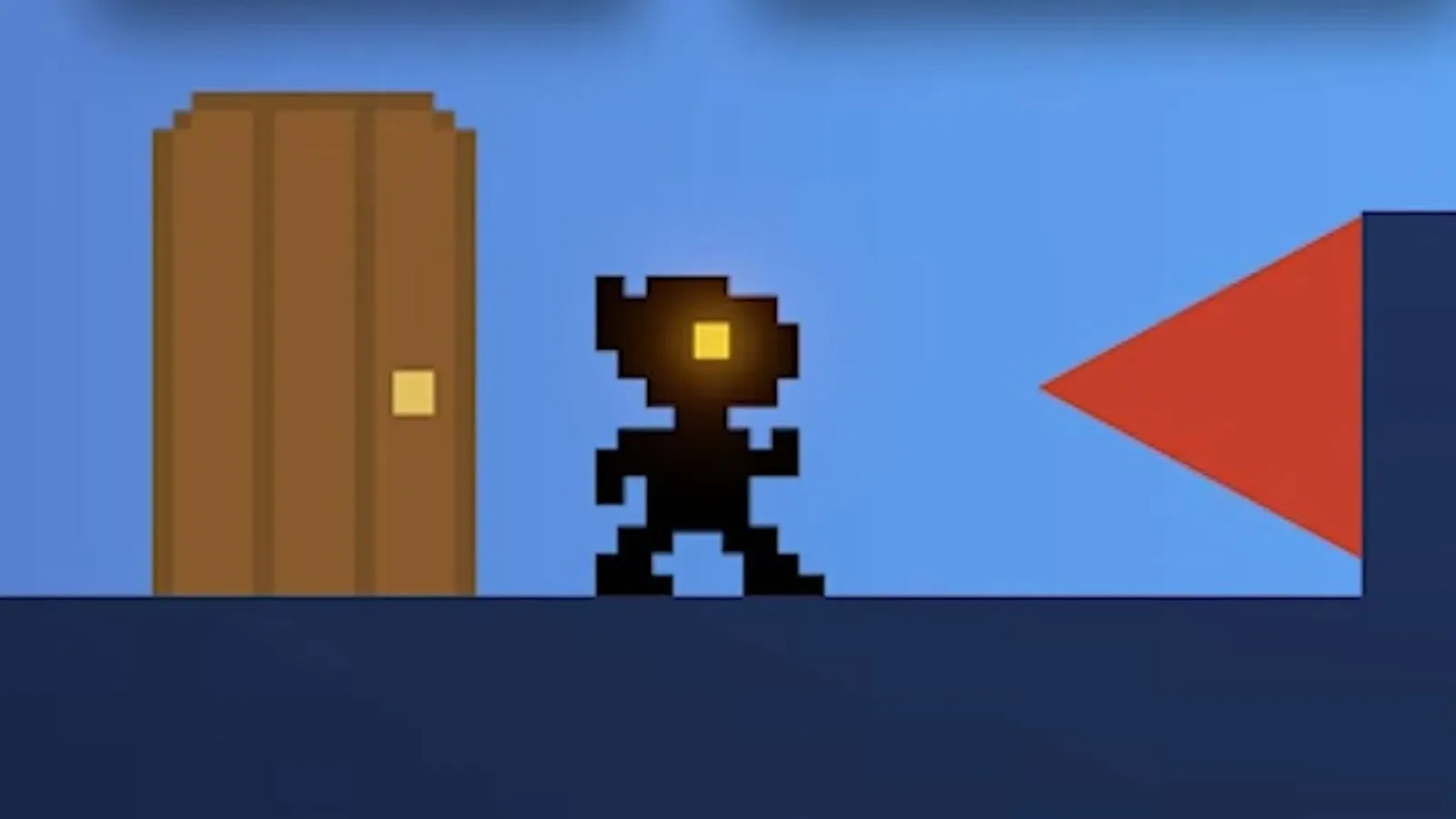
A platformer is usually a solitary test of timing, reflexes, and persistence. Jono takes that familiar format and makes it unexpectedly communal: the game allows only one player anywhere in the world to control its character at a time. That person gets one minute, advances as far as they can, and then hands the exact same ongoing run to whoever is next in the queue.
The free Steam release is a pixel-art 2D platformer from Part Time Monkey, the solo studio of Tuomas Erikoinen, known as an original artist on Angry Birds. On its surface, Jono is built around recognizable platforming challenges: spikes, portals, tricky jumps, and a steady supply of compact rooms. Its defining idea is not a new movement system, however. It is the decision to turn every attempt into a public baton pass.
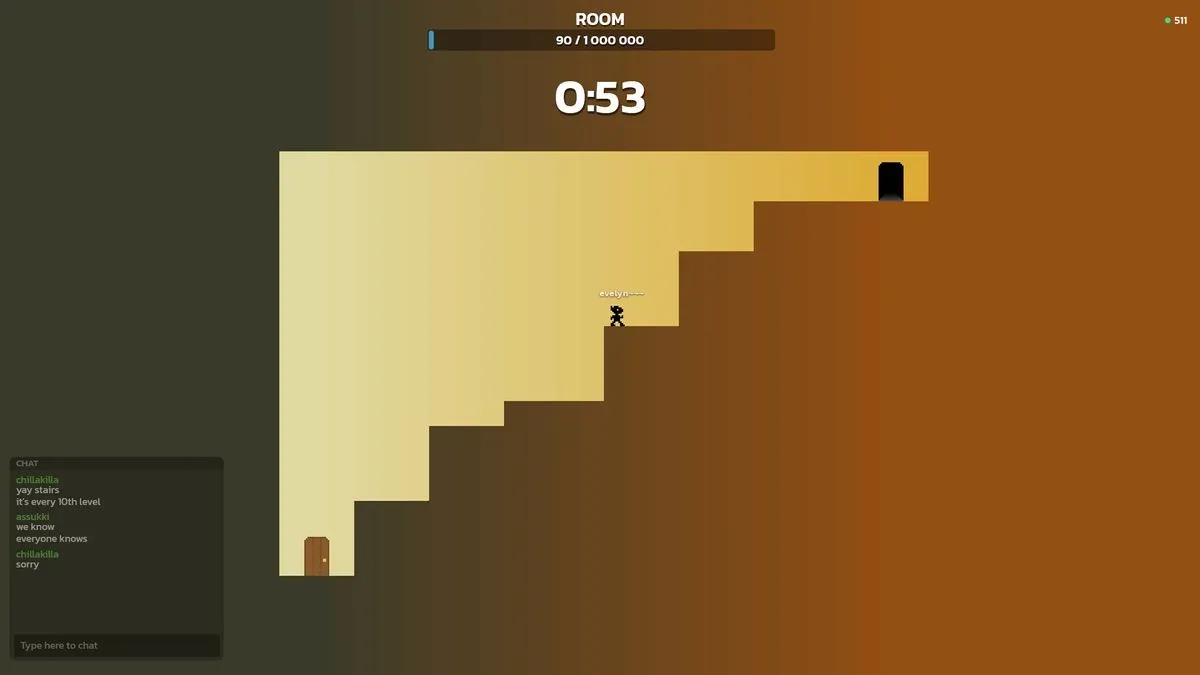
Players who are not currently in control can watch the live in-game feed, wait for their place in the line, chat, react with emotes, and work on levels that may later enter the wider game. The result is described as a "massively singleplayer" experience: one person has the controller, but a crowd is still present around every jump, failure, breakthrough, and strange piece of conversation.
One Minute of Control, Then the Next Player Takes Over
Jono's central rule is simple and unusually strict. When a player's turn arrives, they control the shared avatar for one minute. Once the timer expires, the next player begins from precisely the spot where the previous player stopped. There is no private version of the main climb where everyone can independently make the same progress at their own pace. The community's run is effectively one continuous route, inhabited by a rotating cast of players.
For useful background on this topic, read Tenebris Somnia review: A Smart, Scary Return to Adventure Horror.
That structure changes the emotional texture of a straightforward platformer. A difficult room is no longer just a wall in front of one person; it becomes a short-lived problem for whoever is currently holding control, with spectators able to cheer, offer advice, joke, or simply watch the outcome. Someone can make an important breakthrough only to see their minute end moments later, leaving the next person with the responsibility of continuing the momentum.
The game includes a Twitch-like presentation layer inside its own interface. Chat is part of the intended experience rather than an external companion to it. Players can talk while waiting, fill the feed with emotes, interact with a talking-head feature, and join a conga line. Erikoinen has said that while the game brings people in, the chat may be what keeps them around. That distinction matters: Jono is designed not only around completing obstacles, but around creating a place where players can spend time together between turns.
For a genre often associated with individual mastery, this can produce a different kind of investment. Watching another player reach a difficult section can be meaningful because the progress belongs to everyone in the queue. Likewise, a death is not necessarily the end of a personal run. It is a bump in a collective attempt that will continue as soon as another turn starts.
A Million-Room Goal for a Shared Run
The long-term objective is ambitious: the community is meant to collectively clear one million unique levels. The rooms largely come from procedural generation, combining obstacles and modifiers into an extensive sequence. That lets the game aim for an enormous shared destination without relying entirely on hand-built stages.
At the time discussed by Erikoinen, players had already cleared more than 87,600 levels and died 114,200 times. The leading individual player had personally completed more than 7,500 rooms. Those figures underline the unusual scale of the project. Even though each control session lasts only a minute, participation can build into substantial individual records while the larger total keeps moving forward.
Jono uses what Erikoinen calls deterministic physics, an important foundation for a game where one person's ending position becomes another person's starting point. Consistency is essential when progress passes between players. The game needs jumps, hazards, and interactions to behave reliably enough that a room remains understandable whether it is being watched live or attempted by the next person in line.
New players are not left entirely outside the experience. After a short tutorial, they can join the queue and see their position. On-screen leaderboards track high room-clear totals, while customization options for the shared avatar are displayed in the interface. These small systems give players something to engage with even during the stretches when they are watching rather than actively playing.
Player Levels Have a Place, but So Do the Truly Brutal Ones
Procedural rooms make up most of Jono's progression, but player-made stages are also part of the design. A creator must first build and verify their level before submitting it. Erikoinen then reviews it in the editor, including the creator's replay, to decide whether it is suitable for the standard game mode.
If a stage is judged approachable enough, it can be added to the main room queue. Its eventual placement depends on how many player-created rooms are already waiting. Erikoinen said approved submissions are spaced out, with each one placed roughly 100 to 200 levels after the previous approved player level. That approach should prevent custom stages from overwhelming the procedural flow while still allowing creators to surprise the broader community.
Not every verified level belongs in the standard path. Jono has an optional mode called Meat Grinder, which collects player-made levels considered too difficult for normal play. It serves as a home for Kaizo-style challenges and other demanding creations that are intended for players seeking extreme tests rather than a broadly casual queue experience.
The numbers attached to some of these creations reveal why that separation exists. Erikoinen noted that one level maker died more than 1,200 times in the editor just to demonstrate that a stage could be completed. Another level, titled DONT ASK HOW THE MEAT IS MADE, reportedly took 2,627 deaths and nearly five hours before anybody finally cleared it. Those levels may be too punishing for the main collective route, but their existence gives Jono an outlet for the community's most determined designers and players.
An Idea Built Around Social Presence
Erikoinen said the initial launch version took about a month to create, with the game expanding considerably after its October 5 launch. The concept was partly informed by social experiments in games, including Peter Molyneux's Curiosity, though Erikoinen said that was not the starting point for the idea. The queue concept arrived more organically as he pursued something that would feel distinctive.
Once the one-player queue was established, the million-room target followed as a way to give the community an exceptionally long shared project. It is a design that asks players to value the process as much as the finish line. The next room matters, but so does the act of seeing strangers take their turn, recover from mistakes, and keep an enormous run alive.
That emphasis on a difficult-to-copy social structure also connects to Erikoinen's concerns about the current development environment. He has argued that smaller games can be perceived as easy to make in an era increasingly shaped by AI, while successful concepts may be replicated quickly. In his view, a game such as Jono has more protection in its particular implementation: it is not merely a pixel platformer, but a platformer tied to a live queue, shared state, spectator interaction, procedural progression, moderation of user levels, and a persistent communal goal.
"Something like Jono, with a unique twist with not-so-easy to replicate implementations, may be what is needed now," Erikoinen said while discussing the value of unusual concepts for smaller games.
That does not mean Jono's appeal depends exclusively on novelty. Its early Steam response has been strongly positive, with 96% positive user reviews at the time in question. The game's modest presentation may help make its core idea immediately legible: there is a tiny platforming world, a line of people waiting to touch it, and a public audience attached to every turn.
A Platformer Where Waiting Is Part of Playing
Jono's most striking achievement may be its reframing of waiting. In most games, a queue is an inconvenience before the activity starts. Here, the queue is the activity's social center. Players watch the current run, talk, observe strategies, react to disasters, and anticipate the moment they will inherit the character's position. The limited one-minute window ensures that control itself remains scarce, while the live community ensures that time outside direct control is not necessarily empty.
There is also a compelling tension in the handoff. A player might enter a room with only seconds to spare and leave its decisive jump for someone else. Another might inherit a near-disaster, make one excellent move, and become the person who saves the run. Credit can be measured through leaderboards and room-clear counts, but the broader progress is inherently shared.
For PC players looking for a free experiment that treats platforming as a public relay rather than a private challenge, Jono offers a format that is difficult to compare directly with conventional releases. Its one-million-level destination remains distant, and its community-made stages promise further surprises. But the central question is already enough to make it stand out: what happens when a platformer gives the controller to only one person, then asks everyone else to stay and watch?
Community
Discussion
Start the conversation.
No comments have been posted yet.