

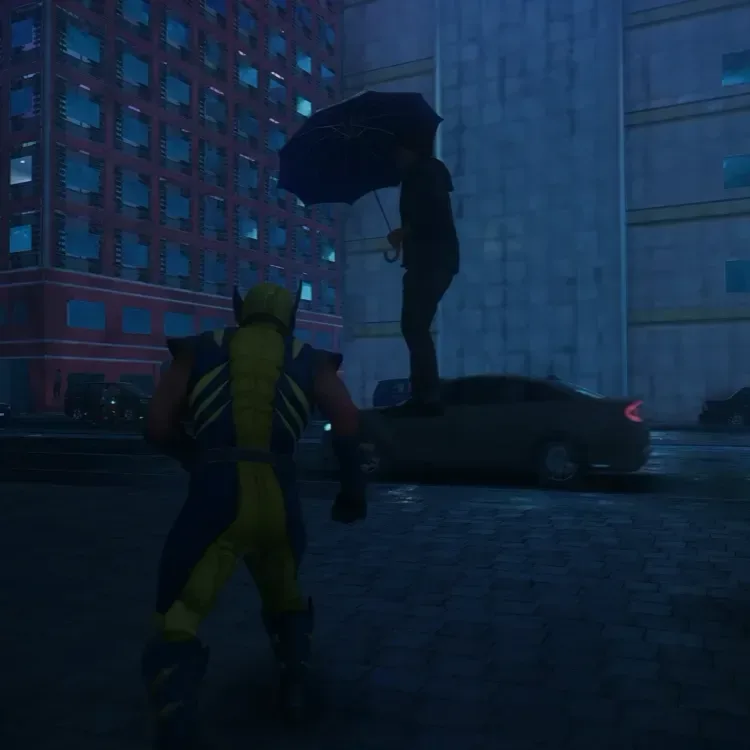
Warning: this article contains light spoilers for missions and environments in Marvel's Wolverine.
Marvel's Wolverine players are already finding ways to slip past the game's intended mission limits, and the results offer a fascinating look at the strange machinery that keeps a polished action game running behind the scenes. Videos shared by YouTuber Turned show Logan accessing large out-of-bounds spaces in at least two areas: the mission The One That Got Away and an environment set in Japan.
Once outside the designed play space, the normally seamless world becomes much less convincing. Trees hover above the terrain. Non-player characters appear suspended in empty space. Cars carry on with their routes even when a wall should stop them. Some buildings have recognizable exterior detail but no functional interior at all, while other sections contain unexpectedly elaborate shops, seating areas, and environmental dressing that players were never meant to examine this closely.
Embedded X/Twitter post
Out-of-bounds exploration is hardly new to games, but the appeal is eternal. It turns a finished adventure into an accidental development tour, exposing shortcuts, triggers, simplified scenery, and automated systems that would usually remain hidden beyond a carefully placed barrier. What stands out in these Marvel's Wolverine clips is how uncomplicated the escapes appear to be.
For useful background on this topic, read Evercade Dual Thumbstick Wireless Controller Brings Analogue Play to a Growing Retro Ecosystem.
A climb beyond the mission boundary
In Turned's footage from The One That Got Away, Logan can apparently get out of the intended area by climbing a relatively ordinary-looking building and moving over its boundary. Rather than being immediately returned to the mission, the character is able to roam into a much broader area than the level's linear structure initially suggests.
The terrain beyond the playable route is a mixture of incomplete-looking scenery and functional geometry. There are floating trees and surfaces whose solidity is uncertain, creating the possibility that a wrong step will drop Logan beneath the map. Collision behavior is predictably inconsistent as well. Objects and environmental features that look substantial from the mission route do not always behave as solid obstacles once approached from the wrong side.
The most striking discovery is the physical edge of the map. Turned reaches an area where the terrain does not fade naturally into a distant horizon or an inaccessible landscape. Instead, the ground ends in squared-off boundaries, making the artificial limits of the game world plainly visible. It is an unusual sight in a major superhero production built to sell the fantasy of moving through a cohesive place, but it is also a normal consequence of how levels are constructed.
Developers do not need to complete every piece of geography beyond a player's intended path to the same standard as the playable space. Distant scenery can be decorative, terrain can exist only to support lighting or camera angles, and geometry may be built in fragments rather than as one giant continuous world. As long as players remain within the approved route, those production choices are invisible.
Japan's hidden streets are more developed
A second Turned video explores an out-of-bounds route in the Japan environment. This one appears even easier to activate: Logan simply jumps over trucks and leaves the active mission zone without setting off the game's automatic respawn behavior.
The space beyond the boundary is packed with the sort of oddities players expect from an inaccessible area. The most memorable example involves cars that pass directly through walls. Rather than reacting to the obstruction, the vehicles continue driving forward along their assigned path until they eventually despawn. It creates a bleakly funny loop: traffic follows its invisible instructions, unconcerned that the physical world around it no longer makes sense.
Pedestrians are similarly unfazed. The footage shows NPCs continuing their behavior amid broken geometry and unexpected sightlines, with some figures floating above the ground. There is also a familiar visual bug for anyone who has spent time watching game glitches: the T-pose, where a character model is displayed with its limbs held out in the default animation posture.
Yet the Japan area is not merely an empty technical shell. Turned finds more detailed environmental work there than in the out-of-bounds section of The One That Got Away. The zone includes eating areas, shops, and some building interiors. That does not necessarily mean the content was meant to be playable or is unfinished in a simple sense. It may exist to support adjacent scenes, scripted sequences, distant views, loading transitions, or routes that changed during development. Still, the greater density makes it a particularly intriguing area for players curious about the game's construction.
Why cars, NPCs, and buildings break outside the intended route
These clips are a reminder that a video game's world is not one uniform simulation. A vehicle system may be designed around a narrow traffic lane and a collection of invisible navigation rules. It does not need to understand every wall, alley, or building in the entire map if players cannot normally reach the vehicle's route or interfere with it from unusual angles.
The same principle applies to pedestrians. NPCs often operate using tightly controlled paths, animation states, spawn locations, and despawn conditions. When a player crosses the intended boundary, they can view those systems from perspectives the developers never needed to fully support. A floating character might be standing correctly relative to a hidden navigation surface, a missing chunk of terrain, or a simplified object that only works from the playable side.
Buildings are another common source of out-of-bounds surprises. A structure that appears complete during normal gameplay may be only a facade from certain directions. Interiors are expensive to create and optimize, especially when players will never enter them. Even when an interior exists, it may lack collision, textures, lighting, or props in places that are never visible during normal play. These techniques are practical compromises, not necessarily evidence that the game is broadly broken.
That said, the apparent ease of these Marvel's Wolverine escapes is what makes them notable. Players often reach hidden spaces through highly specific movement tricks, complicated exploits, or lengthy sequences of carefully timed actions. Here, the reported methods are much more direct: climb over a building or jump a set of trucks. Those are the kinds of openings likely to attract repeated testing from the community.
Will Insomniac patch the escape routes?
Insomniac has said it plans to further refine the player experience based on feedback, although it has not publicly singled out these particular out-of-bounds discoveries. Given how straightforward the routes appear to be, it would be unsurprising if future updates addressed them. A fix could take several forms, from adjusting collision and level geometry to expanding a respawn trigger or placing an invisible blocker in the relevant location.
TT Games developer Tim Spencer also offered a useful perspective on how a bug of this type can survive the journey to release. In a social media post, Spencer suggested there is a very high chance a quality assurance team would have detected an issue like this. The more likely explanation, he argued, is that the problem was assigned a lower priority during production triage and deferred for a later update as the team focused on the issues considered most important for launch.
That distinction matters. Quality assurance is not simply a gate that catches every bug before release; it is a process that identifies, documents, reproduces, and helps assess problems. Developers and producers must then decide what can be fixed in time, what creates the greatest player-facing risk, and what may need to wait. An out-of-bounds path that does not block progress, corrupt saves, or ruin a standard playthrough can reasonably rank below crashes, progression failures, accessibility problems, or severe performance issues.
Marvel's Wolverine has also been the subject of other player feedback in recent weeks. Logan's scent trail, which some players have mockingly dubbed "fart gas," has become a recurring joke online. Critics of the guidance feature have called for an option to disable it, arguing that it can feel overly directive. Players have additionally been testing the game's motorcycle sequence to see what happens if they leave the controller untouched.
Glitch hunting remains part of the fun
For many players, out-of-bounds videos are not an attempt to diminish the game. They are a form of curiosity-driven play. Seeing the hard edge of a map, a car following its route through a wall, or a crowd character frozen in a T-pose is entertaining precisely because it contrasts with the dramatic presentation of the intended experience.
There is also a preservation-like impulse behind this kind of exploration. Patches can close escape routes quickly, meaning a peculiar version of a level may only be accessible for a limited period. Players who document the glitches preserve a snapshot of how the game functioned at a particular moment, including the hidden shortcuts and production seams that will vanish if the gaps are repaired.
For now, Turned's discoveries provide an amusing behind-the-curtain tour of Marvel's Wolverine. The playable missions may present tightly choreographed action and carefully framed environments, but just beyond a climbable structure or a row of trucks lies a stranger version of the world: square terrain borders, wandering traffic with nowhere meaningful to go, floating citizens, and scenery built only as far as the player was ever supposed to see.
Community
Discussion
Start the conversation.
No comments have been posted yet.