

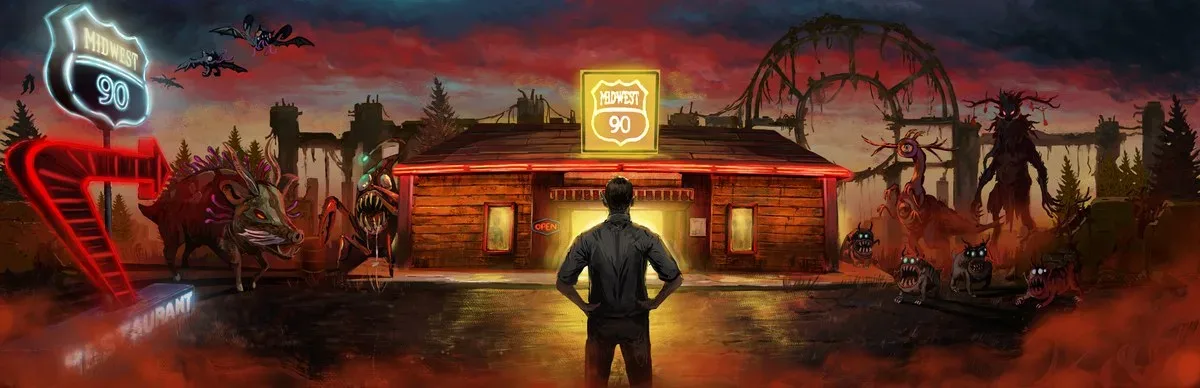
Midwest 90: Rapid City will enter Early Access on Steam on November 10, 2026. Developed by Hidden Chest Studios and published by Rising Tide Publishing, the game places players in charge of a highway diner during a monster apocalypse, where keeping customers fed is inseparable from surviving the threats outside.
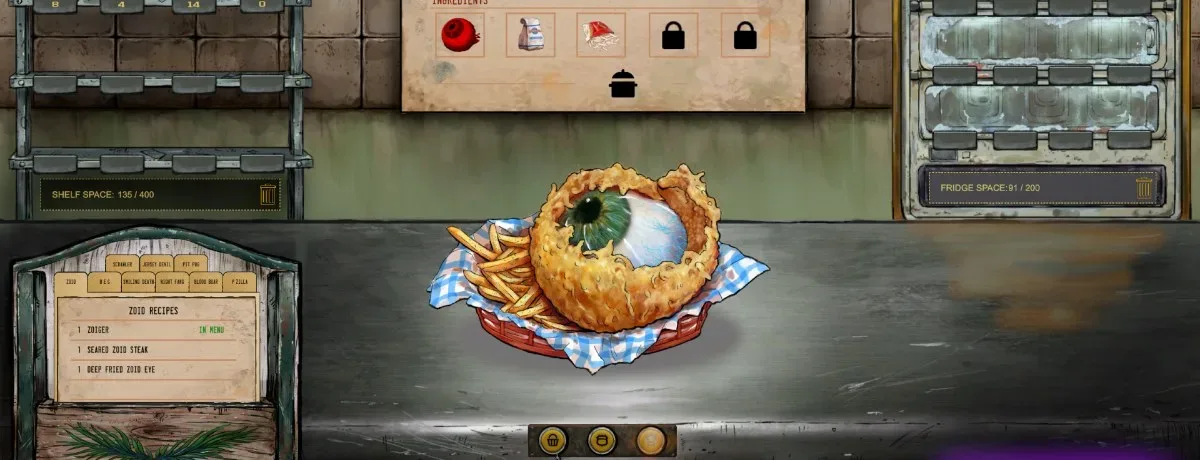
The central idea is intentionally unusual: players capture and harvest monsters, turn their parts into ingredients, prepare meals, manage workers, improve the restaurant, and defend the property from incoming monster attacks. It is a management game with cooking, creature-hunting, research, and tower-defense elements all operating around the same roadside business.
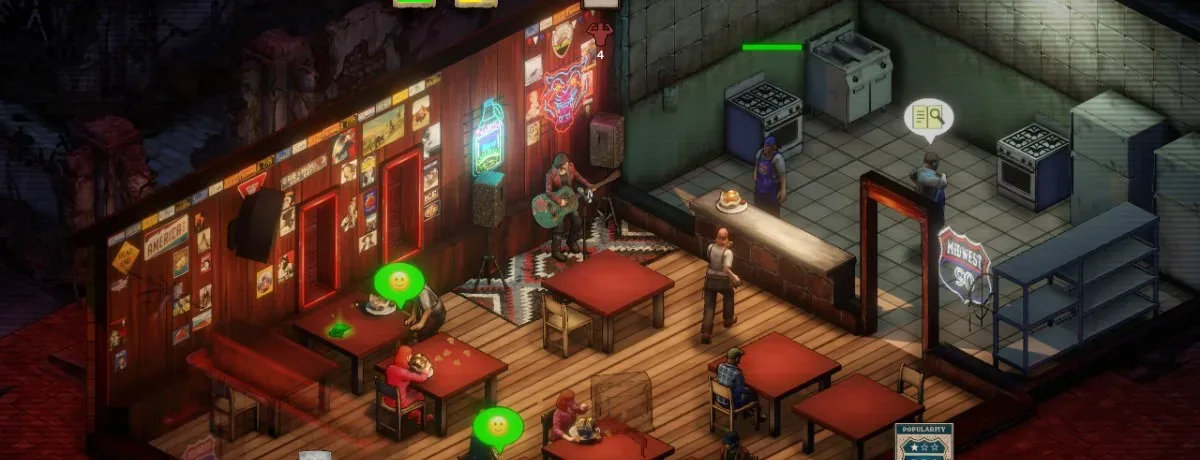
Its Early Access debut will include the opening narrative material, specifically the Prologue and Chapter 1, as well as a complete Endless Mode designed to provide a more repeatable challenge beyond the initial story. A new Early Access release trailer has also been released, offering a look at the game's 1990s-flavored isometric presentation and its unusual food-service apocalypse.
A diner is the last place to stop during the apocalypse
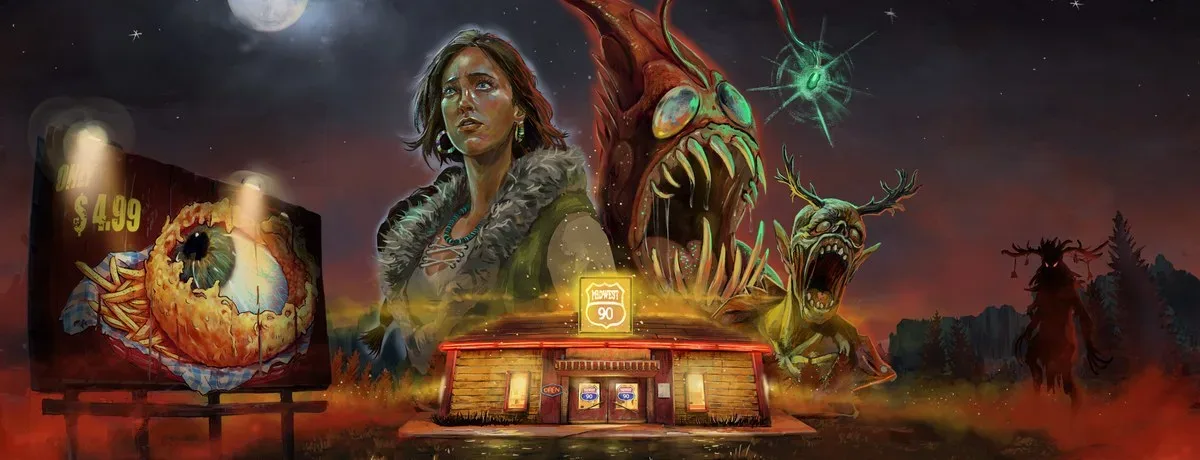
Midwest 90: Rapid City is built around the notion that the end of the world does not necessarily end the need for a good meal. The diner at the centre of the game is both a workplace and a fortified outpost. Players need to keep its operations moving, make smart use of ingredients, and develop the tools needed to endure escalating pressure from monsters.
For useful background on this topic, read Alleged ShinyHunters Leader Arrested After Rockstar Games Breach Claim.
Rather than treating monsters as enemies to merely clear from the map, the game makes them part of the restaurant's supply chain. Trapping and harvesting creatures provides the materials needed for dishes, linking combat and collection directly to the kitchen. What is captured beyond the diner can become a new menu item, which in turn supports the business and helps fund future improvements.
That loop gives the game a different angle from a conventional restaurant sim. Recipes are not simply unlocked through standard shopping or farming systems. The player's ability to acquire, process, and use monster-derived ingredients is part of the strategy. Deciding what to hunt, how to make use of a haul, and what upgrades are needed next should all feed into the survival of the diner.
Staff management is also among the core responsibilities. Running an establishment through a monster crisis means players will be balancing employees and operational upgrades alongside the dangers at the perimeter. The game's systems-driven approach suggests that efficiency inside the building will matter just as much as direct defensive preparation outside it.
Management, upgrades, and defenses share the same counter
While Midwest 90: Rapid City is a restaurant management simulation at heart, it does not confine players to the kitchen. The diner itself can be upgraded and reinforced, while research provides further options for developing the operation. These systems support a growing business, but they also contribute to the game's defensive side.
Monster waves will threaten the diner, requiring players to use tower-defense mechanics to protect their staff, customers, and resources. The exact balance between restaurant oversight and defending against attackers will likely be a major part of the Early Access experience. A diner that produces excellent dishes but cannot withstand a wave is in trouble; equally, investing everything in defenses could leave the kitchen without the resources it needs to grow.
This mix of genres gives the game a potentially broad set of decisions to manage. A player may be preparing dishes from freshly harvested creatures one moment, then deciding where a defensive structure or upgrade will make the biggest difference when the next threat arrives. Instead of separating management and action into entirely different modes, Midwest 90: Rapid City frames both as everyday parts of keeping a strange roadside restaurant alive.
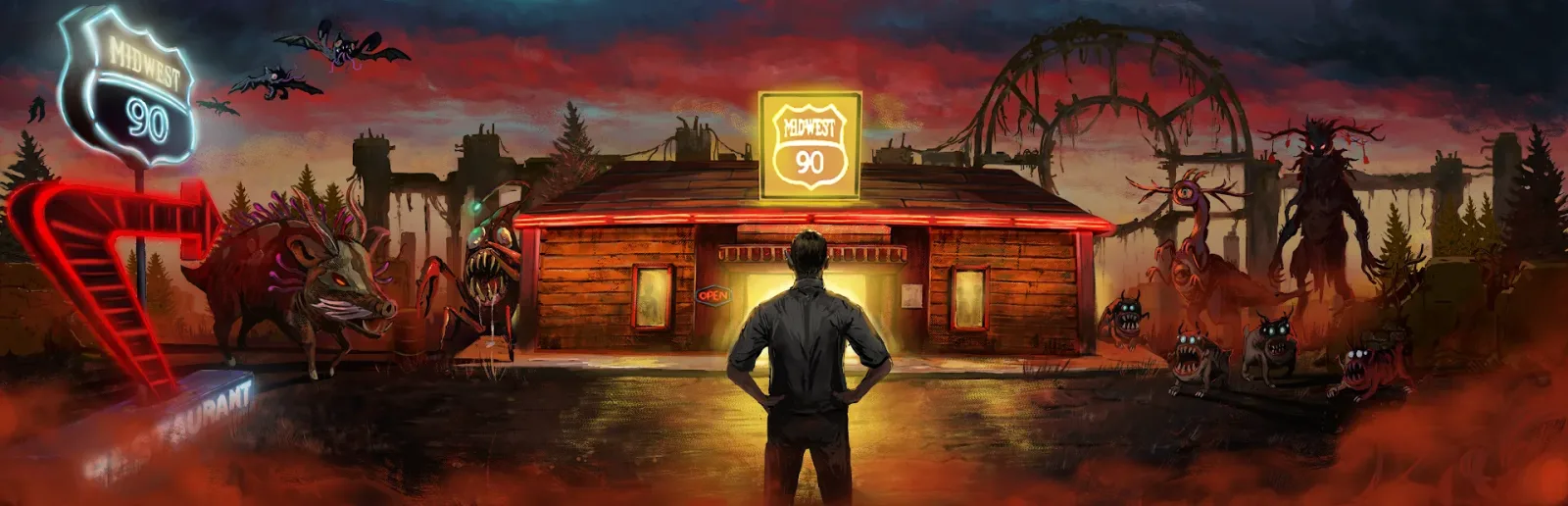
The setting supports that premise with an isometric art style inspired by the visual feel of 1990s games, particularly the early Fallout era. That comparison points to an older-school perspective and atmosphere rather than a modern glossy look. The diner, the surrounding highway environment, and the monsters invading it all sit within a stylized post-apocalyptic world built around that retro-inflected identity.
Endless Mode will be available on day one
Players jumping in on November 10 will have access to a complete Endless Mode in addition to the Prologue and Chapter 1. Endless Mode is intended to be replayable, with its own difficulty and progression options, making it a key part of the package rather than a small bonus alongside the campaign opening.
For a game constructed around interlocking systems, an Endless Mode can provide room to experiment with different strategies. Players may be able to test approaches to upgrades, restaurant organisation, monster harvesting, and defensive planning without being limited to the pace of the initial story chapters. It should also offer a place for players to push their diner operation further as waves and demands continue.
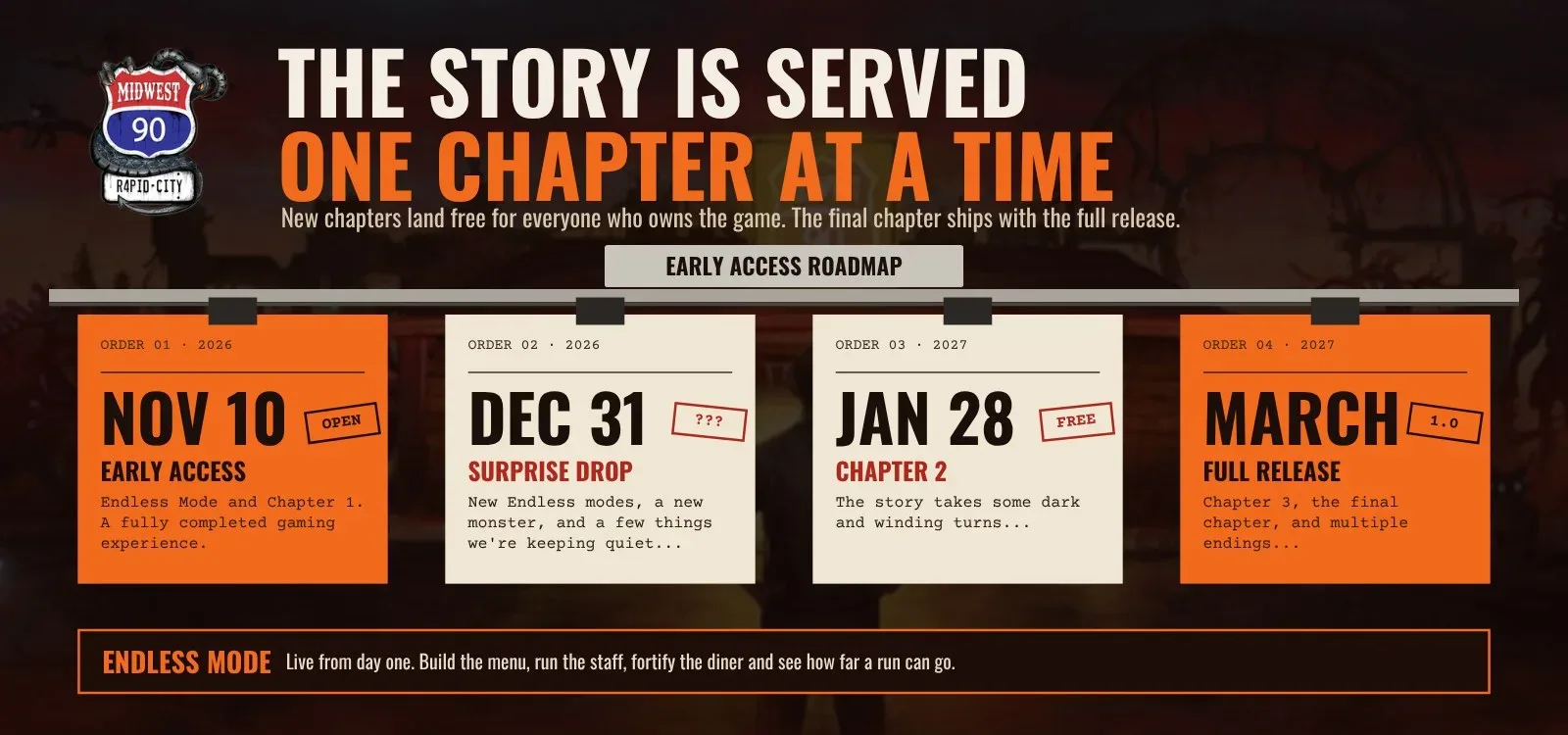
The November Early Access launch is not the end of planned additions. The development roadmap outlines further updates through the start of 2027, culminating in a planned full release in March 2027. That schedule includes both additional Endless Mode options and the next major story chapter.
Midwest 90: Rapid City Early Access roadmap
- November 10, 2026: Early Access begins on Steam with the Prologue, Chapter 1, and a deep, complete Endless Mode.
- December 31, 2026: An additional content update is planned, including customised Endless Mode options and new monsters.
- January 28, 2027: Chapter 2 is scheduled to arrive as a free update for Early Access owners.
- March 2027: Version 1.0 is planned to launch with the final chapter and branching outcomes. Purchasers will receive the Early Access updates as part of the game.
The roadmap makes it clear that the story will grow over the Early Access period. The launch build establishes the premise and first chapter, while Chapter 2 is due in late January. The final chapter is planned for the 1.0 release, where the game is also expected to introduce branching outcomes. How those outcomes will reflect a player's management choices, survival performance, or other decisions has not been detailed.
A deliberately strange pitch with a clear identity
Monster cookery and diner defense is an unusual combination, but that seems to be a core part of Midwest 90: Rapid City's appeal. It is not presenting its premise as a straight-faced apocalypse simulator. The concept leans into the bizarre logic of making a living after civilization has broken down: if monsters are everywhere, they may as well become ingredients.
Early impressions highlighted in the announcement reflect that offbeat tone. YouTube creator Orbital Potato described having "an absolute whale of a time" with the game. Nookrium similarly called it "weird, weird," while concluding that it was "Good Stuff!" Those reactions underline a project that knows its genre blend and setting are unconventional.
For management-game players, the hook is the chance to run a business where every part of the operation is tied to survival. For tower-defense fans, the diner provides a distinctive setting for holding out against waves of enemies. And for players drawn to off-kilter simulations, the monster-to-menu pipeline may be the standout element.
Whether all of those parts settle into a satisfying routine will become clearer once Early Access begins. The first version is set to arrive with more than just a short introduction, thanks to the inclusion of Endless Mode, while the roadmap gives players a defined view of the planned path toward the complete campaign.
Midwest 90: Rapid City launches in Early Access for Steam on November 10, 2026. The game's full 1.0 release is currently planned for March 2027, following additional content, new monsters, more Endless Mode customisation, Chapter 2, and the final story chapter with branching outcomes.

Community
Discussion
Start the conversation.
No comments have been posted yet.